

VIN Decoder

Rising Auto VIN Decoder and OEM Parts Catalog Guide

Free • 3 sec • No signup
Use a supported vehicle identifier to review available Rising Auto data before navigating the OEM catalog. Rising Auto, also known as Feifan, developed from SAIC Motor’s Roewe R electric-vehicle line and operated as a dedicated SAIC EV marque.
Processor-backed VIN recognition where source coverage supports the vehicle
A practical route from returned vehicle data to the Rising Auto OEM catalog
Clear limits for R7, F7, market, model-year, and source-data coverage
No registration required. Results in ~3 seconds.
Public reporting in 2024 described Rising Auto operations being folded back into SAIC Motor Passenger Vehicle and Roewe structures. The Rising Auto badge remains relevant when researching vehicles registered under that marque, but it should not be used by itself to assume a manufacturer identifier.
Overview

Begin with the identifier, then review the returned record

Enter the vehicle’s complete VIN in the available decoder interface. If the identifier is covered, review the manufacturer and vehicle attributes returned by the data source. Returned fields are not uniform: they can vary by market, model year, source data, and catalog availability.

After reviewing the result, continue through the VIN-specific OEM catalog path where available. This workflow is intended to support parts research, not to guarantee fitment. Confirm critical part numbers against vehicle labels, applicable service information, and authoritative documentation before ordering or installation.
Help

Finding the correct VIN on a Rising Auto vehicle

The supplied Rising Auto research does not verify brand-specific VIN label or stamping locations.
Consult the vehicle documentation for the identifier assigned to the vehicle.
Use owner or service information applicable to the specific market and model year.
Compare any identifier shown on the vehicle with the documentation before processing it.
Do not rely on an assumed label or stamping location that has not been verified for the vehicle.
i
Submit the complete identifier exactly as recorded. If identifiers differ between the vehicle and its documents, resolve the discrepancy through an appropriate service or registration channel before conducting parts research.
Capabilities

What a supported Rising Auto lookup may provide

A VIN result can expose manufacturer and vehicle attributes available from the connected source, but it is not a complete history or condition report.
Manufacturer context
The result may identify manufacturer information associated with the VIN. Rising Auto’s relationship with SAIC and Roewe makes source-specific manufacturer context more useful than an assumption based only on the retail badge.
Vehicle attributes
Supported records may return encoded or manufacturer-supplied vehicle attributes. The exact field set is not guaranteed, and users should not expect every option or a complete build sheet.
Catalog research path
Where catalog integration is available, the reviewed VIN result can lead into a VIN-specific OEM catalog path for further parts investigation.
A VIN lookup cannot prove mileage, ownership, accident history, title status, present condition, or the availability of every option and part in every source.
VIN anatomy

Reading the three main VIN sections carefully

The 17-character identifier is commonly presented in three sections. Interpretations must come from supported data rather than assumptions about the Rising Auto badge.
WMI — positions 1–3
The WMI relates to a manufacturer entity and region. No Rising Auto WMI is verified in the supplied research, and SAIC identifiers can span multiple brands and production entities. Do not assign a fixed code from the badge alone.
VDS — positions 4–9
These positions form the VDS portion of the identifier. The supplied research does not establish Rising Auto-specific meanings for individual positions, so they should be interpreted only through supported manufacturer or processor data.
VIS — positions 10–17
These positions form the VIS portion. No Rising Auto-specific model-year, plant, or serial-position rules are asserted here; any returned interpretation depends on the available source.
Manufacturing

Production-site information requires source verification

No Rising Auto plant names, locations, or plant codes are verified in the supplied research packet.
Rising Auto production site
Not specified in the supplied source material
i
Do not derive a factory from the Rising Auto badge or assign a plant meaning to a VIN character without verified manufacturer data. Production entities within SAIC structures may not map exclusively to one retail marque.
Value

A disciplined approach to Rising Auto parts identification

VIN processing is most useful when treated as the first step in a verification workflow rather than as a fitment guarantee.
Preserve the correct badge context
Vehicles registered as Rising Auto remain searchable in that marque context even as public reporting describes operational integration with SAIC Motor Passenger Vehicle and Roewe structures.
Review R7 or F7 data
Rising Auto’s principal model families are the R7 electric coupe-SUV and F7 electric sedan. A supported result may help establish relevant vehicle data, but the model family must come from the returned record or vehicle documentation.
Avoid unsupported identifier assumptions
Because SAIC manufacturer identifiers can cover multiple brands and production entities, a badge alone is not enough to establish a fixed WMI or factory.
Verify parts before use
Use the OEM catalog path to investigate parts, then confirm critical numbers against vehicle labels, current service information, and authoritative documentation before purchase or installation.
Why premium

Why a catalog workflow matters beyond a basic VIN readout

A general decoder may display broad identifier information. Parts work requires a reviewed vehicle record, available OEM catalog data, and final technical verification.

Recommended Rising Auto research sequence

Process the complete VIN and check whether the source recognizes it.
Review the returned manufacturer and vehicle attributes without filling gaps by assumption.
Continue to the VIN-specific Rising Auto OEM catalog path when that route is available.
Verify critical part numbers using vehicle labels, applicable service information, and authoritative documentation.

Compare returned data with the vehicle’s own records

Treat agreement between the VIN result, vehicle documentation, labels, and catalog information as part of the research process. Investigate discrepancies instead of assuming that any single source is complete.
Free
View diagrams per day
View 1 diagrams per day
VIN identifications per month for month(s)
10 VIN identifications per month for 1 month(s)
Ad-free
Full part numbers in catalogs
Applicability Of Spare Parts
Maintenance Parts
Free
View diagrams per day
View 1 diagrams per day
VIN identifications per month for month(s)
10 VIN identifications per month for 1 month(s)
Ad-free
Full part numbers in catalogs
Applicability Of Spare Parts
Maintenance Parts

How the 7zap catalog interface may appear

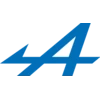
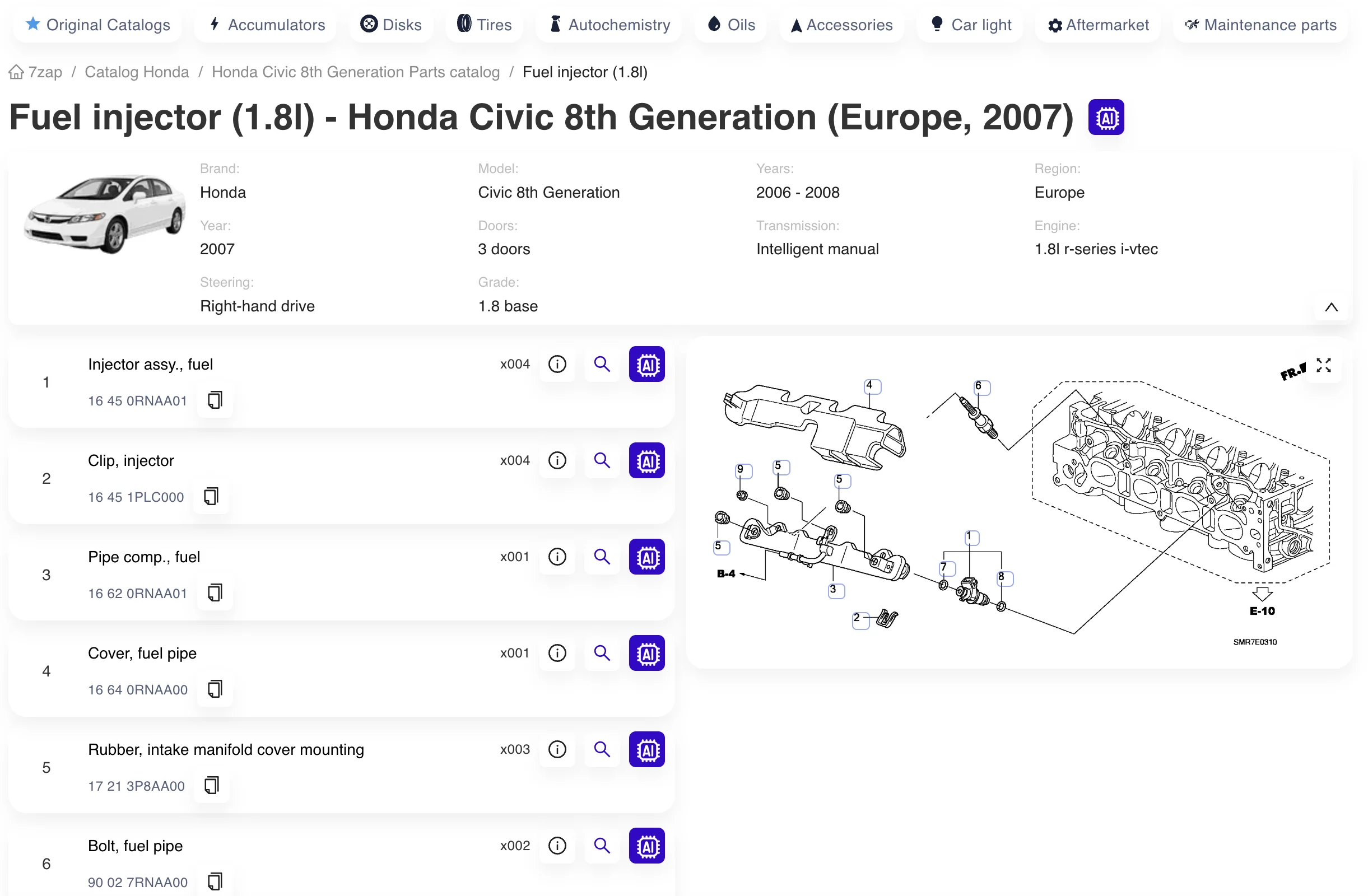
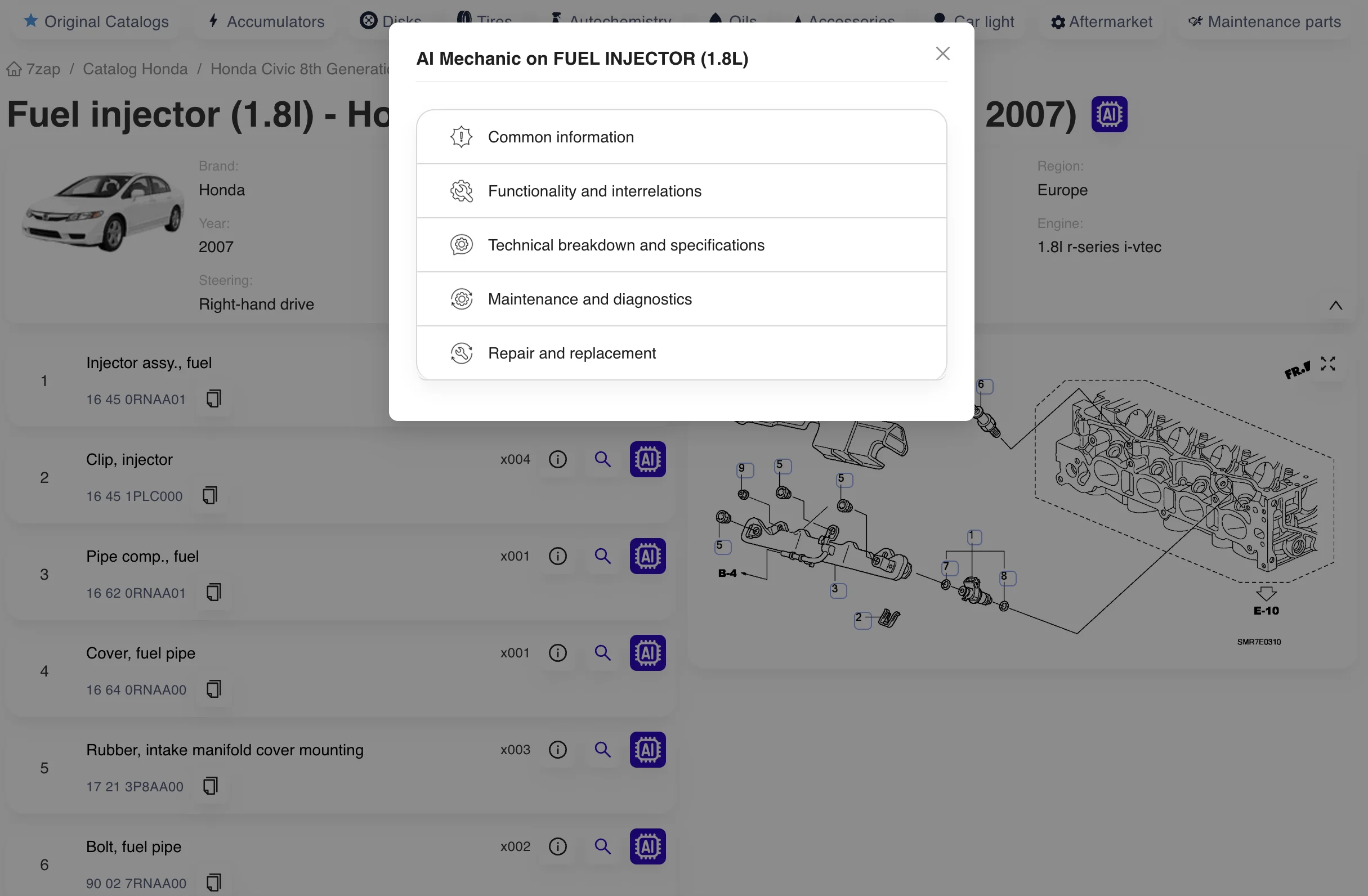
The images below are temporary examples copied from another 7zap brand page. They illustrate interface types only and do not show a Rising Auto vehicle or a successful Rising Auto result.
Review available vehicle information
Decoded preview
VIN
17-character vehicle identifier
Model family
R7 / F7
Coverage
Varies by market and source
Navigate catalog groups and part details
Example 7zap catalog interface; temporary image from another brand page
Example 7zap assembly tools interface; temporary image from another brand page
Example 7zap parts detail interface; temporary image from another brand page
Support

Rising Auto VIN and catalog questions

Concise guidance for researching R7 and F7 vehicles without overstating decoder or catalog coverage.

Explore other manufacturer catalog pages

Use the 7zap catalog navigation for another marque when the vehicle is not registered or documented as Rising Auto. Manufacturer relationships should not replace the badge and identifier shown in the vehicle records.