
VIN Decoder

Tank VIN Decoder - Free VIN Lookup

Free • 3 sec • No signup
Enter your 17-character Tank VIN to decode the exact model, model year, production details, and key specs—plus get a clearer path to the right parts and service information.
✓ Confirm model, year, and build configuration
✓ Identify engine/transmission for parts fitment
✓ Use decoded data for warranty and ownership checks
No registration required. Results in ~3 seconds.
Your Tank’s 17-character VIN is its unique identifier. A Tank VIN decoder translates it into practical details for a tank VIN number check, build sheet verification, and more accurate service/parts decisions.
Overview

Tank VIN Decoder: Decode Your VIN in Seconds

A Vehicle Identification Number (VIN) is a standardized 17-character code defined by ISO 3779/3780 and U.S. requirements (49 CFR Part 565). A Tank VIN decoder reads that code to help you verify what your vehicle actually is—not just what it’s advertised as. This is useful when you need to decode Tank VIN data for registration, ordering parts, confirming a trim level, or performing a tank vehicle identification number audit after repairs or imports.

Most Tank vehicles follow the global VIN layout: WMI (manufacturer/region), VDS (vehicle descriptor), and VIS (vehicle identifier). With a tank vin number check, you can confirm the model year code, validate the check digit, and interpret identifiers tied to factory configuration. For broader decoding and cross-brand support, use our free VIN decoder. If you’re looking for a tank vin decoder build sheet or a tank warranty check by vin, decoded results help you start with the correct baseline specs before contacting a dealer or insurer. To decode other vehicle brands with the same precision, use our decode VIN.

Help

Where is the VIN number on a Tank?

Common Tank VIN locations include:
Dashboard (driver’s side, visible through the windshield)
Driver’s door jamb / B-pillar label (VIN and compliance information)
Engine bay (stamped plate or label near the firewall)
Frame rail stamping (often on the right/front area on body-on-frame SUVs)
Under the hood on the radiator support / slam panel label
Vehicle registration, title, and import documents
Insurance card or policy documents
Service booklet or dealer service paperwork
Window sticker or delivery documentation (where available)
i
For the best Tank VIN decoder results, enter the VIN exactly as shown (17 characters, no spaces). Letters I, O, and Q are not used in VINs—if you see them, re-check the plate or paperwork for a reading mistake.
Capabilities

Tank VIN lookup: what you can learn

A reliable VIN lookup can help confirm:
Basic vehicle identity
Make/brand (Tank) Model family (e.g., Tank 300 / Tank 500) Model year code (position 10) Body type and market/version indicators (when available) Check digit presence (position 9) for format validation
Factory specifications
Engine type (e.g., gasoline turbo / hybrid variants depending on market) Transmission family (automatic/manual where applicable) Drivetrain layout (2WD/4WD depending on configuration) Key configuration clues useful for a tank vin decoder build sheet request
Ownership, service & parts context
Starting point for a tank warranty check by vin (coverage depends on market and first registration) Reduced risk of ordering incorrect parts due to mid-year changes More accurate service planning (fluids, filters, drivetrain service intervals) Better documentation for resale, inspection, and import compliance
A Tank VIN lookup is most helpful when you use it before parts ordering, insurance claims, or used-car purchases. Even small differences in drivetrain or production batch can change part numbers and service procedures. Decode first, then confirm visually (labels, engine bay, and option equipment) to avoid mismatches.
VIN anatomy

How the Tank VIN number is structured

Every modern Tank VIN uses a 17-character format split into three blocks that identify the maker, the vehicle description, and the unique serial information.
WMI (positions 1–3)
The WMI (World Manufacturer Identifier) tells you the manufacturing region and the company responsible for the VIN. For Tank vehicles, the WMI commonly points to Great Wall Motor (GWM) production entities. This is the quickest way to confirm you’re decoding the correct manufacturer family before interpreting the rest of the VIN.
VDS (positions 4–9)
The VDS (Vehicle Descriptor Section) describes key attributes such as model/series, body style, restraint system indicators, and other internal identifiers used by the manufacturer. Position 9 is the check digit in many markets and is calculated from the other characters to help detect typos—useful when you check Tank VIN number entries from paperwork.
VIS (positions 10–17)
The VIS (Vehicle Identifier Section) typically includes the model year code (position 10), the assembly plant code (position 11), and a production sequence number (positions 12–17). This block helps differentiate otherwise similar vehicles built in different plants or batches and is essential for accurate service bulletins and parts selection.
Manufacturing

Major production plants

Tank is part of Great Wall Motor’s manufacturing network. Depending on your VIN and market, assembly and component sourcing may trace back to different facilities.
Baoding Manufacturing Base (GWM HQ) (2002–present)
Baoding, Hebei, China
Xushui Vehicle Plant (SUV/4x4 production) (2013–present)
Xushui District, Baoding, Hebei, China
Tianjin Vehicle Plant (2009–present)
Tianjin, China
Jingmen Manufacturing Base (2019–present)
Jingmen, Hubei, China
Taizhou Manufacturing Base (2014–present)
Taizhou, Jiangsu, China
Chongqing Manufacturing Base (2019–present)
Yongchuan District, Chongqing, China
Baoding Powertrain Plant (engines/transmissions) (2009–present)
Baoding, Hebei, China
Baoding NEV Components & Battery Supply Chain (2020–present)
Baoding, Hebei, China
Rayong Manufacturing Plant (GWM Thailand) (2021–present)
Rayong, Thailand
Tula Vehicle Plant (GWM Russia / Haval facility) (2019–present)
Uzlovaya Industrial Park, Tula Oblast, Russia
Iracemápolis Plant (GWM Brazil) (2024–present)
Iracemápolis, São Paulo, Brazil
Baoding R&D and Validation Center (production support) (2008–present)
Baoding, Hebei, China
i
The assembly plant is typically encoded in position 11 of the VIN (VIS block). Plant codes and allocation can vary by market and production year, so decoding the full VIN is the safest way to connect a Tank vehicle to its build context.
Value

Benefits of Using a Tank VIN Decoder

Practical details that help owners, shops, and parts teams work faster and with fewer errors.
Accurate parts matching
Tank models can share platforms and components but differ by year, drivetrain, and market specification. A Tank VIN decoder helps confirm the correct baseline configuration before you order parts, reducing returns and preventing fitment issues—especially for drivetrain and electronic components.
Smarter service planning
When you decode Tank VIN data, you can align maintenance work with the vehicle’s actual build. That means fewer surprises during service, more accurate fluid and filter selection, and clearer preparation for off-road-related wear items on models like the Tank 300.
Verification for buying and selling
A tank vin number check helps validate key identifiers against listings and documents. It’s a practical step when purchasing used vehicles, importing across borders, or confirming that the vehicle you’re inspecting matches the paperwork, including the model year and plant/serial block.
Warranty and documentation support
For a tank warranty check by vin, decoding provides the core identifiers you’ll be asked for by dealers, insurers, or administrators. It also helps keep consistent records for claims, service history, and resale—especially when vehicles move across markets with different naming conventions.
Social proof

Trusted by Tank Owners & Professionals

Feedback from owners, technicians, and parts teams who use VIN decoding to verify Tank specs and reduce mistakes.
Daniel
5
5.0
Auto Parts ManagerHouston
We see imported SUVs with mixed paperwork, so a Tank VIN decoder is a must. It helped us confirm the Tank 300 configuration and match drivetrain-related parts correctly. The lookup saved time and reduced returns on special-order items.
Amina
5
5.0
Independent MechanicDubai
For a Tank 500 that came in with incomplete service history, decoding the VIN clarified the year code and key powertrain details. That made it easier to plan fluids, filters, and drivetrain checks without guessing. Very shop-friendly results.
Victor
5
5.0
Service TechnicianWarsaw
A quick tank VIN number check helped me confirm a vehicle’s build before ordering sensors and ignition parts. The decoded output aligned with what I saw on the vehicle, which is exactly what you want when multiple versions exist across markets.
Sofia
5
5.0
Garage OwnerCape Town
We used the tank vin decoder build sheet view to verify equipment on a Tank 300 before fitting aftermarket accessories. Knowing the exact build reduced compatibility problems and prevented rework. It’s especially useful for off-road vehicles with option-dependent parts.
Kenji
5
5.0
Car EnthusiastSingapore
I wanted to check Tank VIN number details before buying a used Tank 300. The decoder made it easy to confirm the year and basic configuration, then compare it with the seller’s listing. It gave me more confidence going into the inspection.
Why premium

Tank VIN Decoder vs Free Tools

Basic free tools often return only generic fields like make, model year, and engine size. A Tank-focused decode aims to provide a clearer configuration picture that’s more useful for parts selection, service planning, and documentation.

How to use the decoder to find parts

Enter your 17-character VIN (no spaces) into the Tank VIN decoder search field
Review decoded identity details (model, year code, and key configuration indicators)
Use the results to confirm engine/transmission family before selecting parts
Open the OEM catalog flow and browse by group (engine, drivetrain, suspension, body, electrics)
Cross-check part notes and production splits before purchase or installation

Free vs Premium Tank VIN Decoder

Compare decoding depth feature-by-feature to choose the level of detail you need.
Free
View diagrams per day
View 1 diagrams per day
VIN identifications per month for month(s)
10 VIN identifications per month for 1 month(s)
Ad-free
Full part numbers in catalogs
Applicability Of Spare Parts
Maintenance Parts
Free
View diagrams per day
View 1 diagrams per day
VIN identifications per month for month(s)
10 VIN identifications per month for 1 month(s)
Ad-free
Full part numbers in catalogs
Applicability Of Spare Parts
Maintenance Parts
Reference

Tank WMI codes (manufacturer identifiers)

WMIs are the first three characters of the VIN. Tank vehicles commonly use Great Wall Motor (GWM) manufacturing identifiers; exact allocation can vary by certification, vehicle class, and market.
Examples

Tank VIN examples (how decoding looks)

These examples show how a Tank VIN decoder can interpret the main VIN blocks. Real-world results depend on market, equipment, and factory data availability.
LGWABCD13PB012345
Tank 300, 2.0L turbo gasoline, 4WD, automatic transmission
WMILGW = Great Wall Motor (China)
Check digitPosition 9: 3 (check digit calculated)
Model year (position 10)P = 2023
Plant code (position 11)B = Assembly plant code (varies by market; commonly linked to GWM China facilities)
Use this style of decoding to verify paperwork and reduce parts mismatches when configurations differ by market.

Tank VIN preview

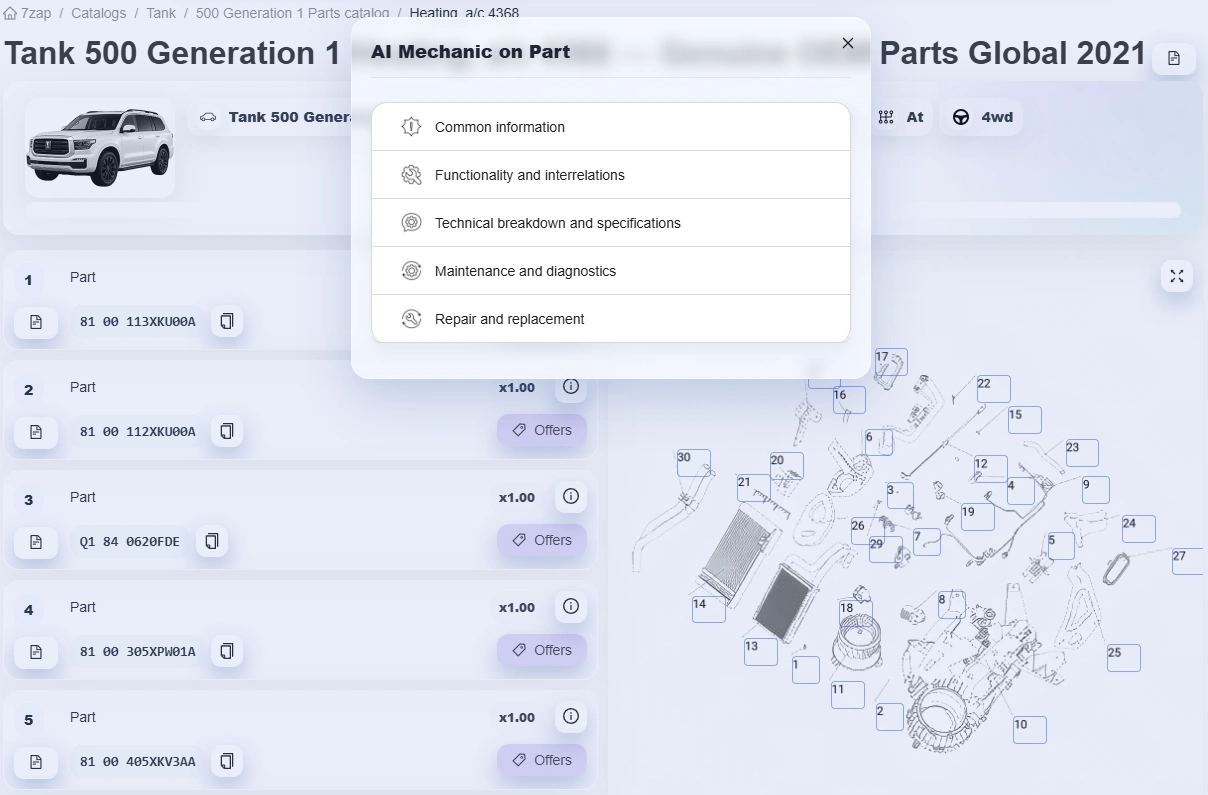
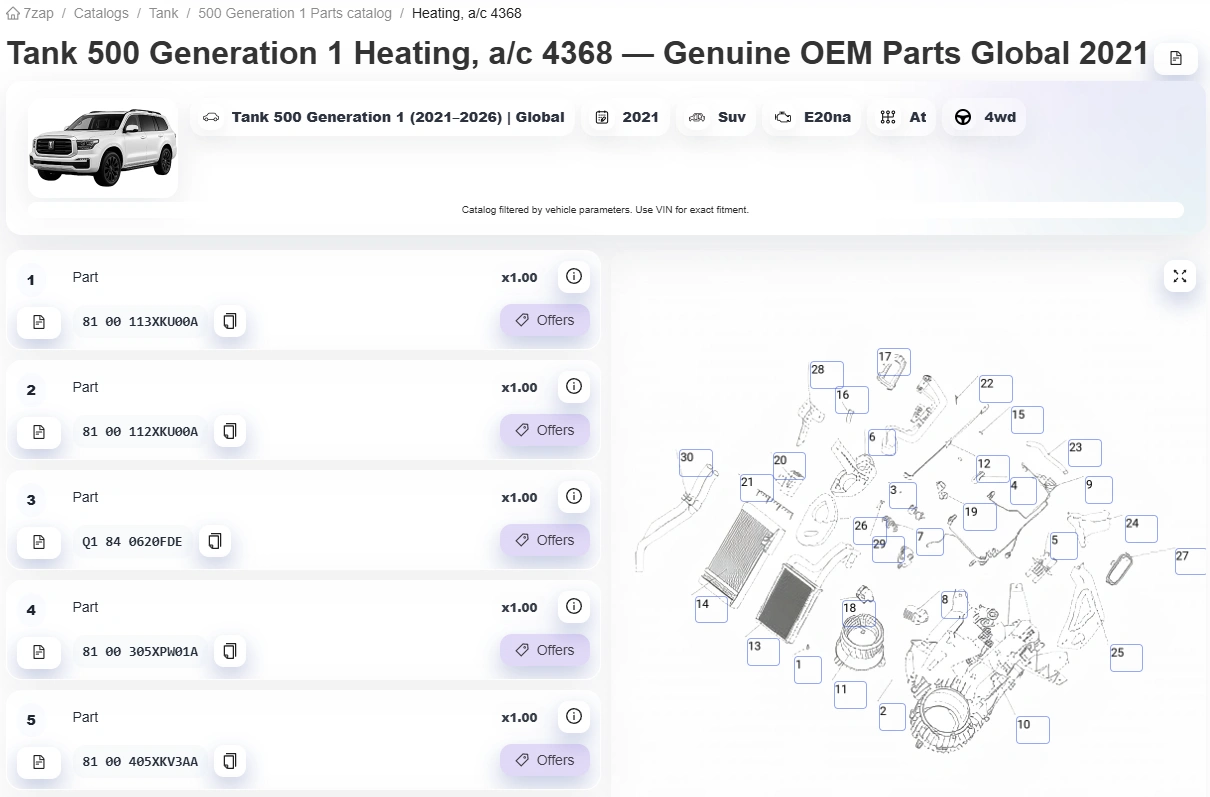
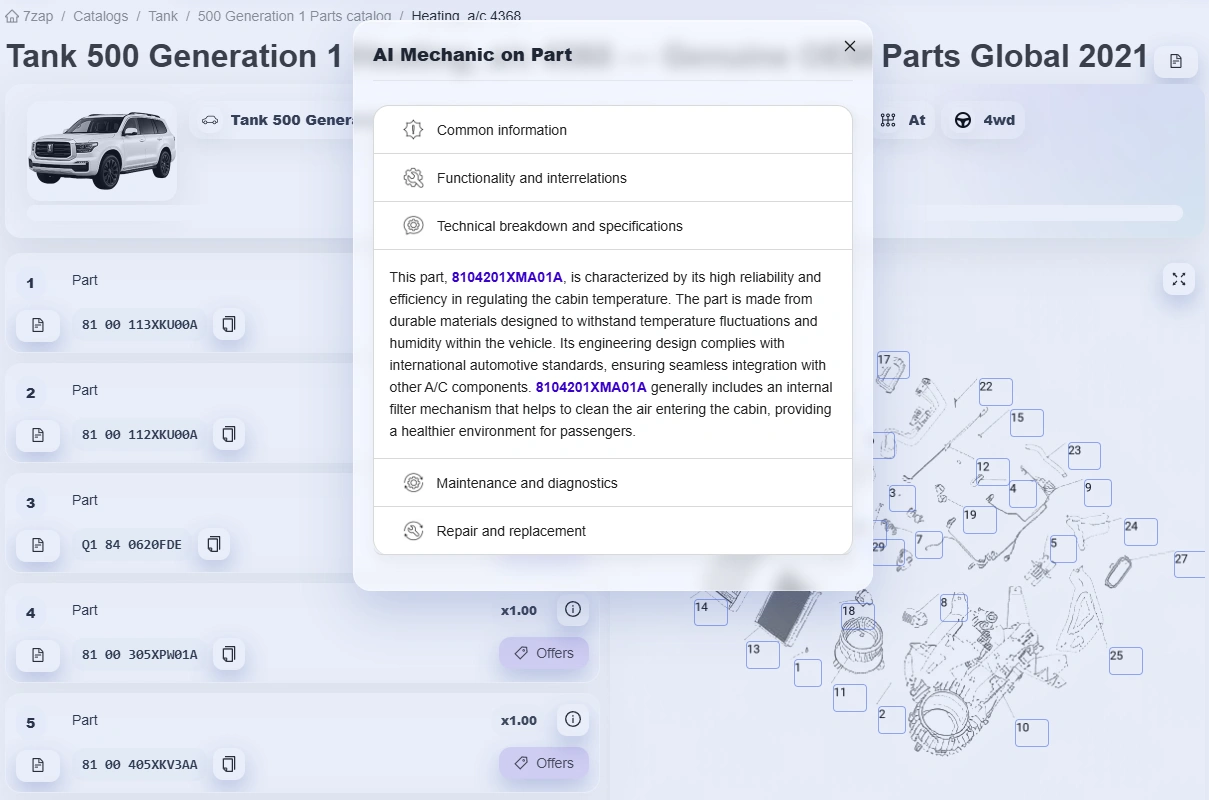
A quick look at typical decoded fields and how the catalog view can be used to navigate parts by groups.
Tank VIN preview
Decoded preview
VIN
LGWTNK507RT987654
Brand
Tank
Model
Tank 500
Year
2024
Production date
2024-03 (example)
Engine
3.0L twin-turbo V6 (market-dependent)
Transmission
Automatic (9-speed, market-dependent)
Tank catalog preview
Screenshot
Screenshot
Screenshot
Support

FAQ

Quick answers to common questions about Tank VIN decoding and VIN lookups.

VIN decoders for other brands

Decode VINs for other manufacturers with the same level of accuracy and OEM-based data.