
VIN Decoder

Saturn VIN Decoder - Free VIN Lookup

Free • 3 sec • No signup
Enter your 17-character Saturn VIN to decode the exact model, trim, factory specs, and compatible OEM parts—ideal for repairs, used-car checks, and documentation.
✓ Confirm exact Saturn model, trim, and model year
✓ Identify engine/transmission for correct parts matching
✓ Spot VIN issues before buying, servicing, or ordering parts
No registration required. Results in ~3 seconds.
Every Saturn has a unique 17-character Saturn vehicle identification number (VIN). A Saturn VIN decoder translates that code into practical details you can verify—so a Saturn VIN lookup and Saturn VIN check help reduce wrong parts, mismatched paperwork, and confusion across trims and mid-year changes.
Overview

Decode a Saturn VIN Decoder Report in Seconds

A Vehicle Identification Number (VIN) follows global standards (ISO 3779/3780) and the U.S. format rules in 49 CFR Part 565. Your Saturn VIN is split into three blocks: WMI (who built it), VDS (what it is), and VIS (when/where it was built and the serial number). With a Saturn VIN decoder, you can decode Saturn VIN details that matter for service—like engine family, transmission type, body style, and plant code—without guessing.

Use this page for a fast Saturn VIN lookup, a quick Saturn VIN number check, or to verify a used vehicle before parts ordering. Some Saturns (for example, Astra imports) may carry a non-U.S. WMI, so it’s helpful to check Saturn VIN number formatting and confirm all 17 characters. For a broader search across brands, use our free VIN decoder and then open the matching catalog to view diagrams and part groups. To decode other vehicle brands with the same precision, use our VIN lookup.

Help

Where is the VIN number on a Saturn?

Common Saturn VIN locations include:
Dashboard plate (driver’s side, visible through the windshield)
Driver’s door jamb label (VIN and tire/loading info)
Passenger-side front door jamb label (some models/years)
Engine bay (stamped on the firewall or inner fender on some Saturns)
Under-hood service/parts labels (varies by model)
Vehicle title and registration documents
Insurance card or policy documents
Original window sticker / dealer paperwork (if available)
Spare tire well / trunk area labels (model-dependent)
i
For a clean Saturn VIN number check, enter all 17 characters exactly (no spaces). Letters I, O, and Q are never used in VINs—if you see them, re-check the characters.
Capabilities

Saturn VIN lookup: what you can learn

A detailed Saturn VIN lookup can help confirm:
Basic vehicle identity
- Brand and model (e.g., SL, Ion, Vue, Aura, Sky, Outlook, Astra) - Body type and restraint/airbag system (where available) - Model year and serial sequence - Manufacturer and country/region indicated by WMI
Factory specifications
- Engine family/displacement (where supported) - Transmission type (automatic/manual and family) - Drivetrain layout (FWD/AWD/RWD as applicable) - Trim/series indicators and platform codes when present
Service, parts, and ownership checks
- Assembly plant code and production identifiers - Compatibility guidance for OEM parts catalog navigation - Helps validate listings during a Saturn VIN check - Useful starting point for a Saturn warranty check by VIN (coverage depends on provider and vehicle age)
Saturn was discontinued, but accurate identification still matters for repairs and resale. A VIN-based lookup helps confirm the exact configuration before ordering parts, comparing used vehicles, or documenting a restoration. It’s also a practical way to catch mismatched titles, swapped powertrains, or incorrect year claims in online listings.
VIN anatomy

How the Saturn VIN number is structured

Every modern Saturn VIN is split into three blocks that identify who built the vehicle, what it is, and when/where it was produced.
WMI (positions 1–3)
The World Manufacturer Identifier shows the manufacturer and region. Many Saturn-branded vehicles use GM-issued WMIs such as 1G8 (Saturn passenger cars) or 5GZ (Saturn multipurpose vehicles). Some Saturns were imported (for example, Astra), so the WMI may identify the original European manufacturer rather than “Saturn” by name.
VDS (positions 4–9)
The Vehicle Descriptor Section defines the vehicle’s core configuration. Depending on model and year, it can encode body style, series/trim, engine family, and safety equipment. Position 9 is the check digit on U.S.-spec vehicles; it’s mathematically calculated to help detect typing errors during a Saturn VIN lookup.
VIS (positions 10–17)
The Vehicle Identifier Section includes the model year code (position 10), the assembly plant code (position 11), and the vehicle’s unique production sequence (positions 12–17). This block is critical when you decode Saturn VIN details for parts selection, because mid-year changes can exist even within the same model year and trim.
Manufacturing

Major production plants

Saturn vehicles were assembled across several GM and partner facilities. Depending on your VIN, the plant can be identified by the WMI and the plant code (position 11).
Spring Hill Manufacturing (Saturn Assembly)
Spring Hill, Tennessee, USA (Saturn vehicle production 1990–2007)
Spring Hill Powertrain
Spring Hill, Tennessee, USA (engine/powertrain production for GM/Saturn programs, 1990s–2000s)
Wilmington Assembly
Wilmington, Delaware, USA (Saturn L-Series 2000–2005; Saturn Sky 2007–2010 model years)
Fairfax Assembly
Kansas City, Kansas, USA (Saturn Aura 2007–2009)
Lansing Delta Township Assembly
Lansing, Michigan, USA (Saturn Outlook 2007–2010)
Doraville Assembly
Doraville, Georgia, USA (Saturn Relay 2005–2007)
Ramos Arizpe Assembly
Ramos Arizpe, Coahuila, Mexico (Saturn Vue 2008–2010)
Opel Antwerp Plant
Antwerp, Belgium (Saturn Astra imports 2008–2009)
Opel Bochum Plant
Bochum, Germany (Astra platform production for global markets, 2000s)
Flint Engine Operations (GM Powertrain)
Flint, Michigan, USA (V6 engine production used across GM including Saturn applications, 2000s)
Tonawanda Engine Plant (GM Powertrain)
Buffalo, New York, USA (engine production supporting GM compact/midsize programs, 2000s)
Toledo Transmission Operations (Hydra-Matic/GM Powertrain)
Toledo, Ohio, USA (automatic transmission production supporting GM programs, 2000s)
Warren Transmission Operations (Hydra-Matic/GM Powertrain)
Warren, Michigan, USA (automatic transmission production supporting GM programs, 2000s)
i
The assembly plant is typically encoded in position 11 of the VIN (VIS block). A Saturn VIN decoder reads that plant code alongside WMI/VDS details to help verify build origin, especially on imported or platform-shared models.
Value

Benefits of Using a Saturn VIN Decoder

VIN-based decoding provides practical, shop-friendly details that reduce mistakes on discontinued models.
Accurate parts matching
Saturn models often share platforms and components with other GM vehicles, and trims can look similar. A Saturn VIN decoder helps verify engine/transmission and key configuration details before ordering parts. This reduces returns, delays, and compatibility errors.
Smarter used-car verification
A Saturn VIN check can confirm the model year code, plant, and manufacturer identifiers against the seller’s claims. It’s a fast way to spot mismatched paperwork, swapped components, or incorrect listing details—especially on older Ion, Vue, and S-Series vehicles.
Better service planning
When you decode Saturn VIN information, you can plan labor and parts more accurately. Knowing the correct drivetrain and powertrain family helps technicians choose the right fluids, filters, and service procedures, and avoids time lost on “close enough” assumptions.
Cleaner documentation & compliance
VIN decoding supports correct records for insurance, registration, repair orders, and fleet logs. It’s also helpful for import models like the Saturn Astra, where the WMI may identify the original European manufacturer. Consistent VIN data reduces administrative errors.
Social proof

Trusted by Saturn Owners & Shop Professionals

Feedback from owners, technicians, and parts teams using VIN decoding for accurate Saturn identification.
Megan
5
5.0
Auto Parts ManagerPhoenix
We still see plenty of Saturn Vue and Aura requests, and trims can look identical. The Saturn VIN decoder helps us confirm engine and transmission before ordering. It saves time on returns and keeps customers from waiting on the wrong parts.
Carlos
5
5.0
Independent MechanicSan Antonio
Saturn VIN lookup is especially useful on older S-Series cars where the paperwork doesn’t always match the vehicle. Decoding the VIN gives me confidence on engine family and model year. It’s a quick check before quoting repairs or sourcing OEM parts.
Hannah
5
5.0
Saturn OwnerChicago
I used the Saturn VIN check before buying a used Ion and it confirmed the year and build details the seller couldn’t explain. The decoded results made it easier to compare listings and avoid surprises. Simple, fast, and it worked on my phone.
Dmitri
5
5.0
Garage OwnerToronto
We service a few Saturn Outlooks and the VIN decoding helps avoid mix-ups between similar GM platforms. The plant/year and drivetrain details are useful for ordering correct components. It’s a reliable workflow step for our parts desk.
Aiko
5
5.0
Car EnthusiastLos Angeles
For Saturn Sky research and documentation, the VIN decoder is a great starting point. It helps confirm model year codes and production identifiers without digging through forum posts. I like having one place to verify details before tracking down parts.
Why premium

Saturn VIN Decoder vs Free Tools

Basic tools often return only year/make/model. A Saturn-focused decode goes further by interpreting Saturn/GM identifiers, plant codes, and configuration clues that matter for parts and service.

How to use the decoder to find parts

Enter your 17-character VIN (no spaces) to run a Saturn VIN lookup
Review decoded results such as model year, plant, engine family, and transmission type
Open the matching OEM catalog and select your vehicle configuration
Browse parts by group (engine, cooling, brakes, electrical, body) and confirm notes/options
Use the decoded data to cross-check compatibility before purchase or installation

Free vs Premium Saturn VIN Decoder

Compare features side-by-side to choose the level of detail you need.
Free
View diagrams per day
View 1 diagrams per day
VIN identifications per month for month(s)
10 VIN identifications per month for 1 month(s)
Ad-free
Full part numbers in catalogs
Applicability Of Spare Parts
Maintenance Parts
Free
View diagrams per day
View 1 diagrams per day
VIN identifications per month for month(s)
10 VIN identifications per month for 1 month(s)
Ad-free
Full part numbers in catalogs
Applicability Of Spare Parts
Maintenance Parts
Reference

Saturn WMI codes (real identifiers)

WMIs are the first three characters of the VIN. They identify the manufacturer and region, which is especially useful for a Saturn VIN lookup because Saturn vehicles were built in multiple GM and partner facilities (including imports).
Examples

Realistic Saturn VIN examples

These examples show how a Saturn VIN decoder reads model year codes, WMIs, and plant identifiers. VINs below are formatted realistically for demonstration.
1G8ZK52702Z123456
SL2 Sedan, 1.9L inline-4, FWD, 4-speed automatic
WMI1G8 = Saturn (GM USA)
Check digitPosition 9: 0 (check digit present for validation)
Model year (position 10)2 = 2002
Plant code (position 11)Z = Spring Hill, Tennessee (commonly associated with Saturn production)
Good example for confirming S-Series trim differences and avoiding mismatched parts across SL/SL1/SL2 variants.

Saturn VIN preview

A quick look at how decoded Saturn VIN details can appear, followed by a catalog-style parts navigation preview.
Saturn VIN preview
Decoded preview
VIN
1G8ZV57758F123456
Brand
Saturn
Model
Aura XR
Year
2008
Production date
2007-11-15 (example)
Engine
3.6L V6 (HFV6 family)
Transmission
6-speed automatic
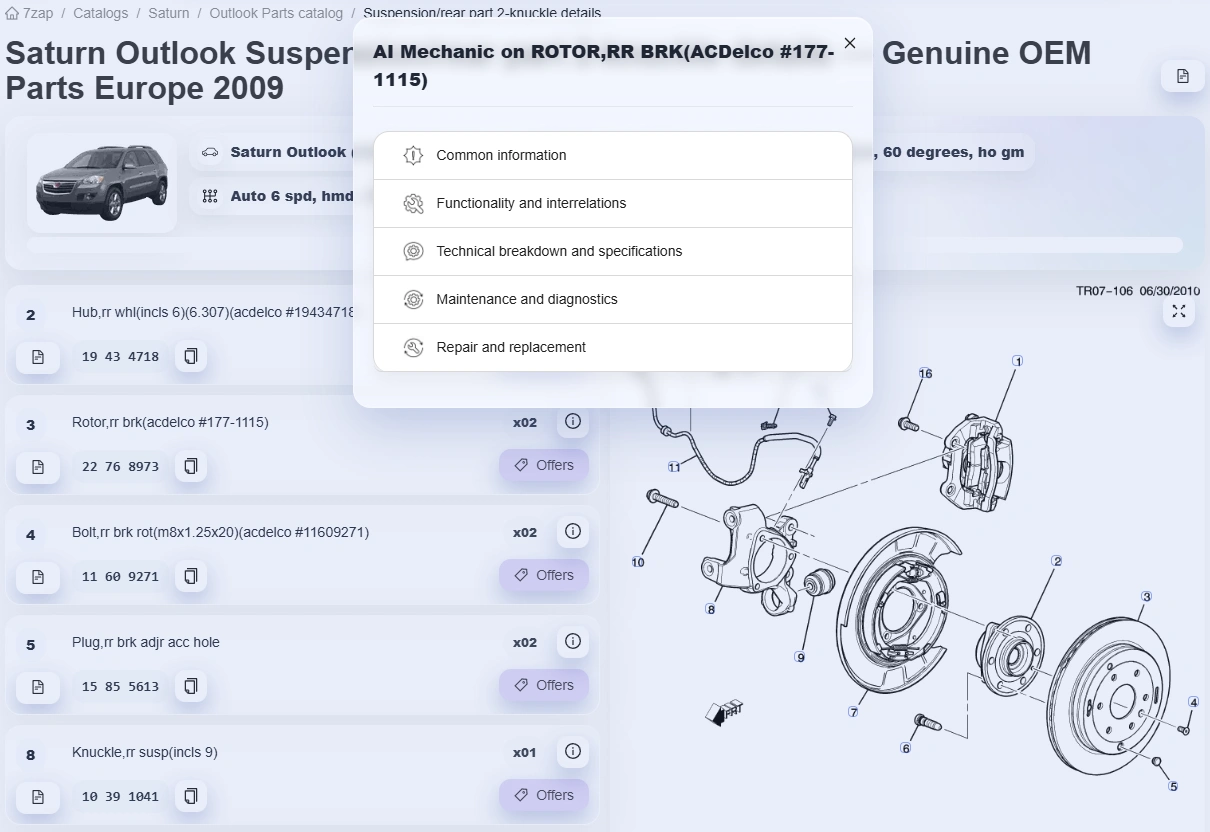
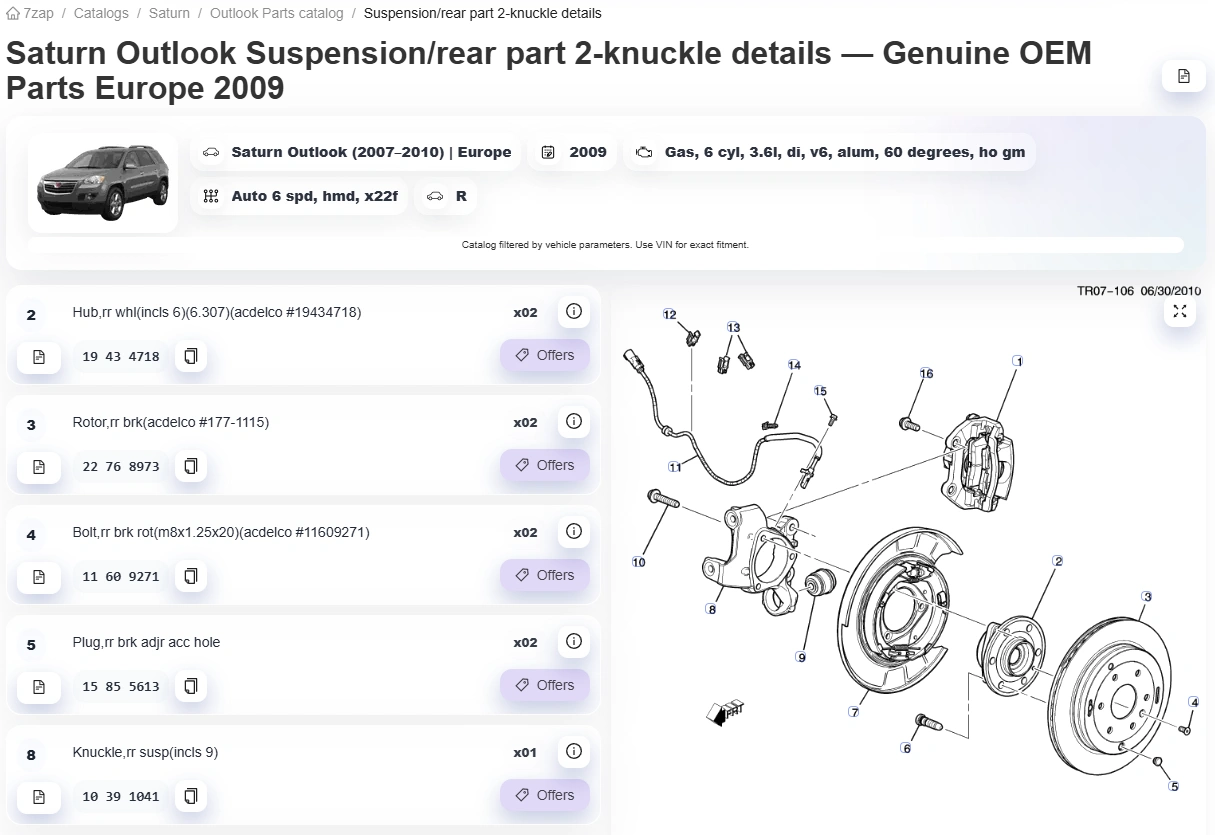
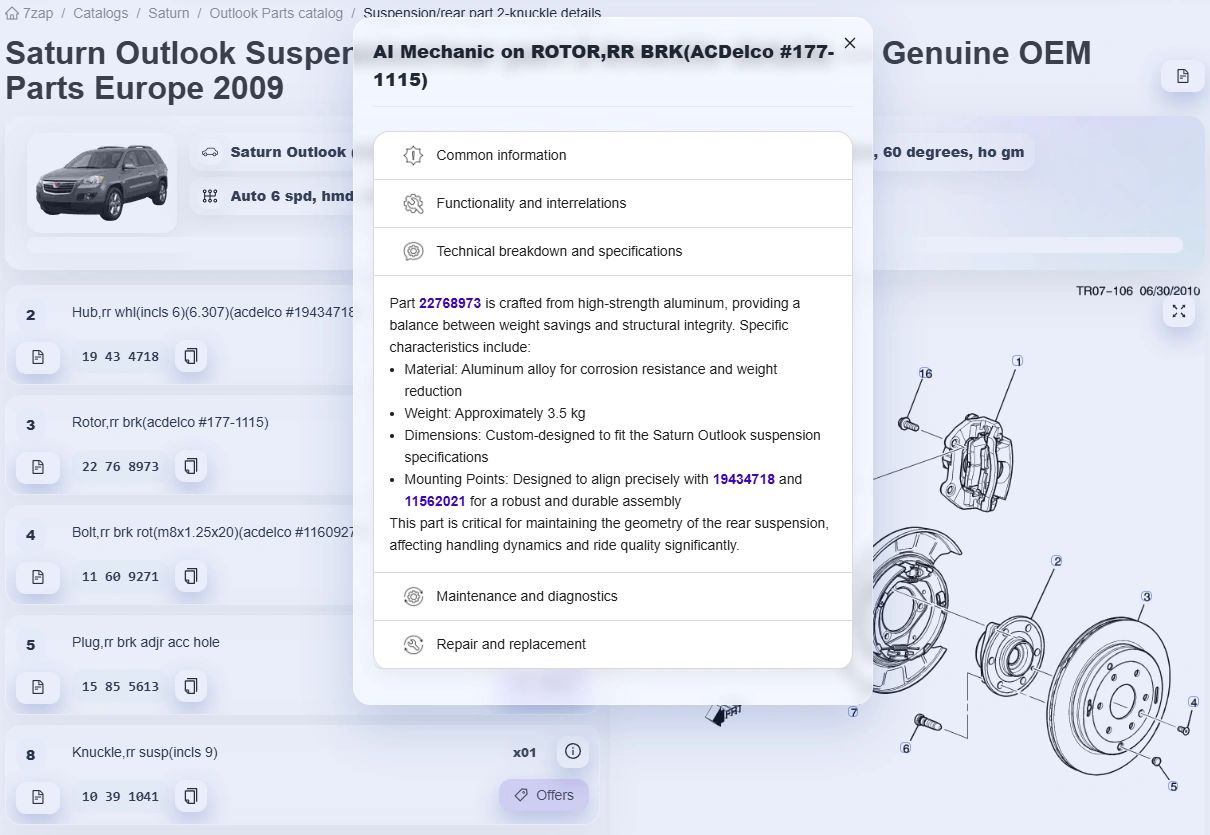
Saturn catalog preview
Screenshot
Screenshot
Screenshot
Support

FAQ

Quick answers to common questions about Saturn VIN decoding and VIN-based identification.

VIN decoders for other brands

Decode VINs for other manufacturers with the same level of accuracy and OEM-based data.