
VIN Decoder

Plymouth VIN Decoder - Free VIN Lookup

Free • 3 sec • No signup
Enter your 17-character Plymouth VIN to decode the exact model, year, factory specs, and compatible OEM parts data—ideal for owners, restorers, and parts professionals working on Voyager, Neon, Breeze, and Prowler.
✓ Verify model, trim, engine & transmission
✓ Identify assembly plant, model year & serial range
✓ Reduce mistakes when choosing parts & service items
No registration required. Results in ~3 seconds.
A Vehicle Identification Number (VIN) is your Plymouth’s unique fingerprint. This Plymouth VIN decoder helps you confirm what the vehicle actually is—use it for a fast Plymouth VIN lookup and a practical Plymouth VIN check before ordering parts, documenting a classic, or comparing listings.
Overview

Plymouth VIN Decoder: Decode Your VIN in Seconds

Modern Plymouth vehicles (generally 1981 and newer) use a standardized 17-character VIN based on ISO 3779/3780 and U.S. requirements (49 CFR Part 565). A Plymouth VIN decoder reads the three main blocks—WMI (manufacturer/region), VDS (vehicle attributes), and VIS (model year, plant, and serial). With a quick decode Plymouth VIN search, you can confirm the correct engine, transmission type, body style, and other identifiers that matter for maintenance and parts matching.

On 7zap, your Plymouth vehicle identification number can be decoded alongside catalog-ready data, helping you cross-check fitment for common platforms like Voyager/Grand Voyager minivans and Neon-based compacts. For a classic-car workflow, keep in mind that pre-1981 Plymouths (for example, many 1960s cars) often used non-17-digit VIN formats—so a 1969 Plymouth VIN decoder approach typically relies on model-specific serial rules. Start here: free VIN decoder to check Plymouth VIN number details quickly and reduce guesswork. To decode other vehicle brands with the same precision, use our VIN lookup.

Help

Where is the VIN number on a Plymouth?

Common Plymouth VIN locations include:
Dashboard (driver’s side, visible through the windshield)
Driver’s door jamb/door pillar label (VIN and tire/loading info)
Under the hood (stamped on the firewall or inner fender on some models)
Front radiator support (older models may have a stamped tag/plate)
Spare tire well or rear cargo area (varies by model/body)
Vehicle title, registration, and inspection documents
Insurance card or insurance policy paperwork
Owner’s manual packet (sometimes recorded on a card/sticker)
Service records from dealers or independent shops
i
For the best results, enter the VIN exactly as shown (17 characters for most 1981+ vehicles; no spaces). The letters I, O, and Q are never used in modern VINs to avoid confusion with 1 and 0.
Capabilities

Plymouth VIN lookup: what you can learn

A good VIN lookup can help confirm:
Basic vehicle identity
• Brand and model family (e.g., Voyager, Neon, Breeze, Prowler) • Body type/class (car vs MPV/minivan) • Model year and serial/sequence range • Assembly plant indicator (when available)
Factory specifications
• Engine size/family (where supported by the VIN/VDS) • Transmission type (automatic/manual where supported) • Restraint system and other regulated attributes • Market/series clues depending on VIN pattern
Service & parts readiness
• Better parts matching for common maintenance items • Confirmation before ordering parts online or at a counter • Help building a “VIN decoder build sheet” style summary for records • Reduced errors when multiple trims share the same model name
A Plymouth VIN lookup is most useful when documents are missing, the vehicle has been modified, or the seller’s description doesn’t match the car. Running a Plymouth VIN number check can also help you confirm the year/plant/sequence and build a consistent record for repairs, restoration notes, and resale listings.
VIN anatomy

How the Plymouth VIN number is structured

Most Plymouth vehicles from 1981 onward follow the 17-character VIN standard and are split into three blocks.
WMI (positions 1–3)
The WMI identifies the manufacturer and region. For Plymouth-badged vehicles built under Chrysler Corporation, common WMIs include codes beginning with 1 (USA), 2 (Canada), or 3 (Mexico). Example patterns such as 1P3 and 1P4 were used to distinguish passenger cars vs multipurpose vehicles in many eras. The WMI is the quickest way to confirm the production region before deeper decoding.
VDS (positions 4–9)
The Vehicle Descriptor Section describes the vehicle’s platform and key attributes. Depending on the Plymouth model and year, it may encode body style, restraint system, engine family, and series/trim. Position 9 is the check digit on North American VINs, used to validate the VIN mathematically. Because Chrysler platforms were shared across brands, the VDS is especially helpful for separating similar trims and drivetrains.
VIS (positions 10–17)
The Vehicle Identifier Section contains the model year (position 10), the assembly plant code (position 11), and the production sequence number (positions 12–17). This block is critical for verifying the exact year for late Plymouth models and for cross-referencing service bulletins or parts changes tied to production ranges. Note: Plymouth was discontinued after the 2001 model year, so later VINs will not be Plymouth-badged.
Manufacturing

Major production plants for Plymouth vehicles

Plymouth vehicles were produced across multiple Chrysler Corporation facilities in the U.S., Canada, and Mexico. Depending on your VIN, the plant code (often position 11) can indicate where final assembly occurred.
Windsor Assembly Plant
Windsor, Ontario, Canada (1928–present)
Belvidere Assembly Plant
Belvidere, Illinois, USA (1965–2023)
Sterling Heights Assembly Plant (SHAP)
Sterling Heights, Michigan, USA (1953–present)
St. Louis Assembly Plant
Fenton, Missouri, USA (1959–2008)
Newark Assembly Plant
Newark, Delaware, USA (1951–2008)
Conner Avenue Assembly Plant
Detroit, Michigan, USA (1966–2009)
Los Angeles Assembly Plant
Maywood, California, USA (1932–1979)
Dodge Main / Hamtramck (historic plant)
Hamtramck, Michigan, USA (1910–1980)
Lynch Road Assembly Plant
Detroit, Michigan, USA (1922–1989)
Toluca Assembly Plant
Toluca, State of Mexico, Mexico (1968–present)
Jefferson Assembly (historic complex)
Detroit, Michigan, USA (1949–present; multiple expansions)
Trenton Engine Complex (powertrain supplier)
Trenton, Michigan, USA (1952–present)
i
On many North American Plymouth VINs, the assembly plant is identified by the character in position 11. Decoding that plant code helps confirm where the vehicle was built and can be useful when parts or running changes vary by factory and production sequence.
Value

Benefits of Using a Plymouth VIN Decoder

Practical details that help owners, restorers, and parts teams avoid mismatches on Plymouth vehicles.
Accurate parts matching
Many Plymouth models share platforms with Dodge and Chrysler, and trims can overlap. Decoding the VIN helps confirm the exact configuration so you can match brakes, ignition parts, cooling components, and drivetrain items more reliably—especially when the badge or paperwork is inconsistent.
Smarter service planning
A quick Plymouth VIN check helps verify the model year, powertrain clues, and production range before you schedule major work. That means fewer surprises when ordering fluids, filters, sensors, or transmission service parts that differ across engines and build periods.
Cleaner documentation for classics and collectors
For collectors, a VIN decode supports consistent records for insurance, restoration notes, and resale listings. It can also help spot discrepancies such as incorrect year claims or swapped components. For pre-1981 cars, it guides you toward the correct serial format and reference resources.
Faster checks when buying or selling
Using a Plymouth VIN lookup during a purchase helps confirm that the listing matches the vehicle in front of you. It’s a simple way to validate year and core identity, and it pairs well with title checks, inspection reports, and mileage/ownership documentation.
Social proof

Trusted by Plymouth Owners & Parts Professionals

Real-world feedback from enthusiasts, technicians, and parts counters using VIN decoding to verify specs on Plymouth vehicles.
Derek
5
5.0
Auto Parts ManagerChicago
We see a lot of late Plymouth Voyagers with mixed paperwork. The Plymouth VIN decoder helped us confirm engine and build details quickly, so we stopped ordering the wrong cooling and belt components. It’s a clean Plymouth VIN lookup that saves counter time.
Marina
5
5.0
Independent MechanicToronto
For Neon-era Plymouths, small differences in engine and emissions equipment matter. Running a Plymouth VIN check before quoting repairs helps me match the right parts the first time. The decoded year and plant info also helps when service histories are incomplete.
Caleb
5
5.0
Garage OwnerPhoenix
A customer brought in a Plymouth Breeze with swapped components. The VIN decoder confirmed the original configuration so we could plan the right tune-up and transmission service. It’s straightforward and the results are easier to read than many basic tools.
Sofia
5
5.0
Car EnthusiastLos Angeles
I’m restoring a Plymouth Prowler and needed to verify build details before sourcing parts. The Plymouth VIN number check gave me confidence that the car matched the seller’s claims. It’s also helpful for documenting the car for insurance and future resale.
Hiro
5
5.0
Service AdvisorSeattle
Older Chrysler/Plymouth minivans can be confusing when trims overlap. This tool gives a fast Plymouth VIN lookup so we can confirm drivetrain and avoid delays at intake. Customers appreciate seeing the decoded results while we build the estimate.
Why premium

Plymouth VIN Decoder vs Free Tools

Basic free tools often return only the year/make/model or generic engine information. A deeper decoder focuses on VIN structure details (WMI/VDS/VIS) and presents the results in a parts-and-service friendly way for Plymouth vehicles and shared Chrysler platforms.

How to use the decoder to find the right parts

Enter your 17-character VIN exactly as shown on the vehicle or documents
Review decoded details (year, model family, plant/sequence, and available powertrain clues)
Use the results to confirm compatibility before ordering parts or booking service
If the VIN is pre-1981 or not 17 characters, switch to model/year-specific identification methods (common for classic Plymouths)
Save the decoded summary for your records or share it with a shop/parts counter

Free vs Premium Plymouth VIN Decoder

Compare plans feature-by-feature to see which level of VIN detail and catalog workflow fits your needs.
Free
View diagrams per day
View 1 diagrams per day
VIN identifications per month for month(s)
10 VIN identifications per month for 1 month(s)
Ad-free
Full part numbers in catalogs
Applicability Of Spare Parts
Maintenance Parts
Free
View diagrams per day
View 1 diagrams per day
VIN identifications per month for month(s)
10 VIN identifications per month for 1 month(s)
Ad-free
Full part numbers in catalogs
Applicability Of Spare Parts
Maintenance Parts
Reference

Plymouth WMI codes (real identifiers)

WMIs are the first three characters of the VIN and identify the manufacturer and region. Plymouth-badged vehicles were produced under Chrysler Corporation, so Plymouth WMIs are commonly found on late-model Plymouth cars and MPVs (mostly 1981–2001).
Examples

Plymouth VIN examples (decoded)

Plymouth production for U.S. markets ended after the 2001 model year, so modern 2020s vehicles will not carry Plymouth VIN branding. These examples show typical 17-character Plymouth VIN formats used on late-model Plymouth vehicles.
1P4GP44R21B123456
Voyager SE, 3.3L V6, FWD, 4-speed automatic
WMI1P4 = Plymouth (USA) multipurpose vehicle
Check digitPosition 9: 2 (check digit present)
Model year (position 10)Position 10: 1 = 2001
Plant code (position 11)Position 11: B = Belvidere, Illinois (commonly used by Chrysler)
A practical example for minivan decoding: year + plant + sequence are the most reliable VIN elements for parts cross-checking.

Plymouth VIN preview

A quick look at what a decoded Plymouth VIN can show, and how the OEM catalog structure helps you navigate parts groups.
Plymouth VIN preview
Decoded preview
VIN
1P4GP44R21B123456
Brand
Plymouth
Model
Voyager
Year
2001
Production date
2001-03 (estimated)
Engine
3.3L V6 (gasoline)
Transmission
4-speed automatic
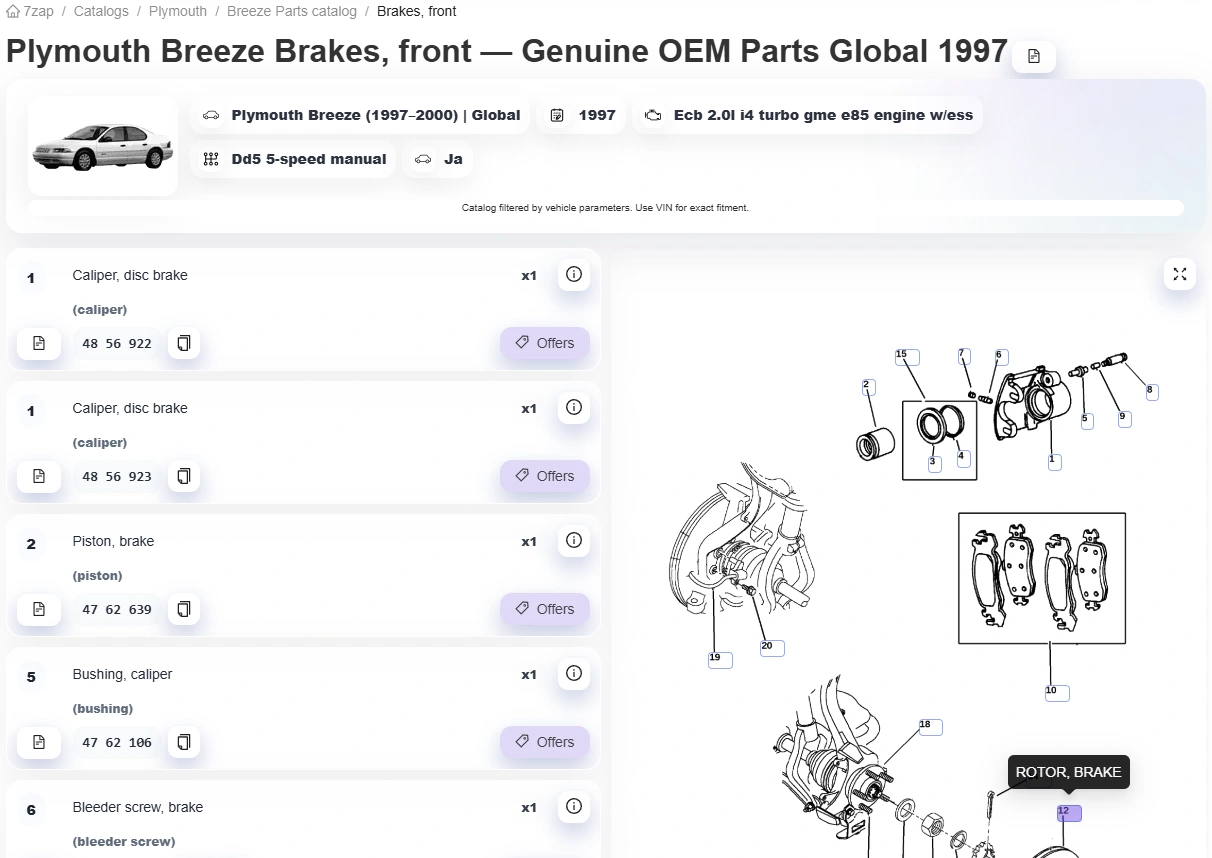
Plymouth catalog preview
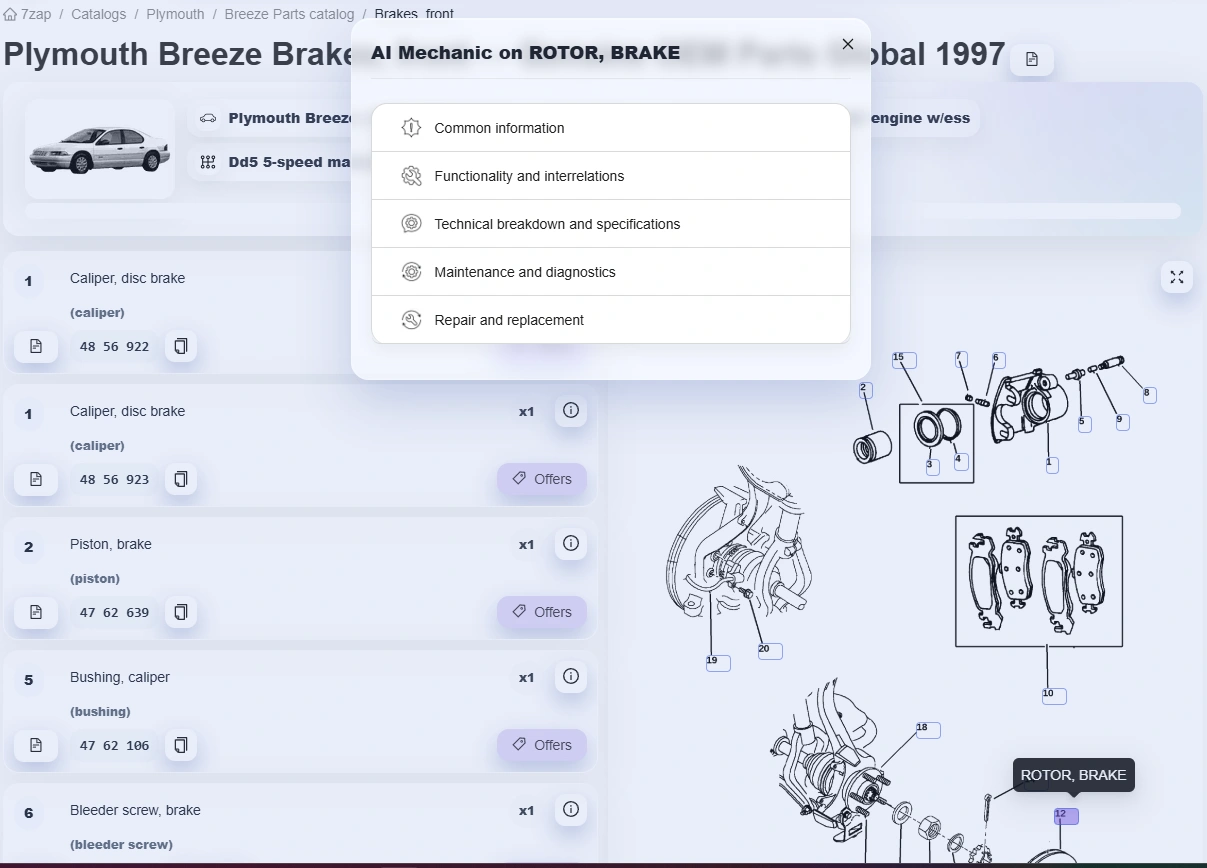
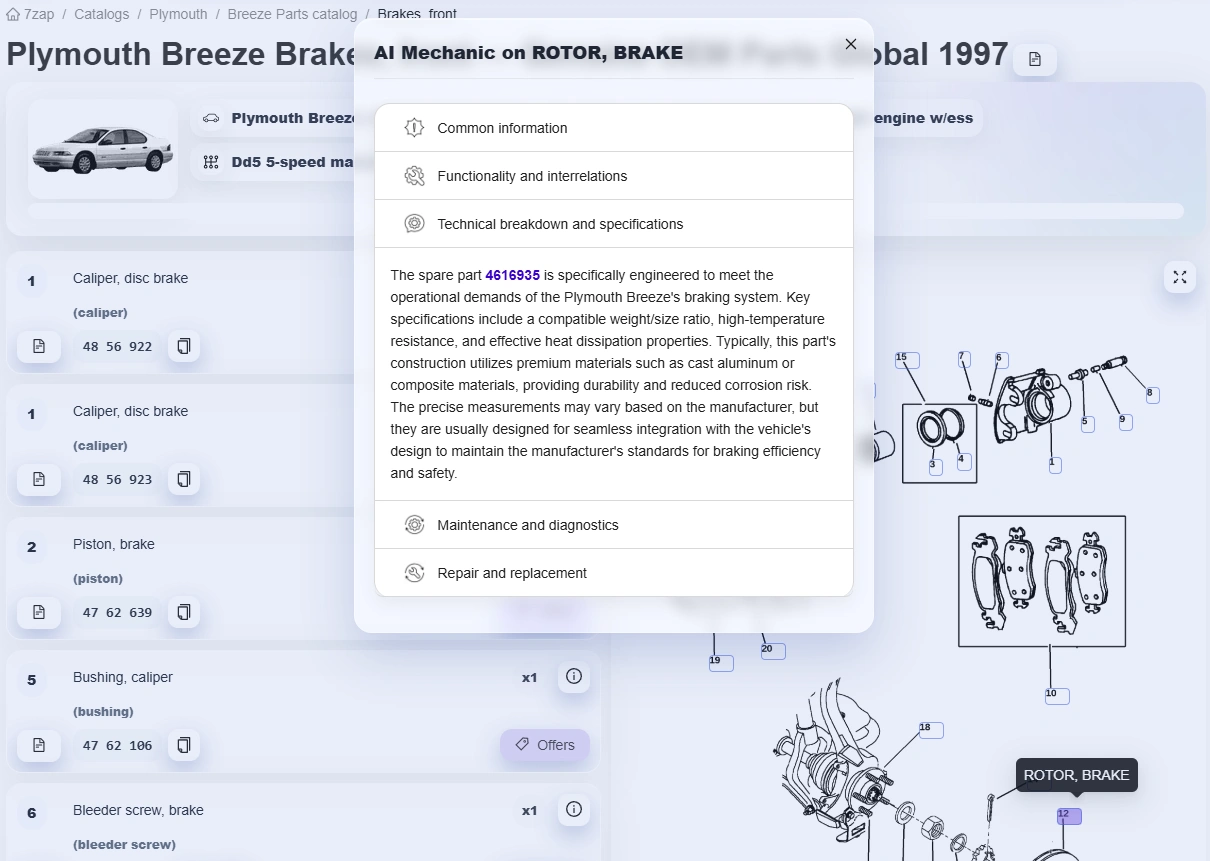
Example 7zap catalog interface
Example 7zap assembly interface
Example 7zap parts interface
Support

FAQ

Quick answers to common questions about Plymouth VIN decoding and VIN lookups.

VIN decoders for other brands

Decode VINs for other manufacturers with the same level of accuracy and OEM-based data.