
Decode your Jeep VIN to find factory specifications, build options, and exact OEM part compatibility.
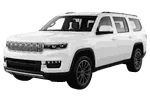
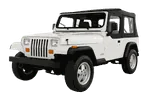
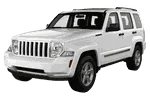
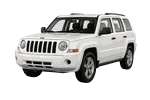
The Jeep parts catalog on 7zap is designed for identifying vehicle assemblies, interpreting exploded views, and researching OEM part numbers. Begin with the Jeep family and generation shown in the catalog, then move through the available assembly groups to locate the area related to the component being investigated.
This diagram-led workflow is useful when a part name alone is ambiguous. A Jeep may contain several components with similar descriptions, while an illustration can show their relative positions, nearby hardware, and connections to a larger assembly. The resulting part number is a research reference that can be compared with vehicle information and other reliable documentation before a replacement is chosen.
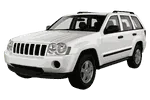
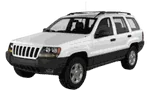
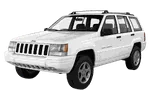
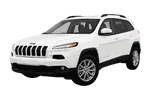
Manual catalog browsing starts with the displayed vehicle generation. The selection matters because similarly named Jeep vehicles can have different construction, assemblies, and parts references. The catalog includes distinct entries such as Cherokee XJ (1997–2001) and Cherokee KL (2014–2023), as well as Grand Cherokee WJ/WG (1999–2005) and Grand Cherokee WK2 (2014–2021). These entries should not be treated as interchangeable.
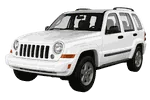
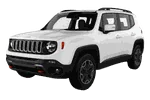
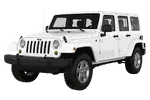
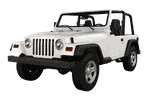
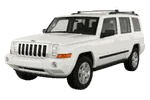
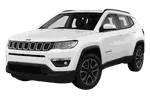
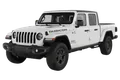
The same care applies to Wrangler TJ (1997–2006) and Wrangler JL (2018–2025). Other displayed choices include Commander XK (2006–2010), Compass MP (2017–2025), Gladiator JT (2020–2025), and Renegade BU (2015–2022). Select the entry matching the vehicle information available to you rather than relying only on a familiar model name.
After choosing a generation, browse the relevant assembly area. Depending on the displayed catalog record, this may help with research involving engine-related groups, transmission components, steering, suspension, brakes, body sections, electrical equipment, cooling, or attached hardware. Coverage can differ between catalog entries, so the visible structure should be treated as the guide for that vehicle selection.
A Jeep parts diagram presents components in an exploded arrangement so their relationship within an assembly is easier to understand. Numbered callouts connect illustrated positions to rows in the accompanying parts list. The row may contain an OEM number, a component description, quantity context, or qualifying notes relevant to the displayed configuration.
A callout is a pointer to a parts-list row; it is not necessarily an orderable part number. Some positions can refer to a grouped assembly, a shared illustration, hardware, or a row that requires further interpretation. Likewise, an OEM number does not establish applicability by itself. It should remain connected to the selected generation, assembly context, and any notes shown beside the listing.
Users seeking a Mopar Jeep parts catalog reference can use this workflow to record numbers found in the displayed Jeep catalogue and compare them with markings on the removed component or trusted service documentation. 7zap is an independent reference catalog and does not represent manufacturer affiliation.
Once the correct generation is open, review the manually displayed configuration choices before interpreting a diagram. Engine, transmission, equipment, production timing, and other factory distinctions may affect which rows are relevant where such qualifiers are presented. Do not assume that visual similarity between two components means they share a number.
VIN lookup is an independent, vehicle-specific route through the catalog. It is separate from choosing a model generation and factory configuration manually. A VIN should not be treated as another configuration option or as a selector inside the manually browsed entry.
Use either path according to the information available. If browsing manually, keep the chosen generation and configuration context attached to any number you record. If using VIN lookup, assess the vehicle-specific results on their own terms and continue to review diagram notes and parts-list details.
Part-number research is strongest when several identifiers agree. Compare the catalog number with the marking on the existing component when readable, the component description, its physical location, connector or mounting context, and the vehicle documentation. Pay attention to prefixes, suffixes, spacing, and character differences when transcribing a number.
A diagram can help distinguish neighboring parts, but it is not an installation guide. It also cannot account for undocumented changes, previous repairs, or components already replaced on a vehicle. Keep a note of the selected Jeep generation, configuration, diagram section, callout, and associated row so another source can review the same evidence.
Start with the displayed family and generation that matches the vehicle records. Then open the assembly group related to the component and follow its callout to the parts list.
Not necessarily. The number on the illustration is commonly a callout. Follow it to the corresponding parts-list row to see whether an OEM reference is provided.
Yes, different displayed generations or factory configurations may lead to different references. For example, Wrangler TJ and Wrangler JL are separate catalog choices and should be researched independently.
No. An OEM number is a useful research identifier, but applicability still requires checking the selected vehicle context, catalog notes, component details, and reliable supporting documentation.
Use VIN lookup as a separate vehicle-specific path when appropriate. Manual browsing is useful when you know the displayed Jeep generation and relevant factory configuration; the two workflows should not be merged.