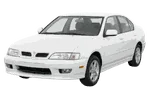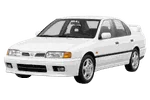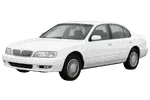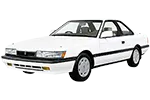














This page helps you work with the original Infiniti spare parts catalog online for vehicles configured for the USA. The series and generations listed above reflect USA-market specifications, so you can navigate to the correct diagrams and read OEM part numbers that match typical US equipment, emissions calibrations, lighting, and safety variants.
Use the catalog to select parts by model, generation, and production year, open illustrated assemblies (engine, transmission, suspension, body, interior, electrical), and verify the exact original spare parts by their OEM numbers before ordering or cross-checking compatibility.
The list above covers multiple Infiniti lines delivered to the USA, from sedans and coupes to crossovers and full-size SUVs. For example, you can open parts diagrams for modern platforms such as the Q50 V37 (2013 - 2017) and QX60 L50 (2012 - 2017), as well as earlier generations like FX S50 (2002 - 2008) or the G20 family (G20 P10, 1990 - 1998; G20 P11, 1998 - 2001).
If you are working on flagship and luxury models, the catalog also includes the Q45 line (Q45 G50, 1989 - 1996; Q45 Y33, 1996 - 2001; Q45 F50, 2001 - 2006) and the M-series (M35/45 Y50, 2004 - 2010). For SUV-focused maintenance common in the USA, you will often use sections such as QX70 S51 (2008 - 2017) and QX80/QX56 Z62 (2010 - 2017).
USA configurations may differ by emissions requirements, engine control components, and exhaust/EVAP systems.
Lighting and safety equipment can vary by market, affecting body electrical diagrams, lamps, sensors, and harnesses.
Trim levels and option packages common in the USA (comfort, infotainment, driver assistance) influence interior and electrical parts selection.
Choosing the correct Infiniti USA section first reduces mismatches when comparing OEM part numbers across similar generations.
Confirm you are on the Infiniti page for the USA region (this page is already filtered for the USA market).
In the list above, select your series (for example QX60, Q50, Q60, FX, or QX80/QX56).
Choose the matching generation and production years, such as QX50 J50 (2007 - 2017) or Q60 V36 (2007 - 2017), to align with the vehicle’s build period.
Open the required assembly group: engine, cooling, fuel and exhaust, transmission, suspension, brakes, steering, body panels, HVAC, interior trim, or wiring.
Use the diagram to locate the component and read its position number, then find the corresponding OEM part number in the parts list.
Search and compare by OEM number when ordering, and verify notes about applicability or equipment where provided.
If the vehicle has mixed options or you want maximum accuracy, refine the selection using a VIN-based search.
For the most precise selection, decode the vehicle identification number to reveal your INFINITI's exact configuration — series, engine, transmission, and USA-specific equipment like EPA/CARB emissions, SAE lighting, DOT safety equipment, and Federal/California-spec components. Use the run a INFINITI VIN lookup to open a catalog filtered to your build. If you maintain multiple brands or need to identify a vehicle with unclear history, the VIN check for any brand helps with any car or truck. You can also search directly by OEM part number to verify applicability across engines, trims, and model years in USA.
Already have an OEM part number? Use it to search and confirm fitment across close generations (for example between G35/37/25 V35, 2002 - 2007 and G35/37/25/Q40 V36, 2006 - 2015), then verify the diagram notes before purchasing.
In the USA, Infiniti owners and workshops frequently look up maintenance and repair parts for crossovers and SUVs like QX60 L50 (2012 - 2017), QX70 S51 (2008 - 2017), and QX80/QX56 (JA60, 2004 - 2010; Z62, 2010 - 2017), as well as sporty sedans/coupes such as Q50 V37 (2013 - 2017) and Q60 (V36, 2007 - 2017; V37, 2016 - 2017). Stop-and-go commuting, long highway mileage, and variable weather make it especially important to verify the exact USA-market parts for cooling, brakes, suspension, and electrical components.
Select your Infiniti series and generation from the list above, open the original parts diagrams, and use the OEM part numbers to confidently identify the right components for a USA-spec vehicle.