
VIN Decoder

Eagle VIN Decoder - Free VIN Lookup

Free • 3 sec • No signup
Enter your 17-character Eagle VIN to identify the exact model, year, factory configuration, and parts-friendly specifications—helpful for Talon, Vision, Summit, Premier, and more.
✓ Confirm model, trim, engine & transmission
✓ Reduce parts-ordering mistakes with VIN-accurate specs
✓ Use decoded data for ownership, insurance, and records
No registration required. Results in ~3 seconds.
Every Eagle has a unique 17-character Eagle vehicle identification number (VIN). An Eagle VIN decoder converts that code into practical details—so you can decode Eagle VIN data, verify configurations, and confidently check Eagle VIN number information before buying parts or documenting a vehicle.
Overview

Decode Your Eagle VIN in Seconds

A VIN (Vehicle Identification Number) is a standardized 17-character code used worldwide under ISO 3779/3780 and regulated in the U.S. by 49 CFR Part 565. With an Eagle VIN decoder, you can translate the VIN into meaningful data such as model line, body style, engine family, transmission type, assembly location, and model year—details that matter when you’re restoring or maintaining an older Eagle.

An Eagle VIN is generally split into three blocks: WMI (positions 1–3) identifies the manufacturer/region; VDS (positions 4–9) describes the vehicle (platform, body, restraint system, engine) and includes a check digit at position 9; VIS (positions 10–17) includes model year, plant code, and serial number. If you want a fast Eagle VIN number check, paste the VIN into our tool and compare the output against the vehicle and paperwork. You can also start from our free VIN decoder hub and then focus on Eagle-specific decoding and catalog matching.

Help

Where is the VIN number on an Eagle?

Common VIN locations on Eagle vehicles include:
Dashboard (driver side, visible through the windshield)
Driver-side door jamb label (VIN and compliance label)
Engine bay (stamped on firewall or strut tower area, depending on model)
Front radiator support (sticker or stamped number on some models)
Trunk or hatch area (spare tire well label on some vehicles)
Vehicle title and registration documents
Insurance card or policy documents
Service records from previous repairs or inspections
Under-hood emissions label (may list VIN or partial VIN on some models)
i
For the best Eagle VIN number check, enter all 17 characters exactly (no spaces). VINs never use the letters I, O, or Q—if you see them, re-check the stamping or paperwork.
Capabilities

Eagle VIN lookup: what you can learn

A good VIN lookup can help confirm:
Basic vehicle identity
- Make/brand (Eagle) - Model family (e.g., Talon, Vision, Summit, Premier) - Body type and door count (when encoded) - Model year code and production sequence - Manufacturer and region from the WMI
Factory specifications (as encoded)
- Engine family/displacement (where available) - Drivetrain layout (FWD/AWD, model-dependent) - Transmission type (manual/automatic, model-dependent) - Restraint system details in the VDS (varies by year) - Assembly plant identifier in position 11 (when applicable)
Ownership, service & parts workflow
- Confirming the VIN matches the title/registration - Building a parts-friendly profile for ordering - Detecting common mismatches (swapped engines/ECUs, rebadged trims) - Supporting documentation for insurance or inspections - Reference for an Eagle warranty check by VIN (historical/in-service data when available)
An Eagle VIN lookup is most useful when you combine the decoded output with what you can physically verify on the car (engine bay tags, transmission type, drivetrain hardware). Because Eagle vehicles are older, VIN decoding is especially helpful for reducing parts returns, confirming donor-car compatibility, and keeping restoration documentation consistent.
VIN anatomy

How the Eagle VIN number is structured

Every 17-character Eagle VIN follows a predictable layout that helps identify the manufacturer, the vehicle description, and production identifiers.
WMI (positions 1–3)
The WMI identifies the manufacturer and region. On Eagle vehicles, you may see WMIs that reflect Chrysler/AMC, Mitsubishi, or Renault involvement, depending on the model and era. For example, DSM-era Eagle Talon models commonly use an Eagle-specific WMI, while some Eagle Summit vehicles may use a Mitsubishi WMI because the manufacturer of record is Mitsubishi.
VDS (positions 4–9)
The Vehicle Descriptor Section encodes the vehicle line and key attributes such as body style, engine family, restraint system, and other platform identifiers (exact meaning varies by manufacturer and year). Position 9 is the check digit on most North American VINs; it’s calculated from the other characters to help detect typos during an Eagle VIN number check.
VIS (positions 10–17)
The Vehicle Identifier Section contains the model year code (position 10), the assembly plant code (position 11, when used), and a sequential serial number (positions 12–17). For owners using an Eagle VIN decoder build sheet approach, the VIS is especially helpful for confirming year and plant, then matching parts catalogs and service bulletins to the correct production period.
Manufacturing

Major production plants

Eagle vehicles were produced through Chrysler/AMC facilities and partner manufacturers. Depending on your VIN, position 11 may point to an assembly plant code, while other plants supplied engines or transmissions used in Eagle models.
Diamond-Star Motors (DSM) Assembly Plant
Normal, Illinois, USA (Eagle Talon production, 1990–1998)
Bramalea Assembly / Brampton Assembly Plant
Brampton, Ontario, Canada (Eagle Premier 1988–1992; Eagle Vision 1993–1997)
Kenosha Assembly Plant (AMC)
Kenosha, Wisconsin, USA (AMC Eagle 4x4 models under the Eagle name, 1981–1988)
Renault Sandouville Plant
Sandouville, Normandy, France (Renault 21-based Eagle Medallion, late 1980s)
Renault Maubeuge Plant
Maubeuge, Hauts-de-France, France (Renault estate/variant production associated with Medallion-era vehicles, late 1980s)
Mitsubishi Mizushima Plant
Kurashiki (Mizushima), Okayama, Japan (Eagle Summit/Mirage-based production, late 1980s–mid 1990s)
Mitsubishi Okazaki Plant
Okazaki, Aichi, Japan (powertrain manufacturing supporting Mitsubishi-built Eagle models, 1980s–1990s)
Chrysler Trenton Engine Plant
Trenton, Michigan, USA (3.5L V6 production used in Eagle Vision, 1990s)
Kokomo Transmission Plant (Chrysler)
Kokomo, Indiana, USA (automatic transmission production used across Chrysler LH vehicles including Eagle Vision, 1990s)
AMC Kenosha Engine Plant
Kenosha, Wisconsin, USA (AMC inline-six production used in AMC Eagle models, 1980s)
Renault Douai Plant
Douai, Hauts-de-France, France (Renault component/powertrain production associated with Medallion-era vehicles, late 1980s)
Brampton Powertrain/Stamping Support (supplier network)
Greater Toronto Area, Ontario, Canada (supporting components for Brampton-assembled Eagle models, late 1980s–1990s)
i
On many Eagle VINs, the plant code is stored in position 11 of the VIN (within the VIS). Because Eagle models were built by different manufacturers over time, plant-code meaning can vary—an Eagle VIN decoder helps interpret it in context with the WMI and model year.
Value

Benefits of Using an Eagle VIN Decoder

Practical, parts-friendly details that reduce mistakes and speed up repairs—especially on older Eagle vehicles with mixed platform origins.
Accurate parts matching
Eagle models often share platforms with Mitsubishi, Chrysler, Renault, or AMC. Decoding the Eagle VIN helps confirm the underlying configuration so you can match the correct engine family, drivetrain layout, and production period before ordering parts.
Trim and drivetrain verification
Badges, interior swaps, and previous-owner modifications can make identification unreliable. An Eagle VIN decoder supports quick verification of model year, plant, and descriptor data so you can determine whether the vehicle is likely FWD or AWD and what it originally was.
Cleaner documentation and resale confidence
A consistent VIN decode makes your records stronger for insurance, inspections, and buyer questions. Running an Eagle VIN number check helps ensure the VIN on the dash, door label, and paperwork all match.
Faster service planning
Knowing the correct year/platform up front helps technicians pick the right service information and compatible replacement components. That reduces comebacks and helps avoid ordering the wrong parts for a similar-looking trim or imported variant.
Social proof

Trusted by Eagle Owners & Professionals

Feedback from owners, technicians, and parts teams who use VIN decoding to keep Eagle vehicles accurate and roadworthy.
Marcus
5
5.0
Independent MechanicPhoenix
We see a few DSM-era cars every month, and the Eagle Talon is the one that most often arrives with swapped parts. The Eagle VIN decoder helped me verify engine and drivetrain basics before ordering components. It’s a real time-saver when customers aren’t sure what they have.
Elena
5
5.0
Auto Parts ManagerChicago
For Eagle Vision and Premier owners, trim and powertrain details can be confusing, especially with older paperwork. The Eagle VIN number check makes it easier to confirm the correct configuration and avoid returns. I also like how clearly the VIN sections are explained.
Dylan
5
5.0
Garage OwnerToronto
We keep a couple of Eagles running for long-time customers. Using the decoder to decode an Eagle VIN gives us consistent year/plant confirmation and helps when sourcing parts across suppliers. It’s especially useful on vehicles that have been repainted or had tags replaced.
Sofia
5
5.0
Car EnthusiastLos Angeles
I’m restoring a ’97 Talon and wanted a simple Eagle VIN decoder build sheet style readout to confirm what the car started life as. The results matched the car’s current setup and helped me document everything for insurance and future resale.
Kenji
5
5.0
Service TechnicianSeattle
Older brands like Eagle can be tricky because people assume a generic VIN tool is enough. This Eagle VIN decoder gives more practical, shop-ready output for verifying platform basics. It’s a clean way to cross-check a VIN when the badge and the parts don’t match.
Why premium

Eagle VIN Decoder vs Free Tools

Basic VIN tools often return generic fields only. A dedicated Eagle VIN decoder is designed to make the output usable for repairs, parts matching, and documentation—especially for older vehicles with partner-manufacturer WMIs.

How to use the decoder to find parts

Enter your 17-character VIN (no spaces) to run an Eagle VIN number check
Review the decoded results: model year, manufacturer (WMI), model line, engine and transmission hints
Confirm the VIN matches the dash/door label and your paperwork
Use the decoded profile to search the OEM-style catalog by category (engine, cooling, drivetrain, electrical)
Save the decoded output for future service records and repeat orders

Free vs Premium Eagle VIN Decoder

Compare plans feature-by-feature and choose the level of detail you need.
Free
View diagrams per day
View 1 diagrams per day
VIN identifications per month for month(s)
10 VIN identifications per month for 1 month(s)
Ad-free
Full part numbers in catalogs
Applicability Of Spare Parts
Maintenance Parts
Free
View diagrams per day
View 1 diagrams per day
VIN identifications per month for month(s)
10 VIN identifications per month for 1 month(s)
Ad-free
Full part numbers in catalogs
Applicability Of Spare Parts
Maintenance Parts
Reference

Eagle WMI codes (real identifiers)

WMIs are the first three characters of the VIN. Because Eagle vehicles were built through Chrysler/AMC and partner manufacturers, Eagle VINs may begin with Eagle-specific WMIs or with partner WMIs (e.g., Mitsubishi or Renault) depending on the model and production source.
Examples

Realistic Eagle VIN examples

These examples show how an Eagle VIN decoder interprets common Eagle VIN patterns across different manufacturing sources (DSM, Chrysler Canada, Mitsubishi, Renault/AMC-era).
4E3AL54F0VE123456
Talon TSi AWD, 2.0L turbo I4 (4G63), AWD, 5-speed manual
WMI4E3 = Eagle / Diamond-Star Motors (USA)
Check digitPosition 9: 0 (check digit for validation)
Model year (position 10)V = 1997
Plant code (position 11)E = Normal, Illinois (DSM)
A common DSM-format Eagle VIN used for Talon models assembled in Normal, IL.

Eagle VIN preview

A quick look at decoded Eagle VIN details and how the catalog view organizes compatible parts groups.
Eagle VIN preview
Decoded preview
VIN
4E3AL54F0VE123456
Brand
Eagle
Model
Talon
Year
1997
Production date
03/1997
Engine
2.0L Turbo I4 (4G63)
Transmission
5-speed manual
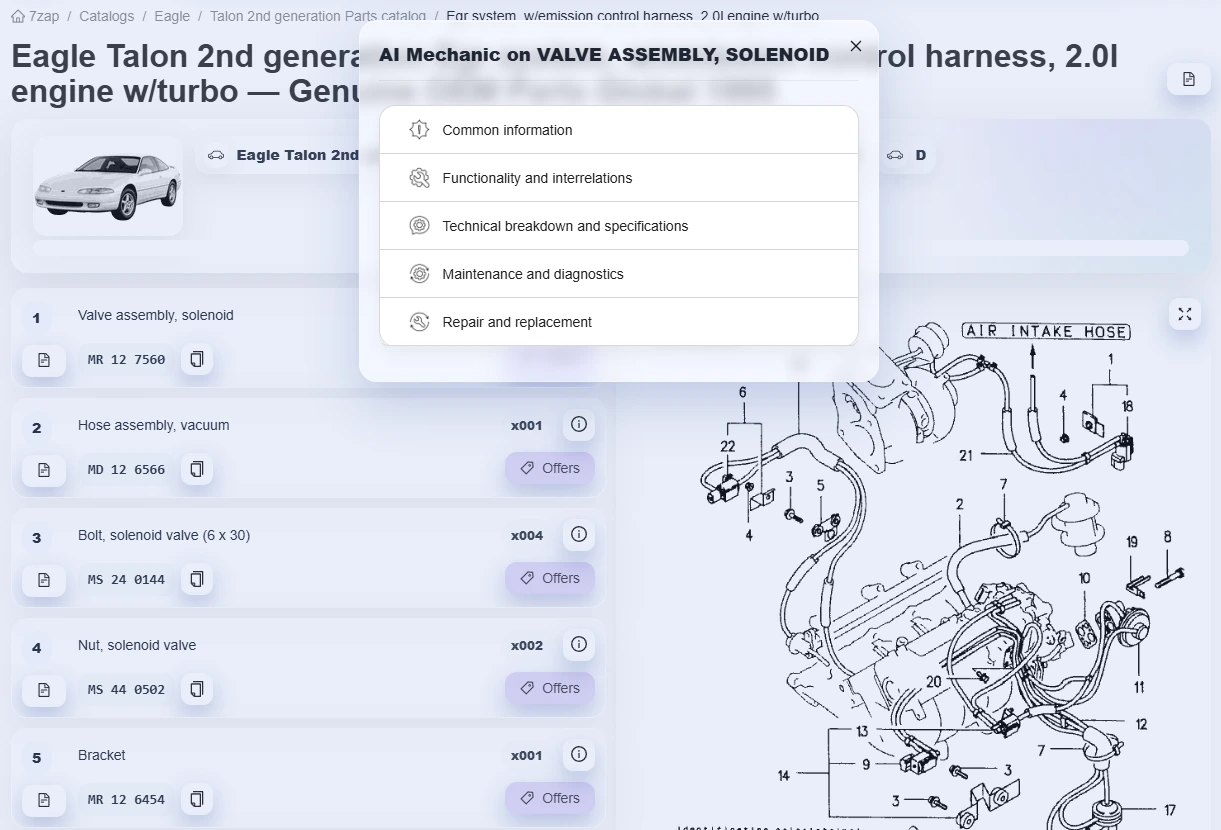
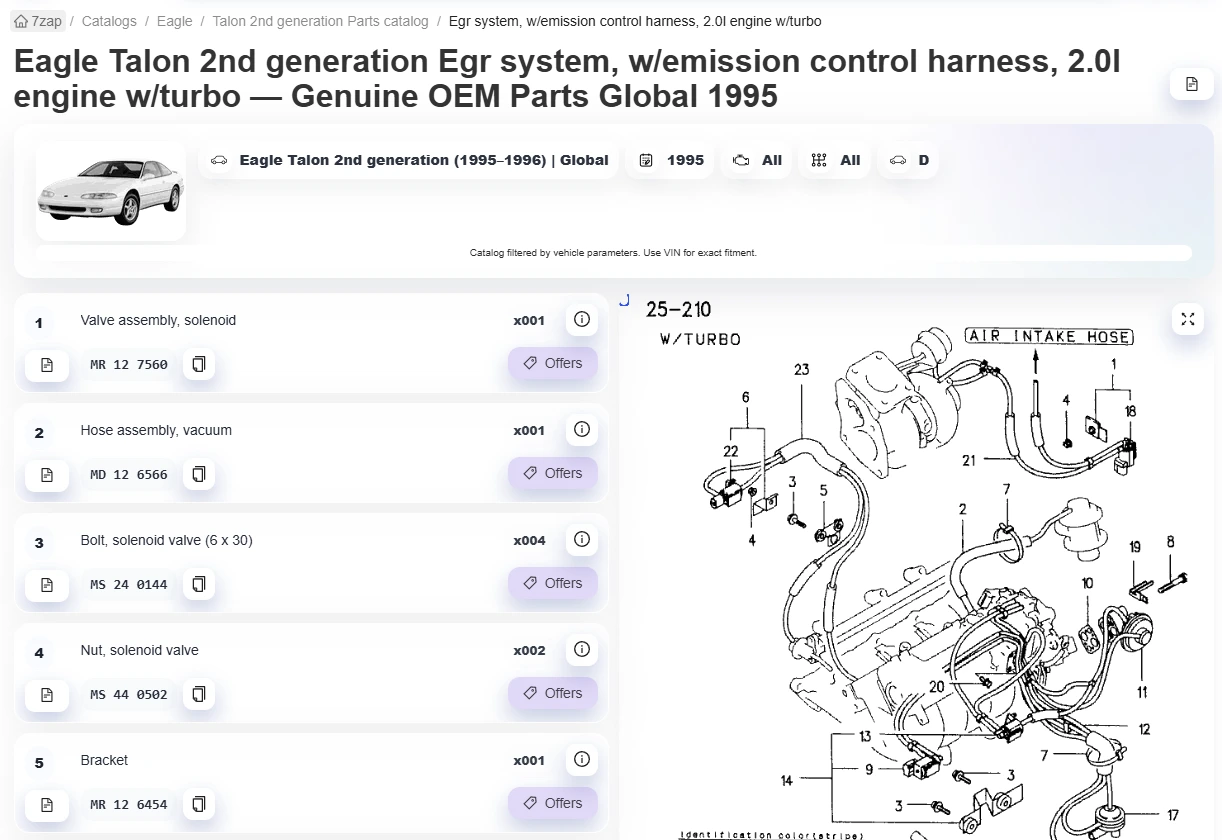
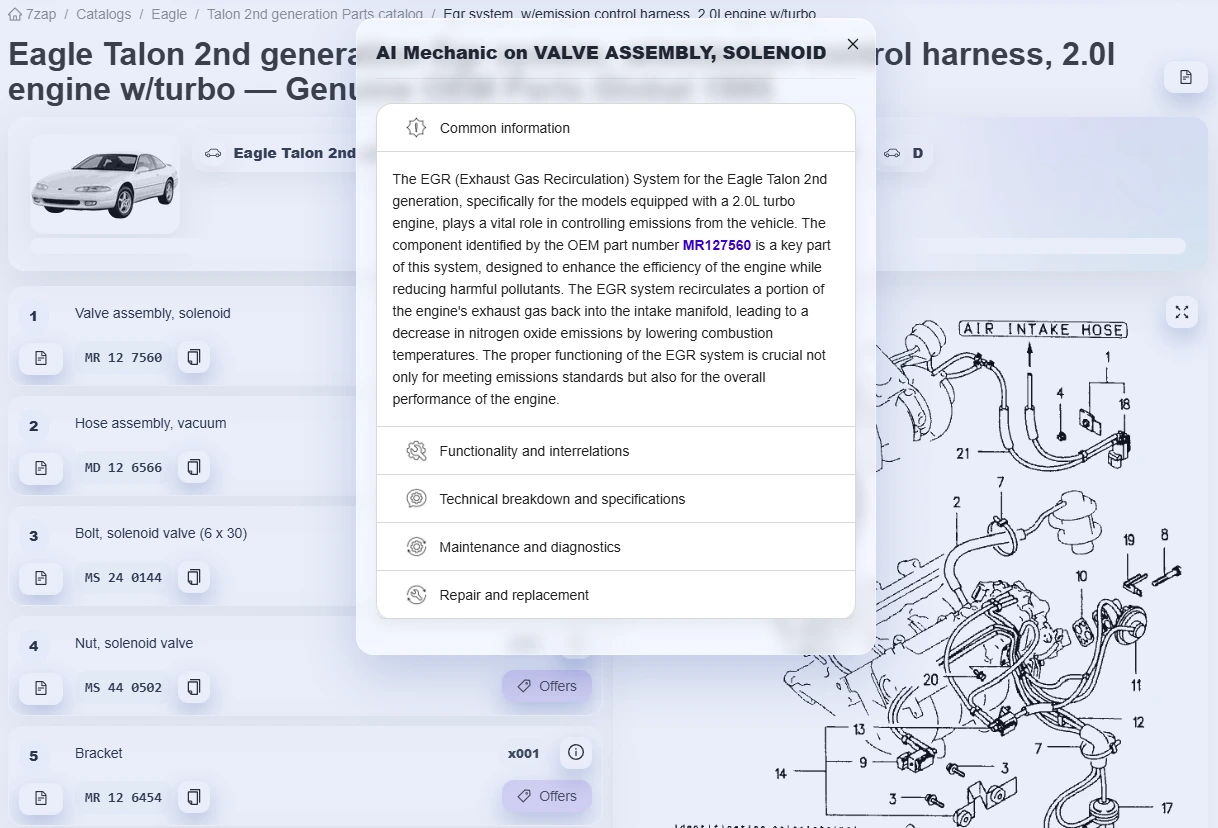
Eagle catalog preview
Screenshot
Screenshot
Screenshot
Support

FAQ

Quick answers to common questions about Eagle VIN decoding, VIN checks, and identifying older Eagle vehicles accurately.

VIN decoders for other brands

Decode VINs for other manufacturers with the same level of accuracy and OEM-based data.