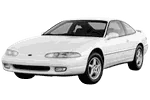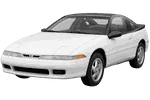

Decode your Eagle VIN to find factory specifications, build options, and exact OEM part compatibility.
This Eagle car parts catalog provides a structured reference for the Talon generations displayed above. Available entries include the Talon 1st generation (1989–1994) and Talon 2nd generation listings covering 1995–1996 and 1995–2000. Select the entry that corresponds most closely to the vehicle being researched before opening an assembly or reviewing Eagle part numbers.
The catalog is intended for identifying components and understanding where they appear within a vehicle assembly. It can support research into Eagle OEM parts without turning a broad search for the Eagle name into unrelated results. 7zap is an independent reference catalog and is not affiliated with the vehicle manufacturer.
After choosing a displayed Talon generation, browse the available sections to locate the relevant vehicle system. Depending on the catalog entry, navigation may be organized through universal categories or manufacturer categories. These routes can help narrow a search from a broad system to a more specific assembly and its associated parts list.
An Eagle car parts diagram is particularly useful when a component name is uncertain or several nearby items appear similar. Assembly context can show how brackets, housings, fasteners, seals, and related pieces are positioned, although the diagram should not be treated as installation guidance or proof of compatibility.
An Eagle exploded view combines an illustration with numbered callouts. Each callout points to a row in the accompanying parts list; the callout itself is not necessarily an orderable part number. The corresponding row may provide an OEM number, description, quantity note, or configuration-related distinction when that information is present.
Record the full Eagle OEM part number exactly as displayed, including letters, spacing, or suffixes. It can then be compared with markings on the removed component, workshop records, or another reliable source. An OEM number is a research reference and does not by itself guarantee that a component applies to a particular car.
Begin with the generation label and production-year range shown in the catalog. The second-generation Talon appears under more than one displayed year span, so do not choose solely from the shared generation name. Review the available entry and any factory configuration choices shown after selection. Engine, transmission, equipment, and production distinctions should only be used when the catalog explicitly presents them.
Before relying on a result, compare the vehicle’s identifying details with the selected catalog path. If two parts-list rows appear similar, check their descriptions, diagram positions, notes, and number formatting rather than assuming they are interchangeable.
VIN lookup is an independent, vehicle-specific research route. It is not a factory configuration and does not select or modify one of the manually browsed Talon entries. Use manual generation navigation and VIN-based lookup separately, then compare the resulting references where appropriate.
The supplied catalog entries are for the Talon 1st generation (1989–1994) and Talon 2nd generation ranges shown above.
No. A callout directs you to a parts-list row. The OEM reference, when provided, appears in that row.
It can support identification, but catalog references alone do not confirm applicability. Verify the generation, displayed configuration details, VIN information, and physical component markings.
Catalog distinctions may reflect the configuration information presented for a vehicle entry. Compare descriptions and assembly context before drawing a conclusion.