

VIN Decoder

WiLL VIN Decoder - Free VIN Lookup

Free • 3 sec • No signup
Enter your 17-character WiLL VIN to decode model details, factory specs, and the right parts fitment for Toyota WiLL vehicles like WiLL Vi, WiLL VS, and WiLL Cypha.
✓ Identify exact WiLL model/trim from the VIN
✓ Confirm engine, transmission, and production details
✓ Use decoded data to reduce OEM parts mismatch
No registration required. Results in ~3 seconds.
Your vehicle’s WiLL vehicle identification number is its unique 17-character ID in many markets. A will vin decoder translates that code into usable details—helpful for a will vin number check, accurate parts selection, and documentation.
Overview

Decode WiLL VINs in Seconds with a Will VIN Decoder

A VIN (Vehicle Identification Number) is a standardized 17-character code defined by ISO 3779/3780 and, in the US, 49 CFR Part 565. While many Toyota WiLL vehicles were sold primarily in Japan (where chassis/frame numbers are common), imported or re-registered cars often carry a 17-character VIN. This will vin decoder helps you decode will vin data into practical specs you can trust.

The VIN is split into WMI (manufacturer/region), VDS (vehicle descriptor), and VIS (year/plant/serial). With a proper will vin number check, you can confirm model family (such as WiLL Vi / WiLL VS / WiLL Cypha), engine and transmission pairing, and production sequence—useful for a will vin decoder build sheet-style summary and fewer catalog errors. Start here or use our free VIN decoder to compare results across brands. To decode other vehicle brands with the same precision, use our VIN decoder.

Help

Where is the VIN number on a WiLL?

Common VIN locations (or ID number locations) on Toyota WiLL vehicles include:
Dashboard plate (driver’s side, visible through the windshield)
Driver’s door jamb label (VIN/weight/tire info label, if equipped)
Engine bay identification plate (on the firewall or inner fender)
Stamped number on the body/frame (varies by model and market)
Vehicle registration/title documents
Insurance documents
Service records from previous repairs
Import/Customs paperwork for JDM vehicles
Window sticker or dealer delivery paperwork (when available)
i
For a clean lookup, enter the VIN exactly as shown (17 characters, no spaces). The letters I, O, and Q are not used in VINs—if you see them, re-check the plate or documents.
Capabilities

WiLL VIN lookup: what you can learn

A WiLL VIN lookup can help confirm:
Basic vehicle identity
• Brand/line: WiLL (Toyota) • Model family and body type (where supported) • Model year code and serial range • Market/region hints from the WMI
Factory specifications (build details)
• Engine family and displacement (where available) • Transmission type and drivetrain clues • Emissions/market configuration indicators • A “will vin decoder build sheet” style summary for verification
Service & parts fitment support
• Reduced parts mismatch by validating configuration first • Better accuracy when searching OEM diagrams/groups • Faster quoting for maintenance items • A reliable starting point for will warranty check by vin or recall research (coverage varies by market)
A proper will vin decoder is most useful when paperwork is incomplete—common with imported Toyota WiLL vehicles. Decode first, then match parts by the verified configuration to reduce returns and rework. If your vehicle uses a Japanese chassis/frame number instead of a 17-character VIN, use the closest identifier available and confirm details with physical tags.
VIN anatomy

How the WiLL VIN number is structured

A 17-character VIN is typically split into three blocks that identify the maker, the vehicle description, and the production sequence.
WMI (positions 1–3)
The WMI (World Manufacturer Identifier) shows the manufacturer and region. For Toyota-built WiLL vehicles, the VIN may use Toyota WMIs such as JTD (Japan passenger cars) or other JT* codes depending on vehicle class. This block is the foundation for a correct will vin number check because it anchors the decoder to the right manufacturer family.
VDS (positions 4–9)
The VDS (Vehicle Descriptor Section) describes the vehicle’s core configuration. Depending on the market and how the VIN was assigned, it can encode body style, engine series, restraint system, and other descriptors. Position 9 is the check digit in many VIN systems, used to validate that the VIN is mathematically consistent.
VIS (positions 10–17)
The VIS (Vehicle Identifier Section) includes the model year code (position 10), plant/assembly code (position 11), and the sequential production number (positions 12–17). This is where a will vin decoder can often distinguish between similar configurations and support a build sheet-style view for parts and documentation.
Manufacturing

Major production plants associated with Toyota WiLL vehicles

WiLL was a Toyota-origin sub-brand primarily produced for the Japanese market. Depending on model and year, production can be tied to Toyota’s Japan manufacturing network and affiliated group plants.
Takaoka Plant (Toyota Motor Corporation)
Toyota City, Aichi, Japan (1966–present)
Motomachi Plant (Toyota Motor Corporation)
Toyota City, Aichi, Japan (1959–present)
Tsutsumi Plant (Toyota Motor Corporation)
Toyota City, Aichi, Japan (1970–present)
Tahara Plant (Toyota Motor Corporation)
Tahara, Aichi, Japan (1979–present)
Toyota Auto Body Fujimatsu Plant
Kariya, Aichi, Japan (1962–present)
Toyota Auto Body Inabe Plant
Inabe, Mie, Japan (1993–present)
Toyota Motor Kyushu – Miyata Plant
Miyawaka, Fukuoka, Japan (1992–present)
Toyota Motor Kyushu – Kanda Plant
Kanda, Fukuoka, Japan (2008–present)
Kanto Auto Works (historical) / Toyota Motor East Japan – Higashi-Fuji site
Susono, Shizuoka, Japan (1967–2020)
Toyota Motor East Japan – Miyagi Plant (Ohira)
Ohira, Miyagi, Japan (2011–present)
Toyota Motor East Japan – Iwate Plant
Kanegasaki, Iwate, Japan (1993–present)
Hino Motors – Hamura Plant (Toyota Group)
Hamura, Tokyo, Japan (1963–present)
Daihatsu – Kyoto (Head Plant) (Toyota Group)
Oyamazaki, Kyoto, Japan (1963–present)
i
On a 17-character VIN, the assembly plant is typically indicated by the 11th character (plant code). Exact plant-code mappings can vary by manufacturer and market, so a will vin decoder is the most reliable way to interpret it for a specific vehicle.
Value

Benefits of Using a WiLL VIN Decoder

Practical details that help owners, shops, and parts teams work faster and avoid mistakes.
Accurate parts matching
Toyota WiLL vehicles often share platforms with other Toyota models, so small configuration differences can affect fitment. A will vin decoder helps confirm key identifiers (engine/transmission/year) before you order. That reduces wrong-part returns and saves time during repairs.
Faster service planning
Decoding the WiLL VIN helps you estimate service needs more confidently—especially for imported vehicles with limited local paperwork. Confirming the configuration supports correct fluids, filters, sensors, and belts, and helps technicians write clearer estimates and work orders.
Better documentation and resale listings
A clean will vin number check makes it easier to document what the car actually is, which is valuable for enthusiast models like WiLL VS. The decoded year/serial details also help create more accurate listings and keep records consistent across insurance and registration documents.
Build verification and compliance checks
A will vin decoder build sheet-style summary can highlight mismatches between the VIN and what’s physically on the vehicle. This is useful for spotting swapped engines, confirming imported vehicle details, and supporting recall or will warranty check by vin workflows (coverage varies by region and vehicle history).
Social proof

Trusted by WiLL Owners & Parts Professionals

Real-world feedback from owners, technicians, and parts teams using VIN decoding to verify Toyota WiLL specs.
Kenji
5
5.0
Auto Parts ManagerLos Angeles
We see imported WiLL VS cars where paperwork is inconsistent. The will vin decoder helped confirm the engine family and transmission type before ordering service parts. It cut returns and made cross-referencing Toyota part groups much faster.
Samantha
5
5.0
Service TechnicianSeattle
A customer brought in a WiLL Cypha and the trim details were unclear. After a quick will vin number check, we verified the build configuration and avoided ordering the wrong sensors. The decoded summary is clear enough to use on the work order.
Miguel
5
5.0
Independent MechanicMiami
On older JDM imports like WiLL Vi, small differences matter. Using the will vin decoder build sheet-style output, I could confirm what the car actually is before quoting repairs. It’s a solid starting point before opening up the catalog.
Aiko
5
5.0
Car EnthusiastTokyo
I collect Toyota WiLL models and I like checking authenticity. Being able to decode will vin details and see year/plant/serial info helps with documentation and resale listings. It’s quick, mobile-friendly, and doesn’t force registration.
Oliver
5
5.0
Garage OwnerToronto
For imported cars, VIN-based confirmation is critical. This will vin decoder gave us a cleaner path to identify the configuration and narrow parts selection. It’s especially helpful when the customer only has photos and a VIN, not full model paperwork.
Why premium

WiLL VIN Decoder vs Free Tools

Basic decoders often return only year/make and can struggle with niche or import-oriented vehicles. A WiLL-focused lookup aims to provide more configuration detail and better parts-catalog context when available.

How to use the decoder to find parts

Enter your 17-character WiLL VIN in the search field
Review decoded results (year, model family, engine, transmission, production identifiers)
Open the OEM catalog/diagrams based on the decoded configuration
Browse parts by group (engine, cooling, brakes, body) and confirm applicability notes
Save or share the decoded summary for the repair order or parts quote

Free vs Premium WiLL VIN Decoder

Compare feature coverage and decoding depth side-by-side.
Free
View diagrams per day
View 1 diagrams per day
VIN identifications per month for month(s)
10 VIN identifications per month for 1 month(s)
Ad-free
Full part numbers in catalogs
Applicability Of Spare Parts
Maintenance Parts
Free
View diagrams per day
View 1 diagrams per day
VIN identifications per month for month(s)
10 VIN identifications per month for 1 month(s)
Ad-free
Full part numbers in catalogs
Applicability Of Spare Parts
Maintenance Parts
Reference

WiLL WMI codes (manufacturer identifiers used on VINs)

WiLL vehicles were produced under Toyota. WMIs are the first three characters of the VIN and identify the manufacturer and region; WiLL VINs typically use Toyota-related JT* / JTD identifiers depending on vehicle class and market.
Examples

WiLL VIN examples (how decoding looks)

These examples illustrate how a will vin decoder can read a 17-character VIN. Actual decoded fields can vary by market, model year, and how the VIN was assigned for import/registration.
JTDKT123610012345
WiLL Vi, compact hatchback, FWD, gasoline I4 (Toyota-family configuration)
WMIJTD = Toyota Motor Corporation (Japan) passenger car allocation
Check digitPosition 9: 6 (check digit character)
Model year (position 10)Position 10: 1 = 2001
Plant code (position 11)Position 11: 0 (plant code varies by mapping)
WiLL Vi was sold mainly in Japan; some imported vehicles use a 17-character VIN for registration.

WiLL VIN preview

A quick look at decoded VIN details and how the OEM catalog can organize parts groups based on the decoded configuration.
WiLL VIN preview
Decoded preview
VIN
JTDVS45683T234567
Brand
WiLL (Toyota)
Model
WiLL VS
Year
2003
Production date
2003-06
Engine
1ZZ-FE (1.8L gasoline I4)
Transmission
4-speed automatic (U341E)
WiLL catalog preview
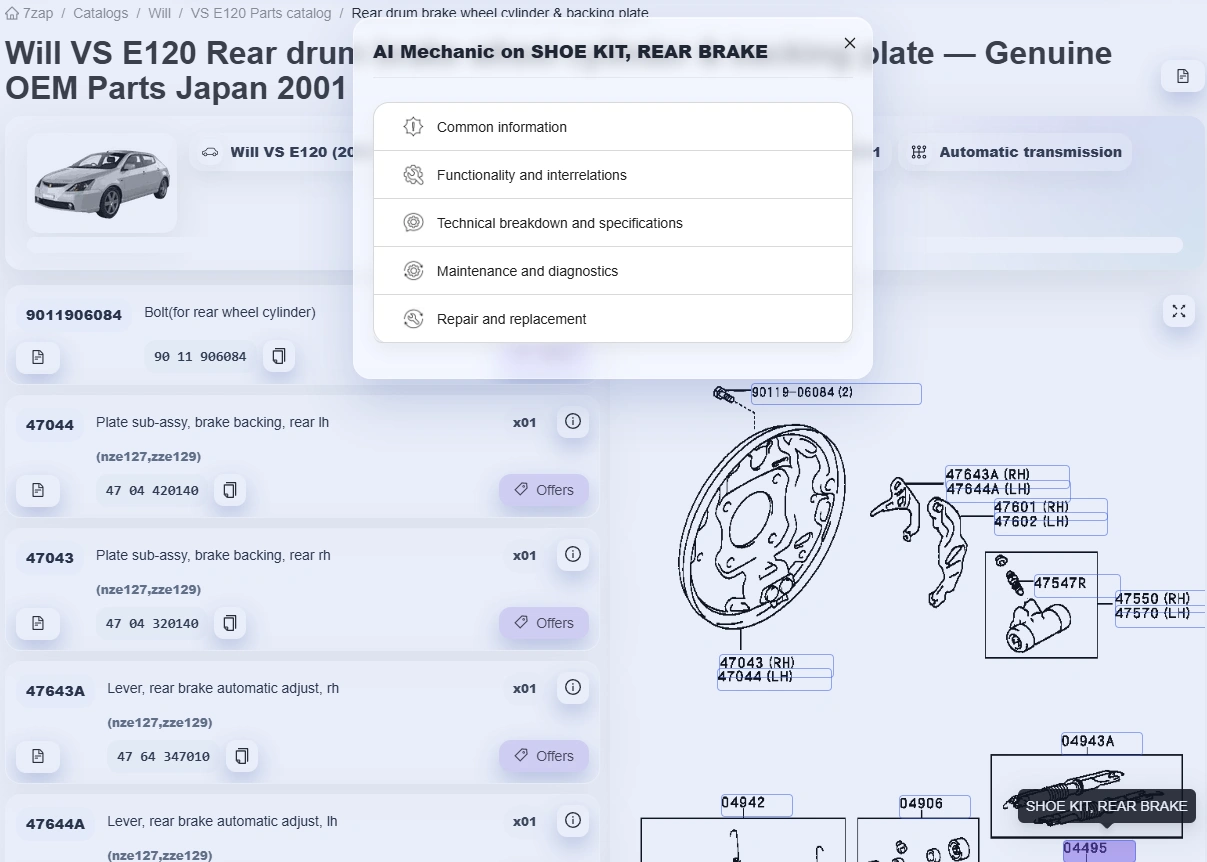
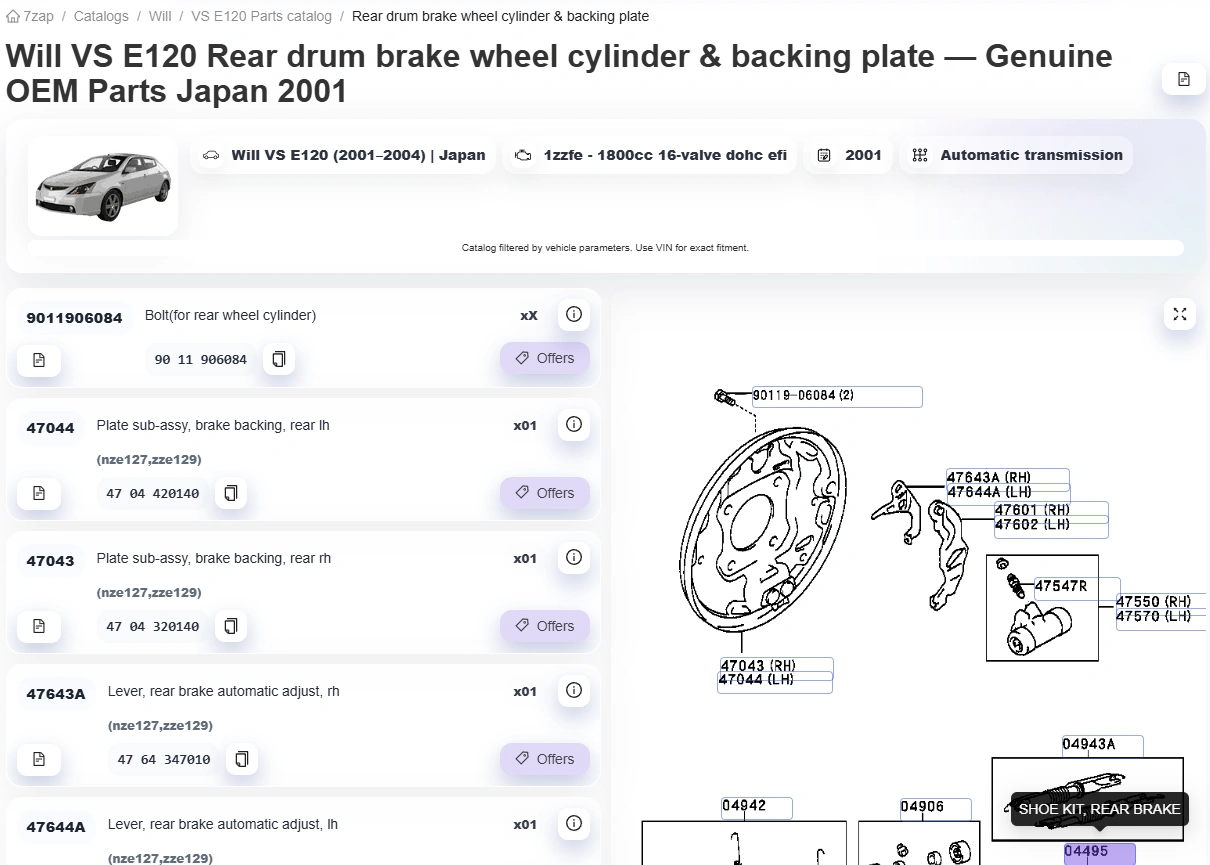
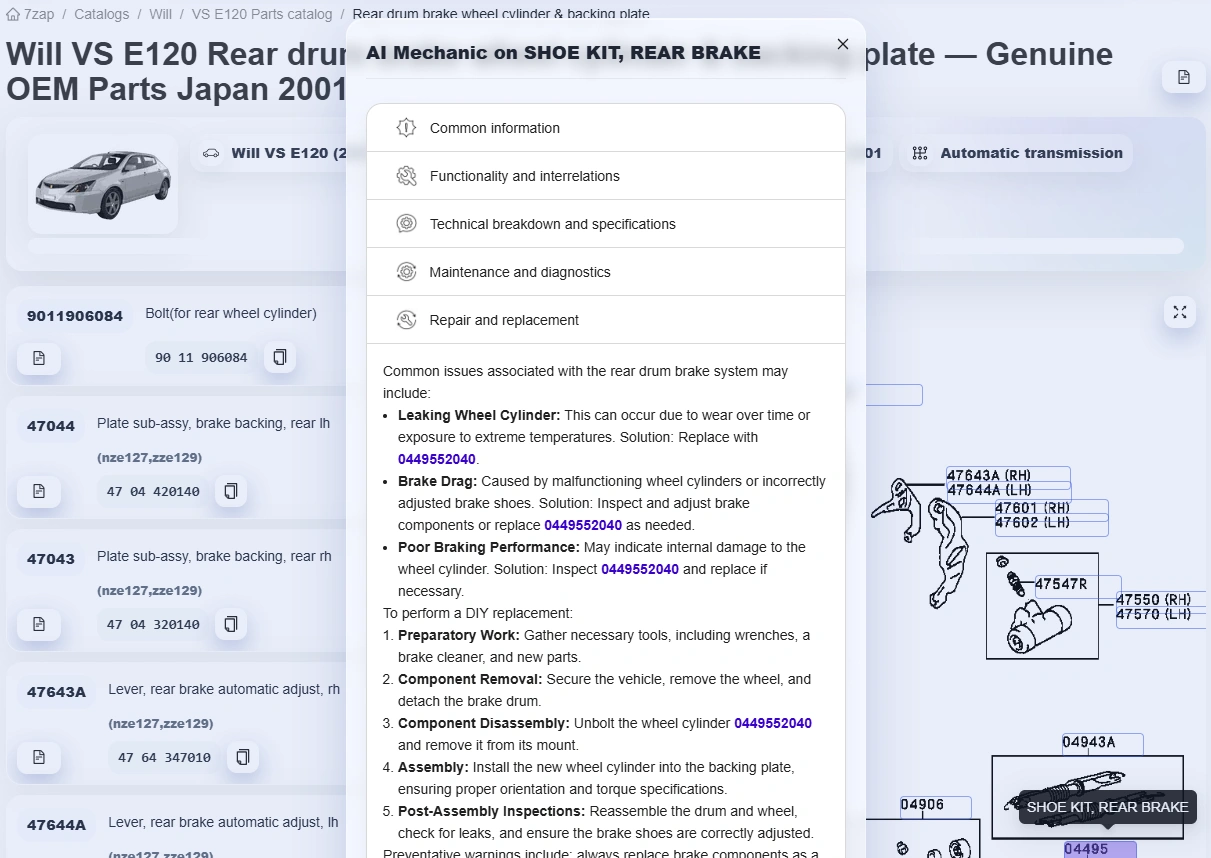
Example 7zap catalog interface
Example 7zap assembly interface
Example 7zap parts interface
Support

FAQ

Quick answers to common questions about WiLL VIN decoding and VIN checks.

VIN decoders for other brands

Decode VINs for other manufacturers with the same level of accuracy and OEM-based data.