
VIN Decoder

Seat VIN Decoder - Free VIN Lookup

Free • 3 sec • No signup
Enter your 17-character Seat VIN to decode the exact model, production details, engine/transmission codes, and factory options for accurate parts matching.
✓ Identify the exact Seat model, configuration, and production date
✓ Reveal engine & gearbox codes plus factory PR equipment options
✓ Reduce parts-order mistakes with VIN-accurate catalog results
No registration required. Results in ~3 seconds.
Every Seat has a unique 17-character identifier called a VIN. A Seat VIN decoder turns that code into practical data you can use for repairs, parts, and documentation. Use our seat vin decoder free lookup to verify your seat vehicle identification number before ordering OEM parts or comparing vehicle specs.
Overview

Decode Your Seat VIN in Seconds

A Vehicle Identification Number (VIN) is a standardized identifier defined by ISO 3779/3780 and, for US-compliant vehicles, by 49 CFR Part 565. Your Seat VIN is split into three blocks: WMI (who built it), VDS (what it is), and VIS (the vehicle’s unique serial and plant info). A reliable vin decoder Seat lookup helps confirm the exact configuration—especially important on Volkswagen Group platforms where similar models may use different engines, gearboxes, or PR option codes.

With 7zap you can decode Seat VIN data to support a Seat VIN number check for parts compatibility, service planning, and documentation. Depending on market and model year, you may see region-specific encoding (for example, some EU VINs don’t strictly encode model year the same way as US VINs). Start here with our free VIN decoder and use the results as a Seat VIN decoder build sheet reference, including engine/transmission codes and equipment (PR) codes. To decode other vehicle brands with the same precision, use our VIN lookup.

Help

Where is the VIN number on a Seat?

Common VIN locations on Seat vehicles include:
Dashboard (driver’s side, visible through the windshield)
Driver’s door jamb / B-pillar label (VIN sticker and tire pressure info)
Engine bay (stamped on the bulkhead/firewall or strut tower area, varies by model)
Front radiator support / slam panel (on some models, label or stamping)
Trunk/spare wheel well (label near the spare tire area on some Seat hatchbacks/sedans)
Service booklet / maintenance record section (often includes VIN and PR code stickers)
Vehicle registration and title documents
Insurance documents
Original window sticker or dealer delivery paperwork (if available)
i
For a clean lookup, enter the VIN exactly as shown (17 characters, no spaces). VINs never use the letters I, O, or Q, which helps avoid common typing mistakes.
Capabilities

Seat VIN lookup: what you can learn

A Seat VIN lookup can help confirm:
Basic vehicle identity
• Manufacturer (WMI) and vehicle line • Model/series and body configuration • Production date or build period (when available) • Market/region indicators (varies by model year)
Factory specifications
• Engine code and displacement • Transmission/gearbox code and drivetrain type • Paint and interior codes (when available) • PR equipment codes (factory-installed options and packages)
Service & parts data
• Correct part selection by configuration • Compatibility checks for brakes, suspension, sensors, and electronics • Better accuracy for quotes and repair planning • A starting point for warranty/recall discussions with a dealer
A proper Seat VIN number check is most useful when you’re ordering parts, verifying a used car, or matching service procedures to an exact configuration. Because Seat shares platforms and components across Volkswagen Group, a small code difference can change the correct part. Decoding the VIN plus PR codes helps reduce guesswork and improves first-time-fit.
VIN anatomy

How the Seat VIN number is structured

Most modern Seat VINs are split into three blocks (WMI, VDS, and VIS). The exact meaning of some positions can vary by market and model year.
WMI (positions 1-3)
The WMI identifies the manufacturer and region. For Seat, the VIN commonly starts with VSS, which indicates SEAT S.A. in Spain. This is the quickest way to confirm you’re decoding a Seat vehicle identification number rather than a similar Volkswagen Group model from another brand. On imports, verifying the WMI is a good first step before any parts ordering.
VDS (positions 4-9)
The VDS describes the vehicle type and key attributes set by the manufacturer—model family, body style, restraint system, and other internal identifiers. Many European Seat VINs use filler characters such as Z in this block (for example, ZZZ), and the 9th character may not be used as a check digit outside North America. The decoder combines these characters with manufacturer data to identify the exact configuration.
VIS (positions 10-17)
The VIS contains the vehicle’s unique identity—often including model year (position 10 for US-standard VINs), assembly plant code (position 11), and a production sequence number. For some EU-market Seat VINs, position 10 may not map cleanly to the US model-year table, so the decoded year is best confirmed using production-date data and manufacturer catalogs. This is where a detailed Seat VIN decoder is especially helpful.
Manufacturing

Major production plants

Seat vehicles are primarily linked to Spanish production, but several Seat-branded models have been assembled across Volkswagen Group facilities depending on model and generation.
SEAT Martorell Plant
Martorell (Barcelona), Spain — 1993–present
SEAT Zona Franca Plant
Barcelona, Spain — 1953–1993 (vehicle assembly); 1993–present (stamping/components)
SEAT Components Plant (Gearboxes)
El Prat de Llobregat (Barcelona), Spain — 1979–present
Volkswagen Autoeuropa
Palmela (Setúbal), Portugal — 1995–present (Seat Alhambra assembled 1996–2020)
Volkswagen Wolfsburg Plant
Wolfsburg, Germany — 2018–present (Seat Tarraco assembly)
Volkswagen Bratislava Plant
Bratislava, Slovakia — 2011–2020 (Seat Mii assembly)
Škoda Kvasiny Plant
Kvasiny, Czech Republic — 2016–present (Seat Ateca assembly)
Škoda Mladá Boleslav Plant
Mladá Boleslav, Czech Republic — 2012–2019 (Seat Toledo IV assembly)
Volkswagen Navarra (Landaben) Plant
Pamplona (Navarra), Spain — 1984–1992 (Seat-badged Polo era); 1992–present (VW Group small cars)
Volkswagen Zwickau Plant
Zwickau, Germany — 2021–present (VW Group MEB production; CUPRA/Seat-related programs)
i
The assembly plant is typically referenced in the VIN’s 11th character (plant code), but the exact mapping depends on market and manufacturer rules. If the VIN is EU-market, some characters may be used as internal identifiers; a decoder that reads manufacturer data is the most reliable way to confirm the build location.
Value

Benefits of Using a Seat VIN Decoder

Practical, shop-friendly details that reduce mistakes and save time on repairs and parts selection.
Accurate parts matching
Seat models often share platforms and components across Volkswagen Group, but PR codes and engine/gearbox codes can change the correct part. A Seat VIN decoder helps confirm the exact configuration so you can order compatible brakes, sensors, filters, and drivetrain components with confidence.
Faster diagnostics and service planning
Decoding helps technicians verify the correct engine family, transmission type, and production date, which can influence service procedures and technical bulletins. It’s especially useful when similar Seat trims use different electronics or emissions equipment within the same model year range.
Better used-car verification
A Seat VIN number check supports ownership decisions by confirming model details and factory configuration. It can help spot inconsistencies in listings (engine type, trim level, drivetrain) and provides a clearer baseline before you purchase history reports or schedule a pre-purchase inspection.
Clear documentation and resale details
For insurance, registration, or resale listings, VIN-decoded specifications help you document the vehicle accurately. When you can reference the correct build details, you reduce disputes about trim, equipment, or drivetrain, and you present a more professional, trustworthy listing.
Social proof

Trusted by Seat Owners & Professionals

Feedback from owners, technicians, and parts teams who use VIN decoding to verify specs and order the right components.
Sergio
5
5.0
Independent MechanicSan Diego
I used the Seat VIN decoder to confirm an Ibiza’s engine code before ordering a timing kit. The decoded engine and transmission info matched the vehicle perfectly and saved me from returning incorrect parts. The PR equipment list is also great for checking brakes and interior variants.
Hannah
5
5.0
Auto Parts ManagerToronto
Customers often bring in a Seat VIN from imported vehicles, and trim details can be confusing. This tool makes a Seat VIN number check straightforward by showing production date and drivetrain details. It reduces back-and-forth and improves first-time-fit on common service items.
Marcos
5
5.0
Service TechnicianBarcelona
For Leon and Ateca repairs, small option differences matter. Decoding PR codes helps me confirm the exact equipment package and avoid mismatched sensors or steering components. It’s a practical VIN decoder Seat solution when you need shop-accurate configuration data quickly.
Emily
5
5.0
Car EnthusiastAustin
I wanted a Seat VIN decoder build sheet view to understand what my car left the factory with. The decoded options and codes were easy to read and helped me plan upgrades while keeping compatibility in mind. It’s also useful for verifying details when buying used.
Tomasz
5
5.0
Garage OwnerChicago
We see European-market Seats where the 10th VIN character doesn’t always map cleanly to the model year like US vehicles. The decoder still pulls usable manufacturer data—engine, gearbox, and build timing—so we can quote repairs and order parts with less risk.
Why premium

Seat VIN Decoder vs Free Tools

Basic decoders often return only generic year/make/model. A Seat-focused decoder goes deeper by resolving engine and gearbox codes and translating PR equipment codes into usable configuration data for parts and service.

How to use the decoder to find parts

Enter your 17-character VIN (no spaces) into the Seat VIN decoder search field
Review the decoded results: model, production date, engine code, and transmission code
Open the OEM catalog view to navigate assemblies and part groups for your exact build
Use PR codes (equipment options) to confirm option-dependent parts (brakes, infotainment, sensors, trim)
Cross-check part numbers and notes before ordering to ensure compatibility

Free vs Premium Seat VIN Decoder

Compare plans feature-by-feature to choose the level of detail you need.
Free
View diagrams per day
View 1 diagrams per day
VIN identifications per month for month(s)
10 VIN identifications per month for 1 month(s)
Ad-free
Full part numbers in catalogs
Applicability Of Spare Parts
Maintenance Parts
Free
View diagrams per day
View 1 diagrams per day
VIN identifications per month for month(s)
10 VIN identifications per month for 1 month(s)
Ad-free
Full part numbers in catalogs
Applicability Of Spare Parts
Maintenance Parts
Reference

Seat WMI codes (manufacturer identifiers)

WMIs are the first three characters of the VIN. Seat vehicles commonly use a single primary WMI (VSS). Depending on how a vehicle was built and certified for a specific market, you may also encounter related Volkswagen Group patterns during decoding, but VSS is the key Seat identifier.
Examples

Realistic Seat VIN examples

Examples below show how a Seat VIN can be interpreted. Note: on some EU Seat VINs, model-year encoding may not strictly follow the North American year table, so production-date data can be more reliable.
VSSZZZ6KZ3R001105
Cordoba/Vario, 1.4L petrol (AUA), 5-speed manual (FFH), FWD
WMIVSS = SEAT S.A. (Spain)
Check digitPosition 9: Z (EU-market, may not be a validated check digit)
Model year (position 10)Position 10: 3 (EU internal; vehicle built 2002 per production data)
Plant code (position 11)Position 11: R (plant code used by manufacturer data; commonly associated with Spanish builds)
This example illustrates why a Seat VIN decoder should use production-date and PR-code data, not only the 10th character, to confirm year and configuration.

Seat VIN preview

A quick look at decoded Seat VIN details—use this preview to verify key specs before you browse the OEM parts catalog.
Seat VIN preview
Decoded preview
VIN
VSSZZZ6KZ3R001105
Brand
Seat
Model
Cordoba/Vario (SEAT)
Year
2002
Production date
01.07.2002
Engine
AUA - 1.40L 4-cyl 75HP Petrol
Transmission
FFH - 5-speed Manual
Seat catalog preview
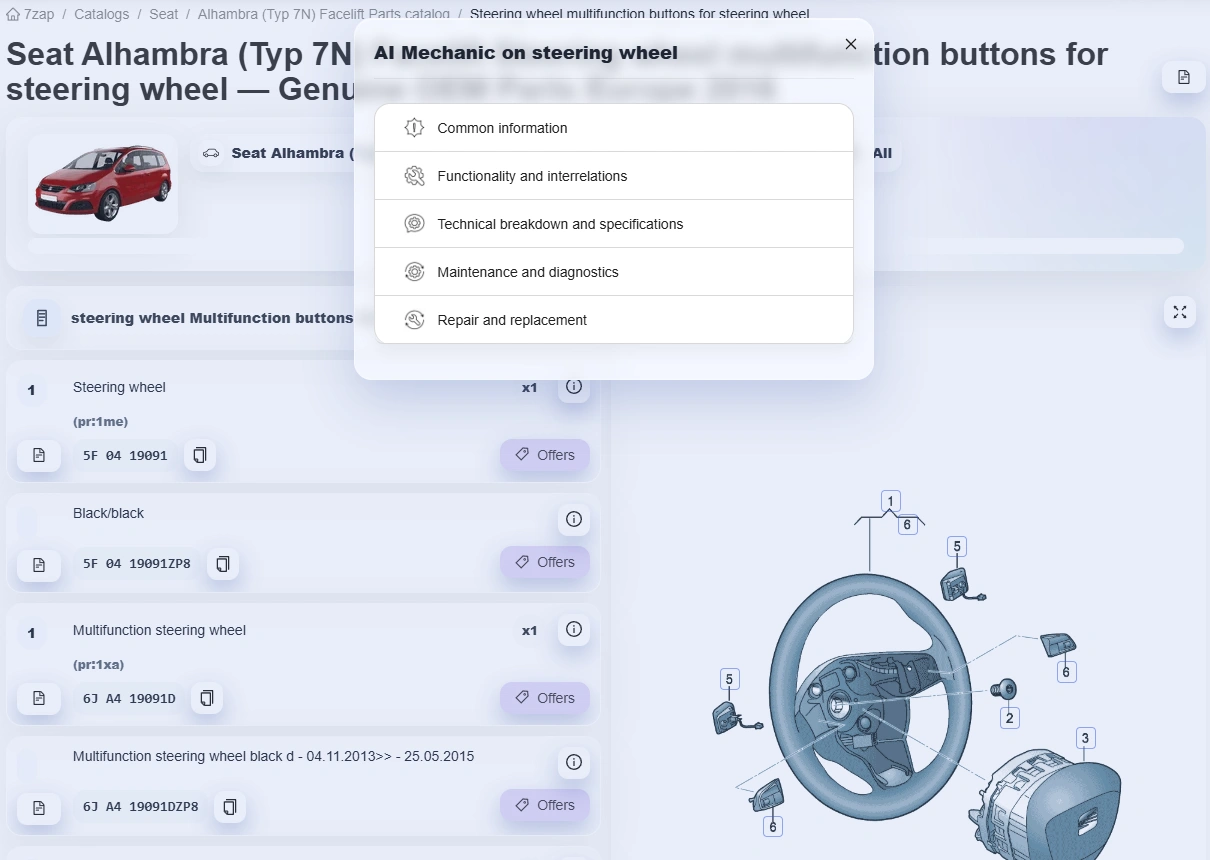
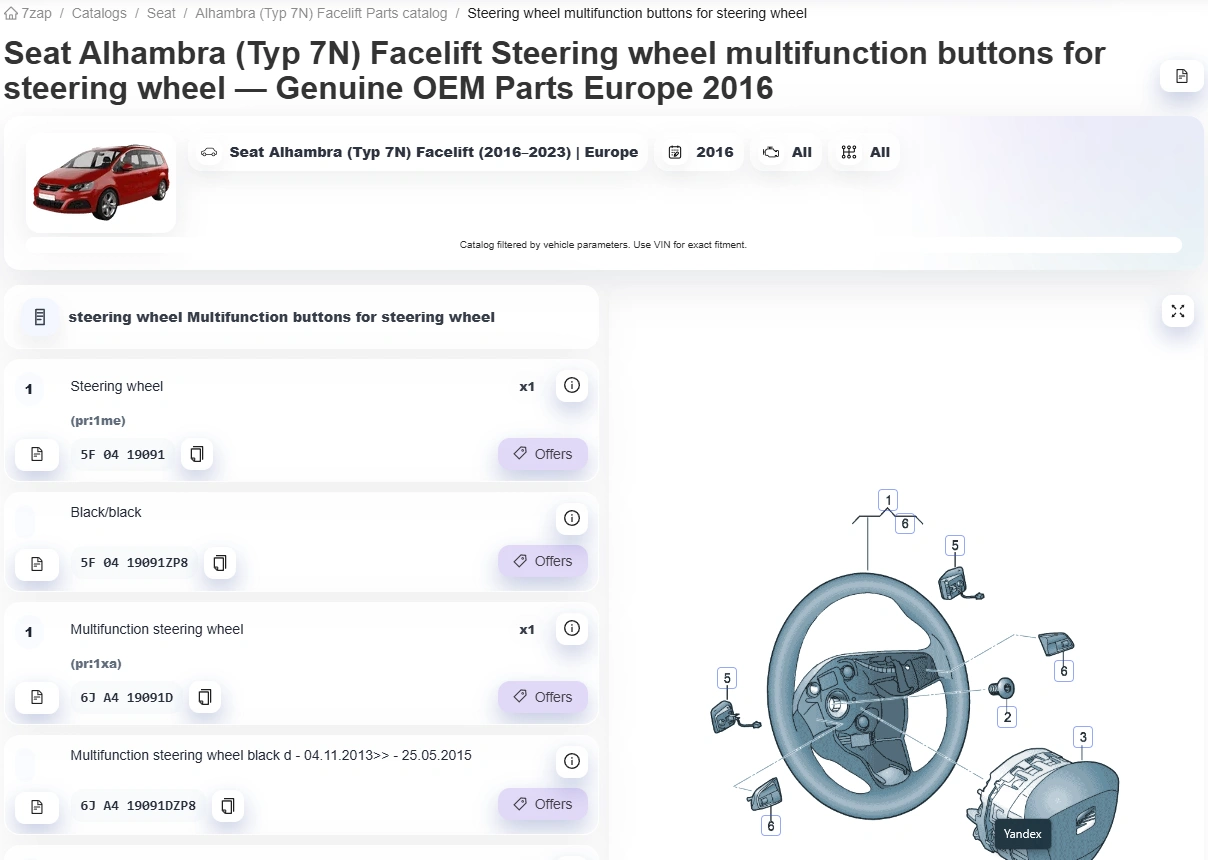
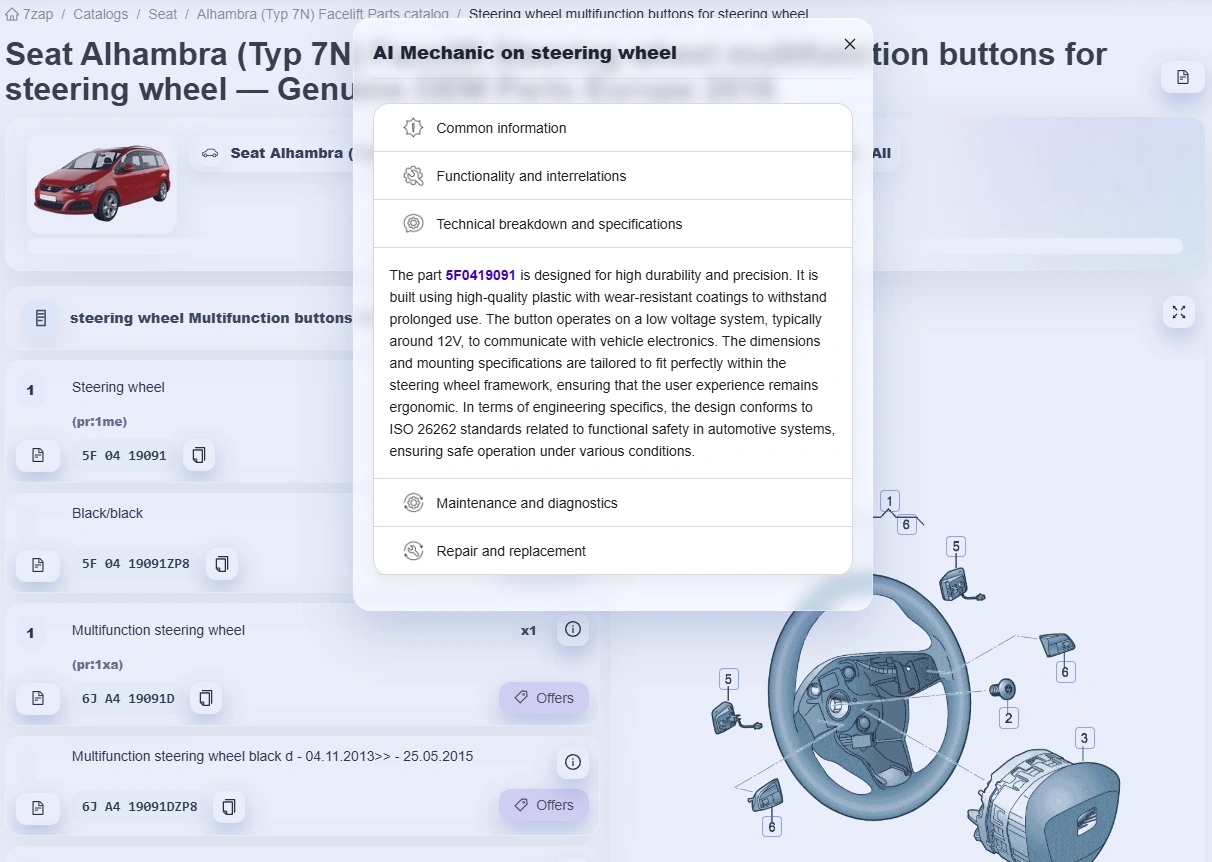
Example 7zap catalog interface
Example 7zap assembly interface
Example 7zap parts interface
Support

FAQ

Quick answers to common questions about Seat VIN decoding and VIN-based parts lookups.

VIN decoders for other brands

Decode VINs for other manufacturers with the same level of accuracy and OEM-based data.