

VIN Decoder

Subaru VIN Decoder

Free • 3 sec • No signup
Enter your 17-character Subaru VIN to instantly confirm the exact model, trim, engine, drivetrain, and key factory specifications—then use the results for parts matching and documentation.
✓ Accurate model, trim & drivetrain identification
✓ Factory specs for service and parts compatibility
✓ Quick authenticity checks before buying or repairing
No registration required. Results in ~3 seconds.
Every Subaru has a unique 17-character identifier called a VIN. A Subaru VIN decoder translates that code into practical vehicle details—so a Subaru VIN lookup helps owners, technicians, and parts teams verify the exact configuration and reduce ordering mistakes.
Overview

Subaru VIN Decoder: Decode Your Subaru VIN in Seconds

A Vehicle Identification Number (VIN) is a standardized 17-character code defined by ISO 3779/3780 and, in the U.S., regulated by 49 CFR Part 565. A Subaru VIN decoder reads that code to identify the manufacturer (WMI), the vehicle descriptor (VDS), and the serial/production block (VIS). In practice, this means a single Subaru VIN lookup can confirm the correct platform, engine family, body style, and drivetrain (including Subaru’s well-known symmetrical AWD setups).

Use this vin decoder Subaru tool when buying used, verifying originality, or matching parts—especially when trims are visually similar (for example, comparing Outback vs Legacy variants, or different Forester generations). For deeper results, try a Subaru VIN number lookup that can surface build-level details and catalog links, similar to a Subaru VIN decoder build sheet workflow. Start here: free VIN decoder—then decode Subaru VIN results to confirm fitment before ordering.

Help

Where is the VIN number on a Subaru?

Common Subaru VIN locations include:
Dashboard plate (driver side, visible through the windshield)
Driver door jamb / B-pillar label (VIN sticker with tire and loading info)
Engine bay (VIN plate or stamped identifier near firewall/strut tower, varies by model/year)
Front frame rail or apron stamping (varies by platform and market)
Vehicle registration and title paperwork
Insurance policy/card documents
Service records from dealerships or independent shops
Original window sticker / buyer’s order (if available)
Owner’s manual packet (sometimes recorded by the selling dealer)
i
For a clean Subaru VIN lookup, enter the VIN exactly as shown (17 characters, no spaces). The letters I, O, and Q are never used in VINs—double-check characters that can be confused with 1 or 0.
Capabilities

Subaru VIN lookup: what you can learn

A Subaru VIN lookup can help confirm:
Basic vehicle identity
Make/brand (Subaru) Model family (e.g., Outback, Forester, Impreza, Crosstrek) Model year code and market/region clues Body type and drive type indicators when available
Factory configuration details
Engine displacement/family (e.g., 2.5L variants) Transmission type (manual/automatic/CVT where supported) Trim/grade identifiers (helps when badges are missing) Left-hand drive vs right-hand drive (market dependent)
Ownership, service, and parts workflow support
Helps verify authenticity before purchase Improves parts matching for maintenance and repairs Supports documentation for recalls, insurance, and resale Creates a reliable starting point for a build-sheet style review when catalog data is available
A good Subaru VIN decoder is most useful when you need to verify what the car actually is—not what it appears to be. Use it before ordering parts, scheduling service, or buying a used vehicle. For popular models, a Subaru Outback VIN decoder or Subaru Forester VIN decoder check can quickly confirm drivetrain, engine family, and trim so you avoid mismatched components.
VIN anatomy

How the Subaru VIN number is structured

Every modern Subaru VIN is split into three standardized blocks that work together to identify the vehicle.
WMI (positions 1–3)
The World Manufacturer Identifier tells you the manufacturer and region. Subaru WMIs commonly start with JF (Japan) or 4S (United States). For example, many Japan-built Subaru passenger cars begin with JF1 or JF2, while U.S.-built vehicles from Subaru of Indiana Automotive often start with 4S3 or 4S4. This is a key first step in any Subaru VIN lookup.
VDS (positions 4–9)
The Vehicle Descriptor Section describes attributes such as series, body type, restraint system, engine family, and other platform-specific identifiers. Position 9 is the check digit on many markets/specs, used to validate the VIN mathematically. Because Subaru uses multiple platforms and mid-cycle updates, decoding the VDS correctly is where a Subaru VIN decoder adds the most practical value.
VIS (positions 10–17)
The Vehicle Identifier Section includes the model year code (position 10), an assembly plant/production identifier (often position 11), and the sequential production number (positions 12–17). The VIN does not always encode an exact build date, but the VIS reliably identifies year and serial sequence. A Subaru VIN number lookup can also link this block to catalog and service data where available.
Manufacturing

Major Subaru production plants

Subaru manufactures and assembles vehicles and major components across several facilities. Depending on your VIN, the WMI and plant code can indicate where final assembly occurred.
Gunma Main Plant (Honko)
Ota, Gunma, Japan (1958–present)
Yajima Plant (Gunma)
Ota, Gunma, Japan (1969–present)
Kita-Ota Plant (Gunma complex)
Ota, Gunma, Japan (1980s–present)
Oizumi Plant (Powertrain)
Oizumi, Gunma, Japan (1960s–present)
Subaru of Indiana Automotive (SIA)
Lafayette, Indiana, USA (1989–present)
Subaru Thailand Manufacturing (STM)
Lat Krabang, Bangkok, Thailand (2019–present)
Chofu Plant (Aerospace manufacturing)
Chofu, Tokyo, Japan (1960s–present)
Utsunomiya Plant (Aerospace manufacturing)
Utsunomiya, Tochigi, Japan (1980s–present)
Ota Aircraft & Components facilities (Subaru Aerospace)
Ota area, Gunma, Japan (various dates–present)
Subaru powertrain machining and components lines (Gunma region)
Gunma Prefecture, Japan (various dates–present)
Tan Chong Motor Assemblies (CKD partner for Subaru, market-dependent)
Shah Alam, Selangor, Malaysia (2010s–present, market-dependent)
Regional CKD/assembly operations (market-dependent)
Various locations (varies by model/year/market)
i
On many Subaru VINs, the assembly plant identifier is found around position 11, but the exact meaning can vary by market and era. Use a Subaru VIN decoder to interpret the plant code together with the WMI, model year code, and serial range for the most reliable result.
Value

Benefits of Using a Subaru VIN Decoder

Practical, shop-friendly details that help you confirm specs, avoid mistakes, and document the vehicle correctly.
Accurate parts matching
Subaru platforms often share body styling across generations, while drivetrain and engine details can change mid-cycle. A Subaru VIN decoder helps confirm the exact variant, reducing wrong orders for brakes, filters, sensors, and drivetrain parts—especially on Outback/Legacy and Forester trims.
Faster service planning
A clean Subaru VIN lookup supports better estimates and fewer surprises. Knowing the engine family, transmission type (manual, automatic, or CVT where applicable), and drivetrain configuration helps technicians select correct fluids, service intervals, and procedures before the car is on the lift.
Used-car verification
VIN decoding is a quick authenticity check when buying used. Use a vin lookup Subaru workflow to confirm the model year and core configuration match the listing, and then compare those results with paperwork, badges, and inspection findings for added confidence.
Clear documentation and resale support
Correct VIN-based identification helps with registration paperwork, insurance, warranty/recall checks, and resale listings. A Subaru VIN number lookup also makes it easier to communicate the vehicle’s exact trim and drivetrain to buyers, service advisors, and parts departments.
Social proof

Trusted by Subaru Owners & Professionals

Feedback from owners, technicians, and parts teams using Subaru VIN lookup results in daily work.
Mika
5
5.0
Auto Parts ManagerVancouver
We use the Subaru VIN decoder to confirm trim and drivetrain before ordering. It’s especially helpful with Outback and Legacy overlap where small differences change part numbers. The Subaru VIN lookup results save us time and reduce returns.
Daniel
5
5.0
Service TechnicianDenver
On older Foresters and Imprezas, customers often don’t know the exact engine or transmission. This vin lookup Subaru flow quickly narrows the configuration so we can quote the right maintenance parts. It’s become part of my check-in routine.
Aisha
5
5.0
Independent MechanicManchester
I like how the Subaru vin number lookup confirms the basics fast, then helps with deeper details when needed. It’s useful for verifying whether a car is a true WRX variant or just has cosmetic changes. Accurate decoding prevents wrong-fit components.
Kenji
5
5.0
Garage OwnerOsaka
For Japan-built models, decoding the WMI and year code is a quick authenticity check. The Subaru VIN decoder makes it easier to document vehicles correctly and match service data. It’s also handy when comparing similar Crosstrek and Forester trims.
Sofia
5
5.0
Car EnthusiastLos Angeles
Before I bought my used Ascent, I ran a Subaru VIN lookup free check to confirm basic details, then used the full decoder view to verify options and drivetrain. It gave me confidence that the listing matched the vehicle. Clear, easy to read, and fast.
Why premium

Subaru VIN Decoder vs Free Tools

Basic tools can show year/make/model, but they often miss trim-level identifiers and catalog-ready details. A full Subaru VIN decoder is designed to reduce ambiguity and improve parts and service accuracy—especially across similar Subaru platforms.

How to use the decoder to find parts

Enter your 17-character VIN into the Subaru VIN lookup field
Review decoded results (model, year code, engine family, transmission/drivetrain)
Open the linked catalog view to browse OEM part diagrams by group
Filter parts by your exact configuration to avoid mismatches
Save or export the results for your service file or ordering reference

Free vs Premium Subaru VIN Decoder

Compare plans feature-by-feature to choose the level of detail you need.
Free
View diagrams per day
View 1 diagrams per day
VIN identifications per month for month(s)
10 VIN identifications per month for 1 month(s)
Ad-free
Full part numbers in catalogs
Applicability Of Spare Parts
Maintenance Parts
Free
View diagrams per day
View 1 diagrams per day
VIN identifications per month for month(s)
10 VIN identifications per month for 1 month(s)
Ad-free
Full part numbers in catalogs
Applicability Of Spare Parts
Maintenance Parts
Reference

Subaru WMI codes (real identifiers)

WMIs are the first three characters of the VIN. They identify the manufacturer and region. Subaru vehicles commonly use JF* identifiers for Japan-built production and 4S* identifiers for U.S.-built production.
Examples

Real Subaru VIN examples

These examples show how a Subaru VIN decoder reads WMI, check digit, model year code, and plant/serial identifiers across different years and models.
JF1GD29692G512345
Impreza family, Japan-built configuration example, AWD platform typical for the era
WMIJF1 = Subaru Corporation (Japan)
Check digitPosition 9: 9 (check digit present)
Model year (position 10)2 = 2002
Plant code (position 11)G (plant/production identifier; meaning varies by market/era)
Use a Subaru VIN lookup to confirm exact engine/trim for early-2000s vehicles where multiple variants share similar exterior cues.

Subaru VIN preview

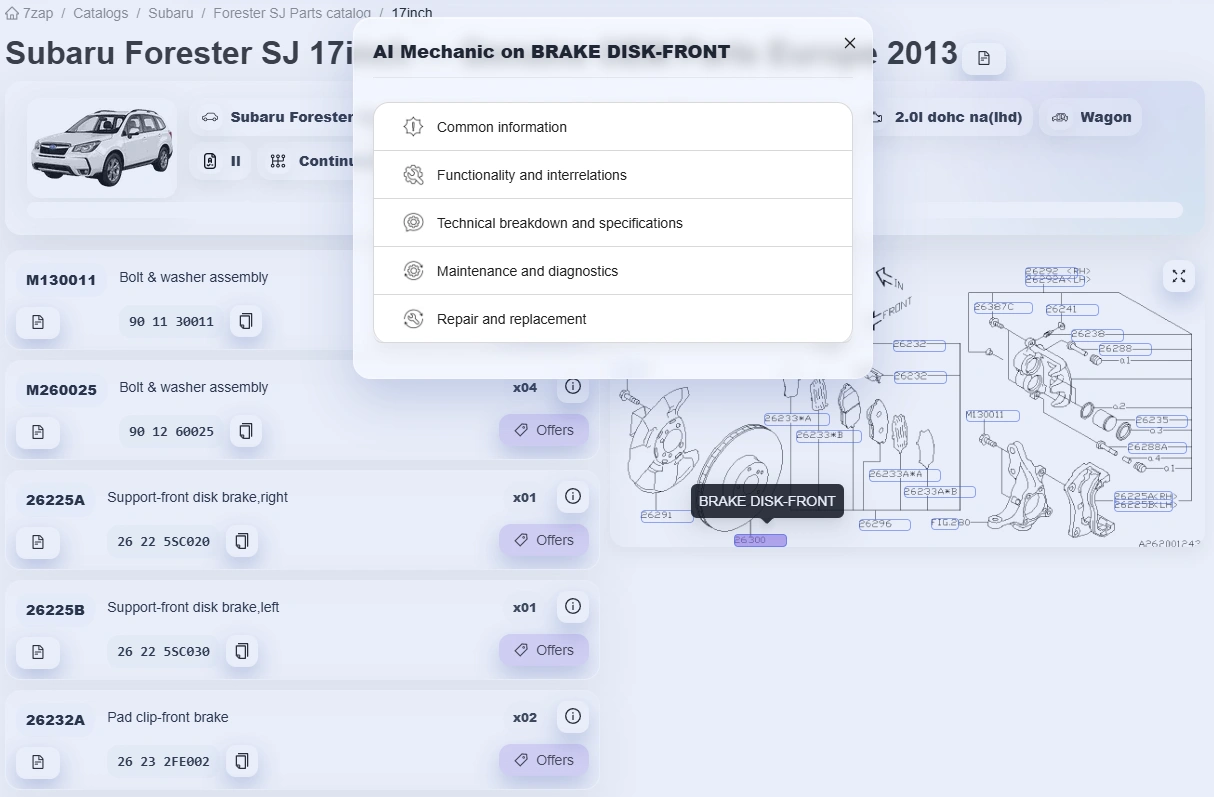
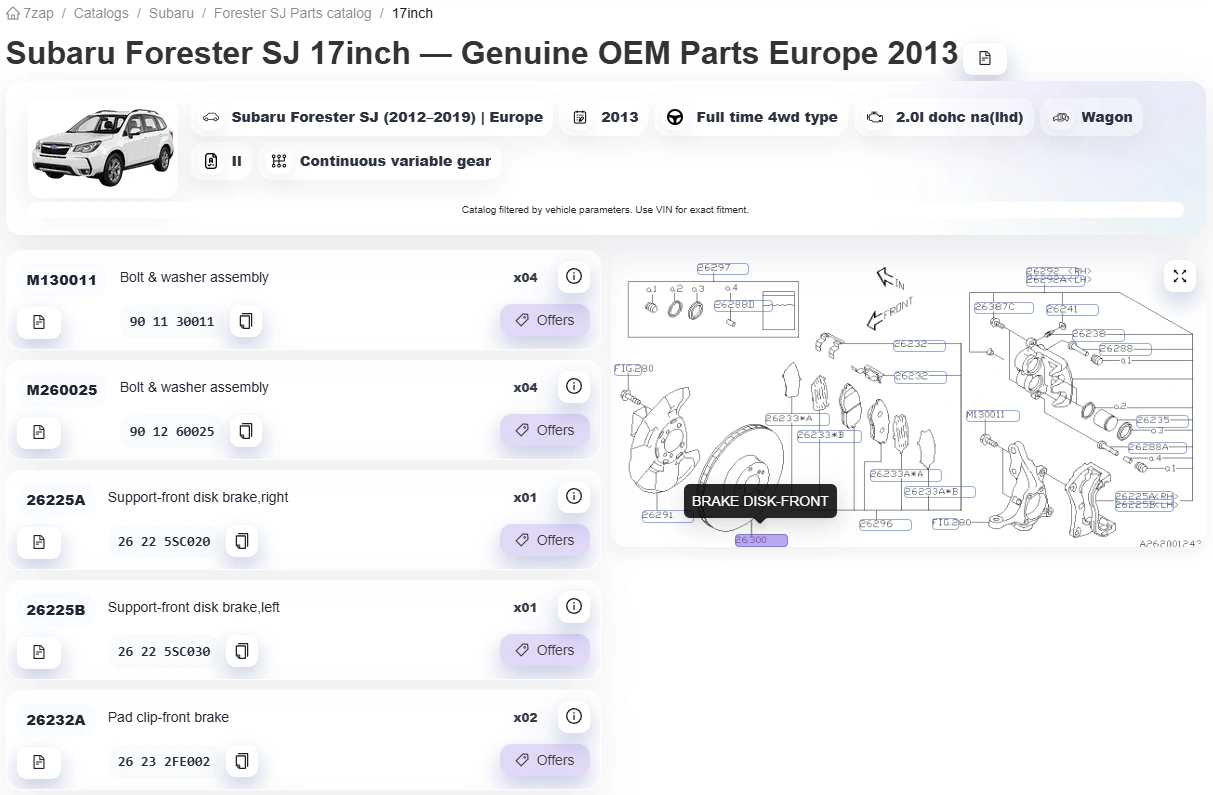
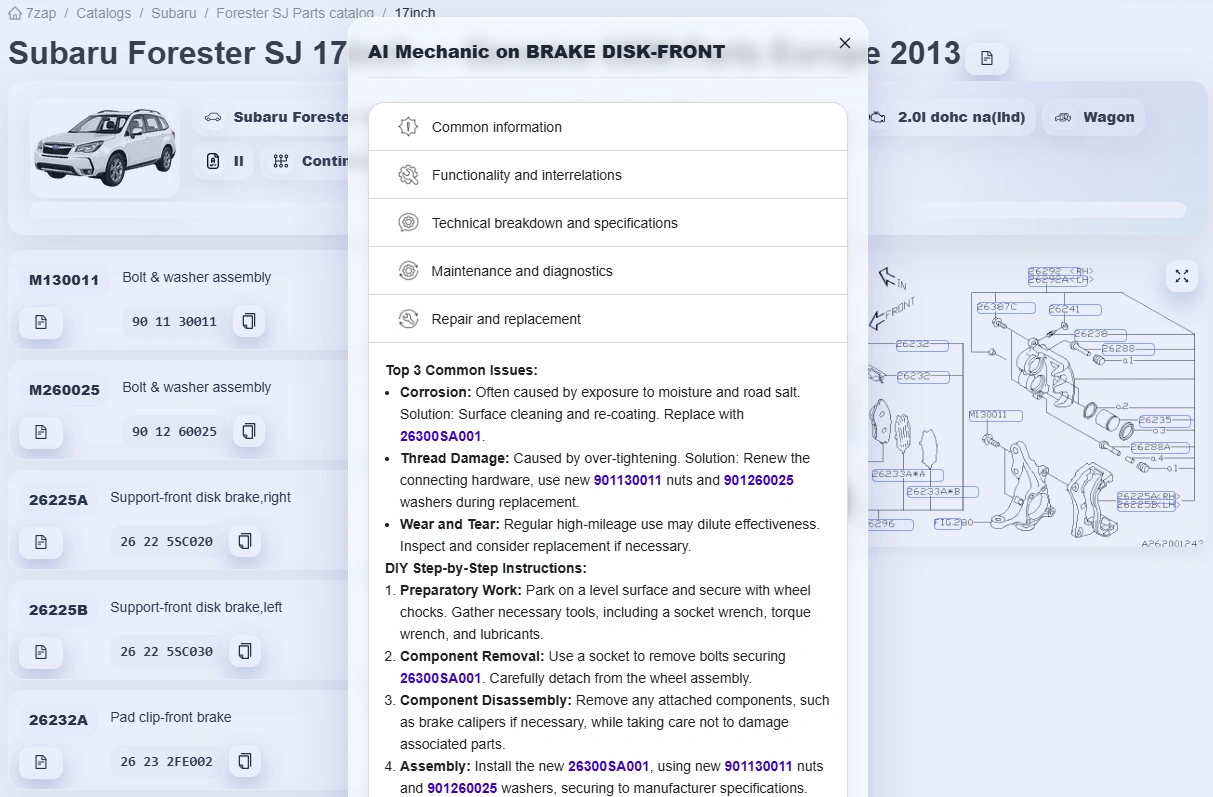
A quick look at decoded VIN details and how Subaru parts can be organized in an OEM-style catalog view.
Subaru VIN preview
Decoded preview
VIN
JF1BR9LM4AG003094
Brand
Subaru
Model
Legacy / Outback (25i, trim J20)
Year
2010 (VIN year code: A)
Production date
Not encoded in VIN (factory build data required)
Engine
2.5L 2500cc (EMPI S)
Transmission
6-speed manual
Subaru catalog preview
Screenshot
Screenshot
Screenshot
Support

FAQ

Quick answers to common questions about Subaru VIN decoding and Subaru VIN lookup tools.

VIN decoders for other brands

Decode VINs for other manufacturers with the same level of accuracy and OEM-based data.