

VIN Decoder

SsangYong VIN Decoder - Free VIN Lookup

Free • 3 sec • No signup
Enter your 17-character SsangYong VIN to decode the exact model, year, engine, transmission, production date, and matching catalog data for parts and service.
✓ Confirm exact model, trim, and market (EU/UK/KR, etc.)
✓ Identify engine and transmission codes for accurate service work
✓ Reduce parts mismatches by verifying factory configuration
No registration required. Results in ~3 seconds.
A VIN is your vehicle’s unique 17-character identifier. A SsangYong VIN decoder translates that code into real-world details—helping you decode SsangYong VIN data for maintenance, repairs, and correct parts selection with fewer costly mistakes.
Overview

SsangYong VIN Decoder: Decode Your VIN in Seconds

Every modern SsangYong vehicle identification number (VIN) follows international formatting rules such as ISO 3779/3780, and the North American VIN framework referenced in 49 CFR Part 565 (where applicable). A proper ssangyong vin number check starts by validating the VIN format (17 characters; letters I, O, and Q are not used) and then interpreting its three main blocks: WMI, VDS, and VIS.

With 7zap, you can check SsangYong VIN number details and see data points owners and workshops actually need: model family, engine code, transmission type, production date, market/region, and more—often the same essentials you’d expect from a SsangYong VIN decoder build sheet. This is especially useful for import vehicles where trims and powertrains vary by region. Start your lookup with our VIN lookup, then use the decoded output to support tasks like a ssangyong warranty check by vin (dealer verification may still be required) and parts compatibility confirmation.

Help

Where is the VIN number on a SsangYong?

Common SsangYong VIN locations include:
Dashboard plate (driver’s side, visible through the windshield)
Driver’s door jamb / B-pillar label (vehicle info sticker)
Engine bay VIN plate (often on the firewall or inner fender area)
Chassis/frame stamping (varies by model; often near front suspension/rail)
Under the front passenger seat area (inspection access varies by market)
Spare wheel well / luggage compartment floor (some SUV variants)
Vehicle registration and title documents
Insurance policy documents
Service booklet or maintenance records (dealer stamps may reference VIN)
i
For a clean lookup, enter the VIN exactly as shown (17 characters, no spaces). VINs never use the letters I, O, or Q—if you see them, re-check the plate or document.
Capabilities

SsangYong VIN lookup: what you can learn

A detailed VIN lookup can help confirm:
Basic vehicle identity
• Model family and body type • Model year and production date (when available) • Market/region specification (e.g., EU) • Manufacturer identifier (WMI) and serial range
Factory powertrain & specification clues
• Engine code and displacement/fuel type (where supported) • Transmission type (manual/automatic, code when available) • Drivetrain notes (FWD/AWD/4WD when available) • Emissions/market configuration indicators (varies by VIN data source)
Parts & service-friendly data
• Compatibility checks for parts selection and catalog navigation • Production timing to choose correct supersessions/updates • Equipment/option hints for trim-dependent components • Better accuracy for workshop estimates and documentation
A SsangYong VIN lookup is most useful when you’re matching parts, validating an imported vehicle’s specs, or confirming year/engine details before scheduling service. Even when a listing or registration has incomplete data, the VIN can help cross-check the vehicle’s true configuration and reduce ordering errors.
VIN anatomy

How the SsangYong VIN number is structured

A 17-character SsangYong VIN is split into three standardized blocks that identify the maker, describe the vehicle, and provide production details.
WMI (positions 1–3)
The WMI (World Manufacturer Identifier) tells you who built the vehicle and the general region. Many SsangYong VINs begin with a Korean WMI, which identifies SsangYong (now KG Mobility) as the manufacturer. This is the fastest way to confirm the vehicle is manufacturer-coded as SsangYong rather than a re-badged or locally re-numbered unit in certain markets.
VDS (positions 4–9)
The VDS (Vehicle Descriptor Section) describes the vehicle’s core configuration. Depending on model and market, it can encode body style, restraint system, engine family, and series/trim information. Position 9 is the check digit on many VINs and is used to validate integrity of the entire number—helpful when you want to check SsangYong VIN number entries for typing errors.
VIS (positions 10–17)
The VIS (Vehicle Identifier Section) contains production identifiers. Position 10 is the model year code (e.g., G = 2016, K = 2019), position 11 is commonly the assembly plant code, and positions 12–17 are the production sequence/serial. For owners, this block is essential for narrowing the correct parts breakpoints and confirming whether a vehicle is an early or late build.
Manufacturing

Major production plants

SsangYong vehicles are primarily manufactured in South Korea, with some markets historically supplied by contract/CKD assembly. Your VIN can help indicate origin through the WMI and plant code.
Pyeongtaek Vehicle Plant (KG Mobility / SsangYong)
Pyeongtaek-si, Gyeonggi-do, South Korea (1986–present)
Pyeongtaek Stamping/Press Shop (within Pyeongtaek complex)
Pyeongtaek-si, Gyeonggi-do, South Korea (1986–present)
Pyeongtaek Body Shop (within Pyeongtaek complex)
Pyeongtaek-si, Gyeonggi-do, South Korea (1986–present)
Pyeongtaek Paint Shop (within Pyeongtaek complex)
Pyeongtaek-si, Gyeonggi-do, South Korea (1986–present)
Pyeongtaek Final Assembly Lines (within Pyeongtaek complex)
Pyeongtaek-si, Gyeonggi-do, South Korea (1986–present)
Pyeongtaek Powertrain/Engine Assembly (within Pyeongtaek complex)
Pyeongtaek-si, Gyeonggi-do, South Korea (1990s–present)
Pyeongtaek CKD/Export Packing Operations (within Pyeongtaek complex)
Pyeongtaek-si, Gyeonggi-do, South Korea (2000s–present)
Taganrog Automobile Plant (TagAZ) – SsangYong CKD assembly (historical)
Taganrog, Russia (mid-2000s–2014)
Derways Automobile Company – SsangYong assembly (historical)
Cherkessk, Russia (late-2000s–mid-2010s)
Morattab Khodro – SsangYong assembly (historical)
Tehran/Parand Industrial area, Iran (2000s–late-2010s)
Allur / SaryarkaAvtoProm – SsangYong assembly (market-dependent)
Kostanay, Kazakhstan (late-2010s–2020s)
Dewan Farooque Motors – SsangYong assembly (historical)
Karachi, Pakistan (early-2000s–late-2000s)
i
On many SsangYong VINs, the plant is indicated by position 11 (the plant code). For CKD/contract assembly in some regions, the VIN/WMI may reflect the local manufacturer rules, so always decode the full 17 characters for the most reliable result.
Value

Benefits of Using a SsangYong VIN Decoder

Practical, shop-friendly details that reduce mistakes and save time—especially on imported vehicles and mixed-market trims.
Accurate parts matching
SsangYong models can share names across markets but differ in engine families, sensors, and driveline parts. Decoding the VIN helps confirm the exact configuration before you order components, reducing returns and downtime. It’s especially useful for trim-dependent body and electrical parts.
Faster service planning
A VIN decode can quickly identify the powertrain and build timing so technicians can prepare the right fluids, filters, and service procedures. Production dates and model-year codes are useful for selecting correct technical bulletins and updated part revisions where applicable.
Better documentation for imports
SsangYong vehicles are often imported into markets where they were never officially sold. A VIN lookup helps validate model year, body type, and engine details for inspection paperwork, insurance notes, and resale listings—supporting cleaner, more consistent documentation.
Cross-checking listings and paperwork
Mis-typed or mismatched vehicle details are common in classifieds and even registration documents. A VIN number check lets you verify key identifiers (model year code, manufacturer, and configuration clues) so the vehicle you’re buying or servicing matches what’s written on the page.
Social proof

Trusted by SsangYong Owners & Workshop Professionals

Feedback from people who decode SsangYong VINs for parts matching, service planning, and import verification.
Daniel
5
5.0
Auto Parts ManagerChicago
We see imported Korando and Rexton models with different engine/trans variants than the paperwork suggests. This SsangYong VIN decoder helps us confirm the engine code and transmission type before ordering. It’s saved multiple returns on drivetrain and cooling parts.
Hana
5
5.0
Service TechnicianBerlin
On Tivoli/XLV jobs, production dates and market specs matter for sensors and update kits. The VIN decoding output is clear and fast, and it helps us double-check configurations when the customer’s documents don’t match the vehicle.
Miguel
5
5.0
Independent MechanicMadrid
I regularly do a SsangYong VIN number check before quoting repairs. Knowing the exact engine family and transmission reduces surprises when I open the hood. It’s particularly helpful on Kyron and Actyon models where parts vary across years.
Soo-jin
5
5.0
Garage OwnerSeoul
For Musso and Rexton service, correct parts identification is everything. The decoder results make it easier to verify what was built at the factory and avoid ordering the wrong components. It’s a solid workflow step for our front desk, too.
Oliver
5
5.0
Car EnthusiastToronto
I imported a SsangYong and needed to decode SsangYong VIN details for registration and insurance notes. The decoded model and production date matched the inspection data and gave me confidence that the vehicle specs were correctly recorded.
Why premium

SsangYong VIN Decoder vs Free Tools

Basic decoders often return only year/make/model and may miss SsangYong market differences. A deeper decoder focuses on factory configuration signals that matter for parts and service decisions, not just generic identification.

How to use the decoder to find parts

Enter your 17-character VIN (no spaces) into the SsangYong VIN decoder search field
Review the decoded results: model, model year, production date, engine code, and transmission
Open the corresponding catalog view to confirm the vehicle’s configuration and breakpoints
Browse parts by group (engine, brakes, body, electrical) or use search by part name/number
Match notes and supersessions to your build date, then select the correct compatible part

Free vs Premium SsangYong VIN Decoder

Compare decoding depth and parts-catalog usefulness feature-by-feature.
Free
View diagrams per day
View 1 diagrams per day
VIN identifications per month for month(s)
10 VIN identifications per month for 1 month(s)
Ad-free
Full part numbers in catalogs
Applicability Of Spare Parts
Maintenance Parts
Free
View diagrams per day
View 1 diagrams per day
VIN identifications per month for month(s)
10 VIN identifications per month for 1 month(s)
Ad-free
Full part numbers in catalogs
Applicability Of Spare Parts
Maintenance Parts
Reference

SsangYong WMI codes (manufacturer identifiers)

WMI codes are the first three characters of the VIN. Many SsangYong (KG Mobility) vehicles are identified by Korean WMIs starting with “KP”. Exact usage can vary by vehicle category and certification market.
Examples

Real SsangYong VIN examples

These realistic examples show how a decoder reads key VIN positions (WMI, model year code, plant code) across different years and model lines.
KPT0A1KS14P123456
Rexton (Y200), diesel, AWD/4WD (configuration varies by market), automatic/manual depending on trim
WMIKPT = SsangYong / KG Mobility, South Korea
Check digitPosition 9: check digit used for VIN integrity validation
Model year (position 10)4 = 2004
Plant code (position 11)P = Pyeongtaek, South Korea (primary production site)
Use the full VIN decode to confirm exact engine code and transmission, which can vary widely by region on early Rexton models.

SsangYong VIN preview

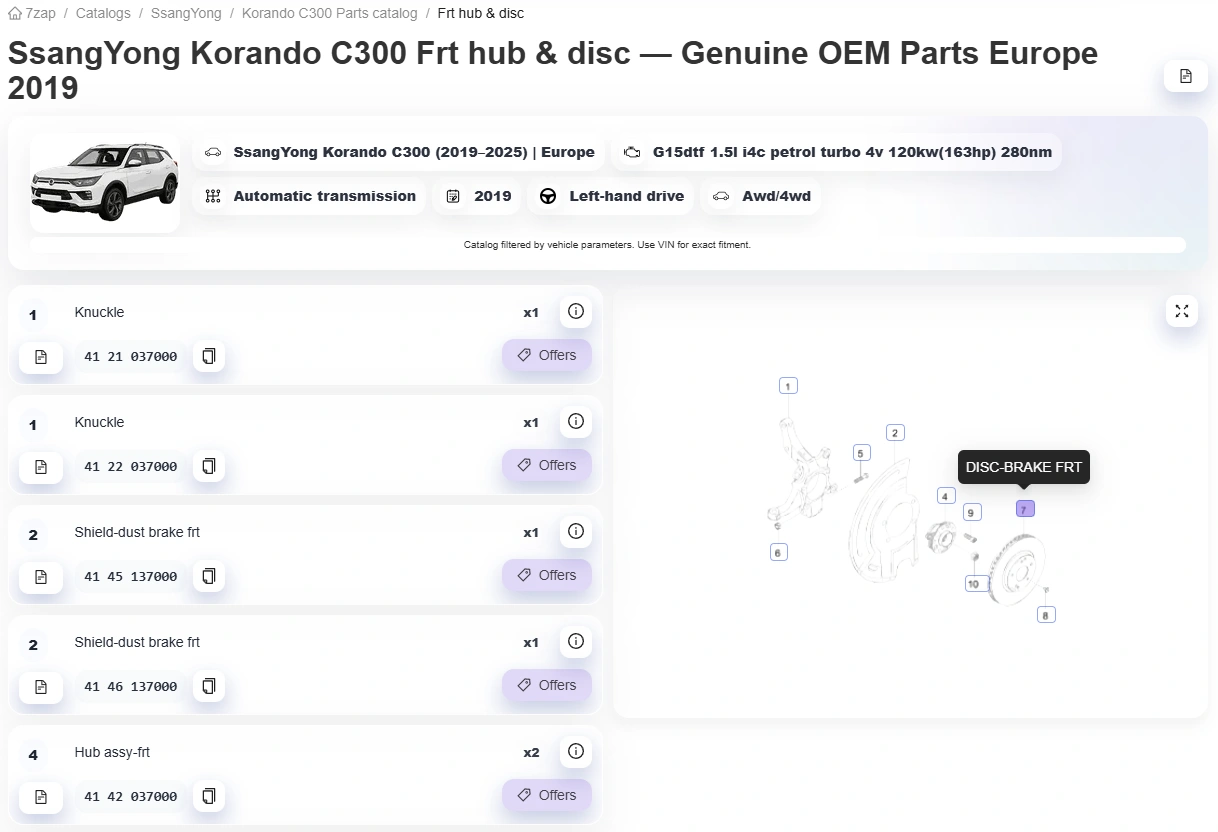
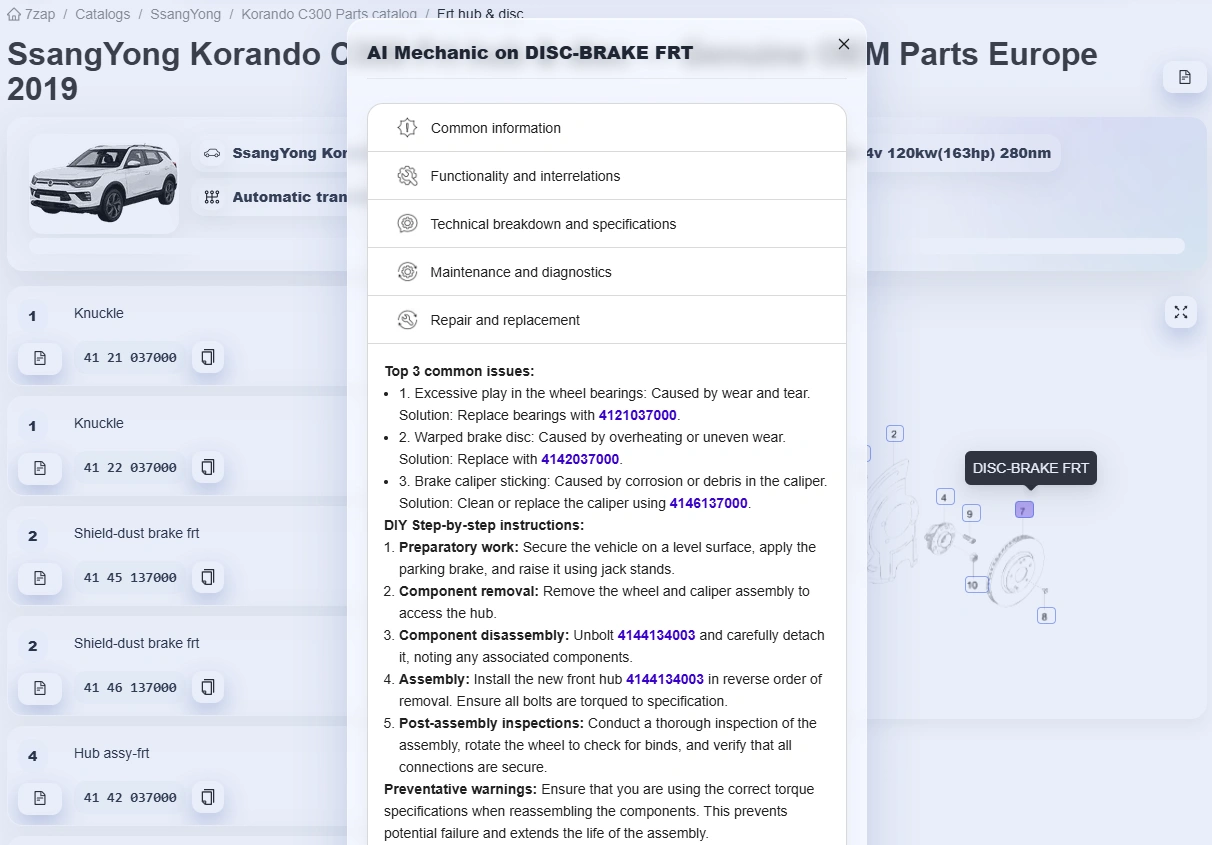
A quick look at decoded VIN details and how the catalog can display vehicle-specific parts information based on your SsangYong VIN.
SsangYong VIN preview
Decoded preview
VIN
KPT26B1VSGP122061
Brand
TIVOLI /XLV
Model
X100 EU EXP-5P G16DF WAGON-LON
Year
2016
Production date
2016-08-19
Engine
G16DF - G16DF 1.6L Petrol Turbo
Transmission
L - Manual
SsangYong catalog preview
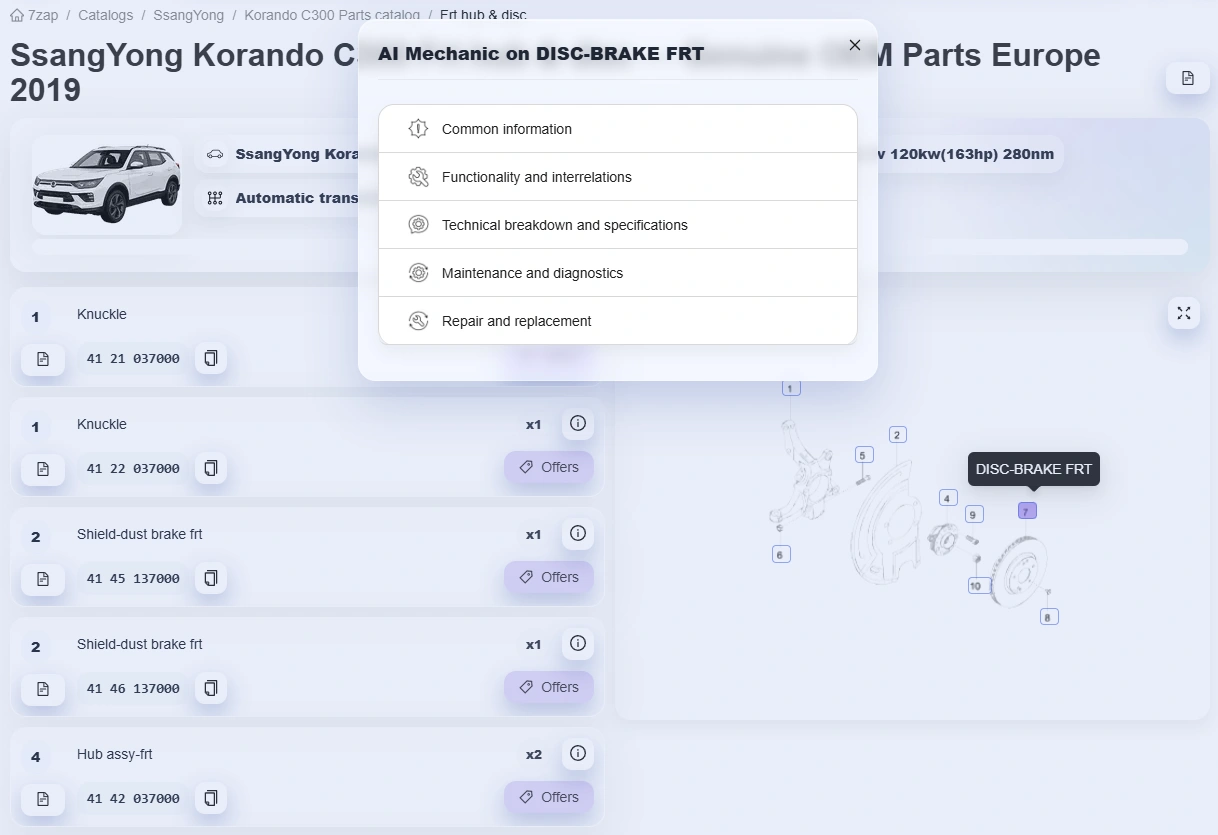
Screenshot
Screenshot
Screenshot
Support

FAQ

Quick answers to common questions about SsangYong VIN decoding, VIN checks, and how to use decoded data for parts and service.

VIN decoders for other brands

Decode VINs for other manufacturers with the same level of accuracy and OEM-based data.