
VIN Decoder

Smart VIN Decoder

Free • 3 sec • No signup
Enter your 17-character Smart VIN to decode the exact model, trim, key factory specs, and get a cleaner path to the right OEM parts and service information.
✓ Identify exact Smart model & variant (fortwo/forfour/BRABUS/EQ where supported)
✓ Verify authenticity with WMI, check digit, and key identifiers
✓ Reduce parts mismatch by confirming drivetrain and build configuration
No registration required. Results in ~3 seconds.
Every Smart vehicle has a unique 17-character VIN that works like a factory fingerprint. A smart vin decoder (or smart car vin decoder) translates that code into practical details—helping you confirm what you actually own, cross-check registration data, and order parts more confidently, especially on trim-sensitive Smart models.
Overview

Smart VIN Decoder: Decode Your VIN in Seconds

A Vehicle Identification Number (VIN) is standardized worldwide under ISO 3779/3780, and in the US it also follows 49 CFR Part 565. Your Smart VIN is split into the WMI (manufacturer ID), VDS (vehicle descriptor), and VIS (vehicle identifier). A vin decoder smart tool reads those blocks to surface model family, body style, restraints, drivetrain hints, and a serial sequence used by the factory.

With Smart, decoding is especially useful because trims and drivetrain options can change parts fitment (for example, BRABUS vs standard, or EV vs gasoline). Use our VIN lookup to start a Smart VIN lookup and confirm key identifiers before buying parts or booking service. If you’re searching specifically for a smart fortwo vin decoder, the VIN is the fastest way to validate generation and configuration across markets.

Help

Where is the VIN number on a Smart?

Common Smart VIN locations include:
Dashboard at the base of the windshield (driver side, visible from outside)
Driver door jamb/door pillar sticker (VIN and compliance label)
Passenger-side floor area or under-seat area (model-dependent, stamped/label)
Front trunk/service compartment label (where fitted, especially on fortwo)
Engine bay or rear frame area stamping (rear-engine generations may differ)
Vehicle registration document (V5C/title) and purchase paperwork
Insurance card or policy documents
Service booklet/maintenance records (dealer stamp pages often include VIN)
OEM build/option label inside the cabin (market- and model-dependent)
i
For a clean Smart VIN lookup, enter all 17 characters with no spaces. VINs never use the letters I, O, or Q (to prevent confusion with 1 and 0).
Capabilities

Smart VIN lookup: what you can learn

A good VIN lookup can help confirm:
Basic vehicle identity
Manufacturer (WMI) and country/region identifier; model family and series coding; body type and safety/restraint indicators (market-dependent); VIN check digit presence; serial/production sequence.
Factory configuration hints
Generation cues (e.g., fortwo 450/451/453 patterns where supported); drivetrain type (gasoline/diesel/EV) depending on data availability; transmission family indicators (manual/automated/DCT where supported); trim/edition hints such as BRABUS on supported datasets.
Service, parts, and documentation use
Improved parts matching for brakes, filters, drivetrain and body parts; clearer communication with workshops and insurers; validation of paperwork during used-car checks; faster navigation into an OEM catalog when available.
A Smart VIN decoder is most useful when you’re confirming build details that affect parts fitment or documentation. Even when the VIN doesn’t explicitly encode every option, it still anchors your search to the correct manufacturer, series, and identifier block—reducing mismatches when comparing listings, service records, and parts catalogs.
VIN anatomy

How the Smart VIN number is structured

Every modern Smart VIN is split into three blocks that identify the maker, describe the vehicle, and provide a unique serial number.
WMI (positions 1-3)
The World Manufacturer Identifier tells you who built the vehicle and the region where the manufacturer is registered. On many Smart vehicles you’ll see WME, historically associated with smart/MCC under Daimler. The WMI is the quickest way to confirm you’re decoding a genuine Smart VIN rather than a lookalike badge swap or paperwork error.
VDS (positions 4-9)
The Vehicle Descriptor Section provides model and engineering descriptors chosen by the manufacturer. Depending on market, these characters may reflect body type, restraint system, drivetrain, and internal model series identifiers. For Smart, the VDS can be important when separating similar-looking trims and generations (such as fortwo vs forfour, or BRABUS vs standard) when supported by decoder data.
VIS (positions 10-17)
The Vehicle Identifier Section contains the serial sequence and often includes a model year code and a plant/production code. In some regions (especially US-regulated formats) the model year is encoded at position 10; in other markets, Smart VINs may use position 10 differently and the year may not be directly readable without factory data. The final characters uniquely identify your specific car.
Manufacturing

Major Smart production plants

Smart production has involved dedicated Smart assembly as well as partner facilities for specific models and generations. Depending on your VIN and market, the plant code and manufacturer records help pinpoint origin.
Smartville (Hambach plant)
Hambach, Moselle, France (1997–2020; fortwo/roadster family production era)
Revoz (Renault) vehicle plant
Novo Mesto, Slovenia (2014–2021; smart forfour (453) production partner)
NedCar (contract manufacturing)
Born, Netherlands (2004–2006; first-gen smart forfour (454) production partner)
Geely vehicle assembly plant (SEA-platform production)
Xi'an, Shaanxi, China (2022–present; Smart #1/#3 era production for global markets)
Mercedes-Benz Berlin-Marienfelde powertrain plant
Berlin, Germany (powertrain components, electrification components; supplied programs across Daimler brands)
MDC Power GmbH engine plant
Kölleda, Thuringia, Germany (engine production site historically linked to small-displacement Daimler engines)
Mercedes-Benz Untertürkheim plant
Stuttgart, Germany (powertrain production and components; Daimler supply base)
Mercedes-Benz Accumotive / Deutsche Accumotive
Kamenz, Saxony, Germany (battery system production for Daimler EV programs, including Smart EV eras)
Renault engine plant
Cléon, Normandy, France (small gasoline engine production used across Renault-aligned platforms)
GETRAG transmission production (DCT programs)
Cologne, Germany (dual-clutch transmission manufacturing for compact-car applications)
Mitsubishi Motors powertrain manufacturing
Kurashiki (Mizushima), Okayama, Japan (powertrain production associated with Mitsubishi small-engine families used in some Smart generations)
Mercedes-Benz engine plant
Mannheim, Germany (engine and powertrain manufacturing within Daimler’s production network)
i
Plant information can be encoded via a plant code and/or serial range inside the VIS block. Because Smart VIN formats vary by market, the most reliable plant confirmation combines VIN structure with manufacturer data and catalog records tied to the VIN.
Value

Benefits of Using a Smart VIN Decoder

Practical details that help owners, technicians, and parts teams confirm exactly what’s on the vehicle.
Accurate parts matching
Smart vehicles can share similar exterior styling while using different brakes, sensors, or drivetrain components. Decoding the VIN helps anchor your parts search to the correct platform and configuration, reducing the risk of ordering the wrong item—especially on BRABUS editions or EV variants where equipment can differ.
Faster service planning
A VIN decode supports faster intake and quoting by confirming the vehicle identity and narrowing down service data. For workshop workflows, it’s a reliable way to start the job with fewer assumptions—useful when customers aren’t sure about model year, engine type, or whether the car is a fortwo or forfour.
Authenticity and paperwork checks
A Smart VIN lookup helps you compare the VIN on the car to the VIN on registration, insurance, and sales documents. It’s a simple verification step during used-car purchases and can help detect clerical errors, swapped plates, or mismatched documentation before they become expensive problems.
Cleaner communication with insurers and suppliers
Parts suppliers and insurers often rely on the VIN to confirm the correct vehicle record. Providing decoded identifiers reduces back-and-forth and helps ensure the right labor operations, parts references, and claim documentation—particularly when market trims and equipment packages vary across Europe, the USA, and Japan.
Social proof

Trusted by Smart Owners & Professionals

Feedback from owners, independent workshops, and parts teams who decode Smart VINs to confirm build details and avoid ordering mistakes.
Nina
5
5.0
Auto Parts ManagerBerlin
Smart trims can look identical, but the VIN details help us confirm what’s on the car before we order. I used it on a fortwo 451 and immediately narrowed the catalog to the right variant, which saved us a return and a day of downtime.
Carlos
5
5.0
Independent MechanicBarcelona
For Smart forfour jobs, the VIN lookup is my first step because brake and suspension parts can vary by configuration. The decoder gives a consistent starting point, and the catalog navigation makes it easier to confirm part compatibility before the car is on the lift.
Maya
5
5.0
Service AdvisorToronto
We see a mix of gas and electric Smart models, and customers often don’t know the exact variant. The Smart VIN decoder helps us verify the vehicle record quickly and communicate clearly, especially when checking recalls, service bulletins, or build-specific items.
Kenji
5
5.0
Car EnthusiastTokyo
I used the smart car vin decoder while shopping for a used fortwo and it helped me confirm the model family and spot mismatched paperwork. It’s a simple step that gave me more confidence before paying for a full history report.
Amir
5
5.0
Garage OwnerDubai
On Smart BRABUS cars, small differences in equipment can affect parts selection. The VIN decoding view gives us a quick sanity check before ordering, and it reduces the back-and-forth with suppliers when we can reference the exact VIN configuration.
Why premium

Smart VIN Decoder vs Free Tools

Basic tools may only return generic make/model and a year guess. A Smart-focused VIN decoder aims to translate more of the Smart-specific structure and connect you to catalog-friendly identifiers for parts and service research.

How to use the decoder to find parts

Enter your 17-character Smart VIN in the search field
Review decoded results (manufacturer, series/model family, key identifiers)
Open the linked OEM catalog view (when available for your VIN/market)
Browse parts by group/category or search by part name/number
Confirm applicability notes and compare with your vehicle before purchase

Free vs Premium Smart VIN Decoder

Compare plans feature-by-feature to choose the level of decoding and catalog access you need.
Free
View diagrams per day
View 1 diagrams per day
VIN identifications per month for month(s)
10 VIN identifications per month for 1 month(s)
Ad-free
Full part numbers in catalogs
Applicability Of Spare Parts
Maintenance Parts
Free
View diagrams per day
View 1 diagrams per day
VIN identifications per month for month(s)
10 VIN identifications per month for 1 month(s)
Ad-free
Full part numbers in catalogs
Applicability Of Spare Parts
Maintenance Parts
Reference

Smart WMI codes (real identifiers)

WMIs are the first three characters of the VIN and identify the manufacturer and region. Smart vehicles are most commonly found under the WME WMI; the entries below explain how it appears across model eras and markets.
Examples

Real Smart VIN examples

These realistic examples show how a Smart VIN can be read into manufacturer (WMI), check digit, model year code (when used), and a plant/sequence identifier. Exact decoded equipment may vary by market and dataset coverage.
WME4503326X123456
fortwo coupe, compact city car, gasoline, RWD
WMIWME = Smart (Europe/Daimler-era WMI commonly used on Smart)
Check digitPosition 9: 2 (check digit character)
Model year (position 10)Position 10: 6 = 2006 (model-year coding may vary by market)
Plant code (position 11)Position 11: X (plant/line code; interpretation depends on factory records)
Early fortwo generations often require catalog confirmation for engine/transmission specifics due to market variations.

Smart VIN preview

A quick look at decoded VIN details and how compatible OEM parts are typically organized in the catalog view.
Smart VIN preview
Decoded preview
VIN
WME4533621K271796
Brand
Smart
Model
SMART COUPE BRABUS (453.362)
Year
2019
Production date
2019 (exact date depends on factory records and market data)
Engine
0.9L turbo (common BRABUS 453 configuration; confirm by catalog for exact code/output)
Transmission
6-speed dual-clutch automatic (twinamic, where equipped)
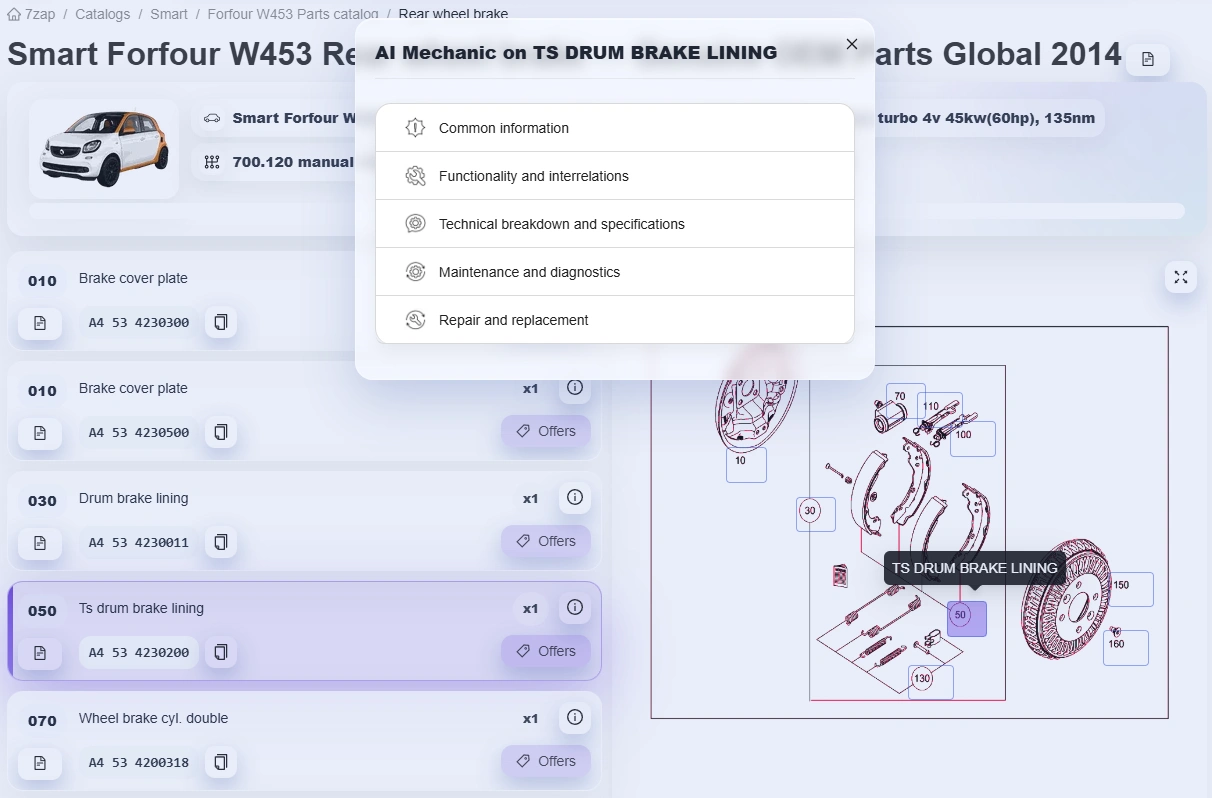
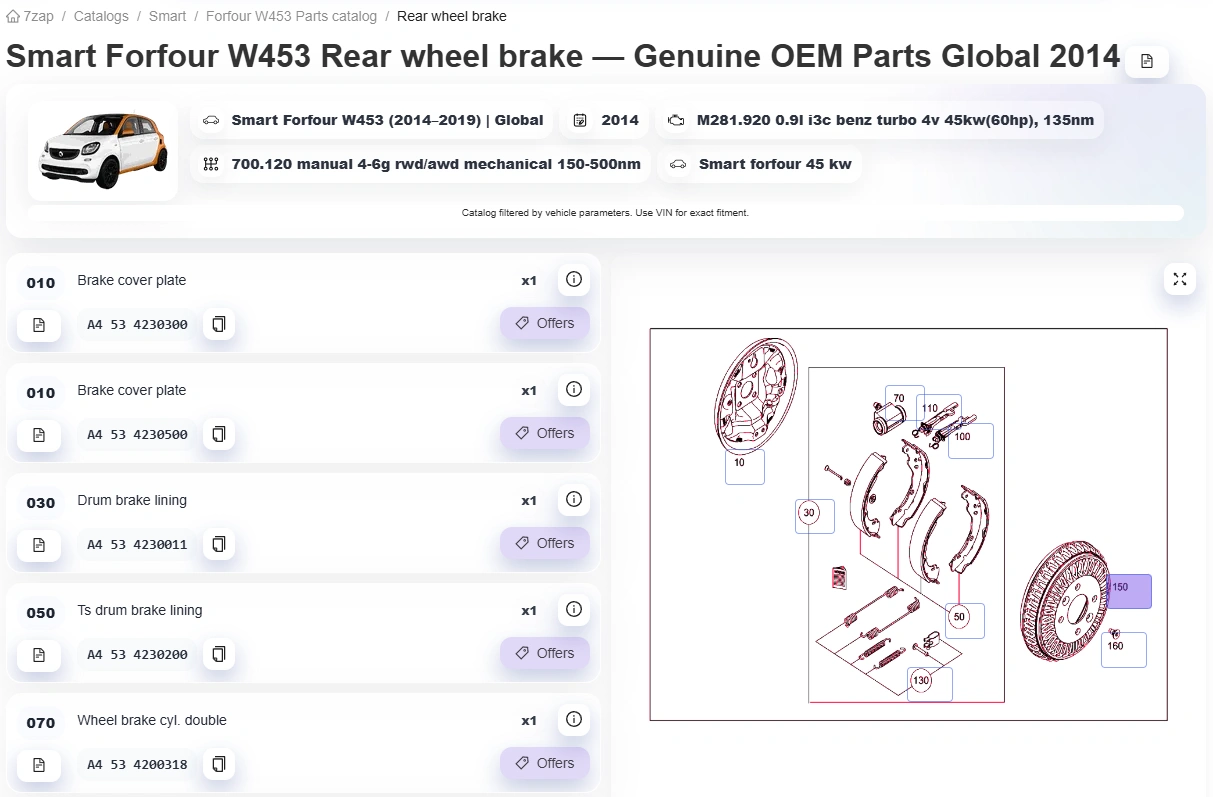
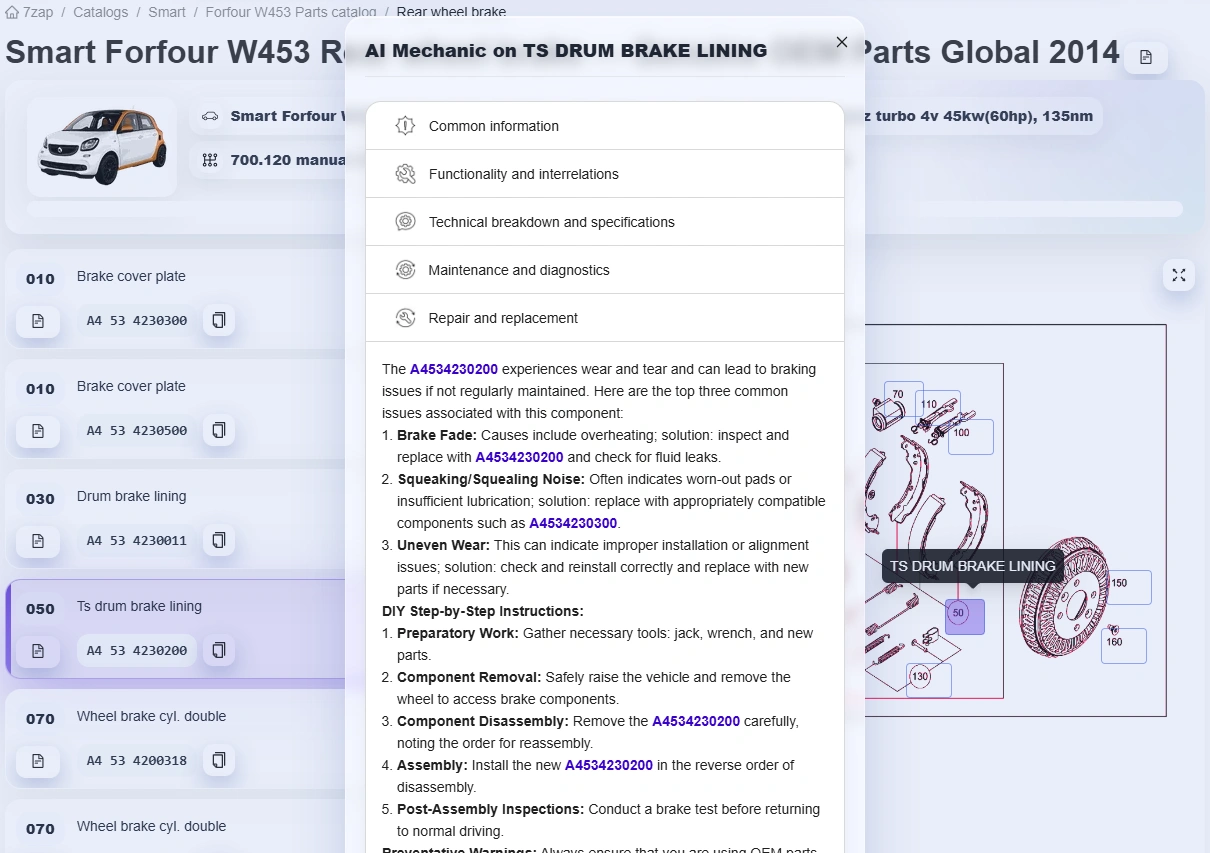
Smart catalog preview
Screenshot
Screenshot
Screenshot
Support

FAQ

Quick answers to common questions about Smart VIN decoding and VIN lookups.

VIN decoders for other brands

Decode VINs for other manufacturers with the same level of accuracy and OEM-based data.