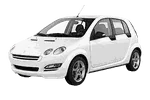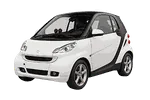

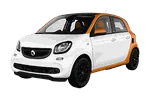
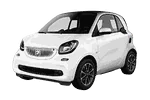
The smart car parts catalog on 7zap is an independent reference for identifying vehicle assemblies, diagram positions and OEM part numbers. It is designed for owners, repair professionals and parts researchers who need to distinguish between closely related components before consulting a retailer, workshop or other technical source.
Begin with the generation list displayed above this guide. The available catalog paths include familiar smart families such as Fortwo, Forfour and Roadster, but the generation code matters. For example, the catalog distinguishes Fortwo W450 (1998–2004), Fortwo W451 (2007–2015) and Fortwo W453 (2014–2019). Choosing by model name alone may therefore be insufficient for reliable research.
After selecting a displayed vehicle generation and factory configuration, browse the relevant assembly groups. Depending on the selected catalog path, these may help investigate engine-related components, transmission parts, steering, brakes, suspension, electrical equipment, body fittings, interior elements and other vehicle systems. The scope shown can vary between configurations, so a missing group should not be interpreted as proof that a component does not exist.
Navigation may be presented through manufacturer categories, which follow the organization associated with the vehicle catalog, or universal categories, which provide a standardized way to approach common component groups. These are alternative navigation structures for locating useful references rather than evidence that two listed components are interchangeable.
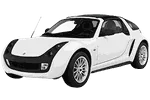
The generation distinction is also important within the Forfour family. Forfour W454 (2003–2006) and Forfour W453 (2014–2019) should be treated as separate catalog choices. Roadster users should select Roadster W452 (2004–2006) when that is the vehicle shown in the generation list.
A smart car parts diagram presents an exploded view of an assembly so that components can be understood in context. Lines, numbered callouts and adjacent parts lists connect the illustrated positions to descriptions and reference data. This can help clarify whether the item being researched is a main component, bracket, seal, fastener, cover or related fitting.
A diagram callout is only a pointer to a row in the accompanying parts list. It is not necessarily an orderable smart part number. The row may contain an OEM number, a description, quantity information or a note relevant to the illustrated assembly. Read the diagram and list together rather than copying the callout number as though it were a manufacturer reference.
When an OEM part number is displayed, use it as a research identifier. Formatting, option-dependent differences and vehicle revisions can affect applicability. A number associated with one diagram position does not by itself confirm that the component suits another smart generation or configuration.
Manual browsing starts with the displayed model family and generation, followed by the available factory configuration. Confirm the generation code instead of relying only on appearance or a broad production period. This is particularly relevant where W453 appears under both Fortwo and Forfour: the family selection remains part of the catalog context and should not be skipped.
Within a chosen path, compare the component description, illustration, quantity and any qualifying notes. Where possible, check markings on the removed part and compare the reference with vehicle documentation. For safety-critical or configuration-sensitive components, confirmation from a knowledgeable parts specialist is advisable before repair or procurement decisions.
VIN lookup provides an independent, vehicle-specific path where that function is available. It is separate from choosing a model, generation and factory configuration through manual catalog browsing. A VIN is not a configuration and should not be treated as a selector within the manually browsed choices.
Information reached through either route remains reference material. Verify the resulting smart OEM parts information against the vehicle, existing component and an appropriate technical source, especially if equipment may have changed during the vehicle’s service life.
Select the correct displayed family and generation, open the relevant assembly, then match the exploded-view callout to its parts-list row. Review the listed description and any qualifiers before recording the OEM reference.
Not necessarily. A callout identifies a position in the illustration. The corresponding row may show an OEM number or other reference information, but the callout itself should not be assumed to be an orderable number.
Fortwo W450, W451 and W453 are separate catalog generations in the supplied list. Their diagrams and references should be researched within the appropriate generation path rather than combined by the shared Fortwo name.
No. A smart OEM number is a valuable research reference, but compatibility can depend on the selected generation, factory configuration and component details. Compare multiple identifiers and obtain further confirmation where needed.