



The Saab parts catalog on 7zap provides a structured way to research components used across the displayed legacy passenger-car generations. Select a vehicle generation, review the available factory configurations, and navigate assembly groups to find diagrams, parts-list descriptions, and Saab part numbers. This independent reference catalog is intended for identification and comparison rather than as a statement of manufacturer affiliation or confirmed compatibility.
Catalog navigation can be useful when a component name is unknown, when several visually similar parts need to be distinguished, or when an existing number must be checked against the catalog context. Depending on the selected vehicle and the material displayed, assembly sections may cover areas such as the engine, cooling system, transmission, suspension, brakes, body equipment, interior fittings, and electrical components.
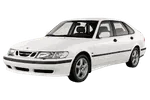
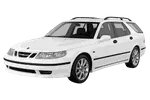
Generation choice matters because a familiar model name can cover substantially different catalog branches. The Saab 9-3 appears here as the 9-3 YS3D from 1998–2003 and the 9-3 YS3F from 2003–2012. Similarly, the 9-5 is divided between the 9-5 YS3E from 1998–2010 and the 9-5 YS3G from 2010–2011. These distinctions should be preserved when researching a component or recording an OEM reference.
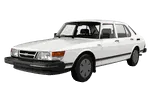
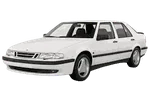
The displayed catalog also includes older Saab families such as the 900 l/ll NG from 1986–1998 and the 9000 from 1985–1998, along with the 9-7X from 2005–2009. Rather than relying only on the model badge, begin with the generation label and production period shown on the page. Then compare the available configuration descriptions with the vehicle being researched.
After selecting a displayed generation and configuration, parts can be approached through universal categories or manufacturer categories. Universal categories help when the type of component is already known, while manufacturer categories follow the assembly organization presented for that Saab catalog branch. The useful route depends on whether the search begins with a system, a component name, or a visible location on the vehicle.
A Saab parts diagram presents components in their assembly context. Numbered callouts connect illustrated items to rows in an accompanying parts list, where a description and an OEM number may be shown. A callout is only a pointer to a parts-list row; it is not necessarily an orderable part number. One illustration may also contain optional, related, or configuration-dependent items, so the diagram and list should be read together.
Saab OEM parts references can help with cross-checking labels, documentation, and component listings. However, an OEM number is a research reference and does not establish applicability by itself. Punctuation, suffixes, notes, quantity information, and the surrounding assembly should be reviewed before treating two references as equivalent.
Start from the model family and generation displayed in the catalog. Confirm the production period, then use only the factory configuration details presented for that branch. Avoid choosing solely from a broad model name, especially where the catalog separates generations such as YS3D and YS3F for the 9-3 or YS3E and YS3G for the 9-5.
Once inside a configuration, keep track of the assembly group and diagram title. If several entries have similar descriptions, compare their notes and illustrated positions. Details from the vehicle, the removed component, and reliable service records can provide additional evidence.
VIN lookup is an independent, vehicle-specific research path. It is not a factory configuration and does not select one of the manually browsed configurations. Manual catalog browsing and VIN-based lookup should therefore be treated as separate methods, with findings compared carefully when both are available.
Yes. Select the relevant displayed generation and configuration, open an appropriate assembly group, and use the exploded view to connect the illustrated component with its parts-list row.
The supplied catalog separates these model families by generation code and production period. Choosing the matching branch reduces confusion between similarly named vehicles.
No. The callout identifies a row in the parts list. The row may contain a part number, description, note, or other catalog information relevant to the illustrated item.
No. It should be checked against the vehicle generation, displayed configuration, assembly context, catalog notes, and evidence from the component being replaced.