
VIN Decoder

Datsun VIN Decoder - Free VIN Lookup

Free • 3 sec • No signup
Enter your 17-character Datsun VIN to decode model details, factory specs, and compatibility clues for parts and service—fast and accurately.
✓ Identify model, year, and key configuration
✓ Verify engine/transmission and factory options
✓ Reduce parts mistakes with VIN-based lookup
No registration required. Results in ~3 seconds.
A VIN is your vehicle’s unique ID. A Datsun VIN decoder turns that code into usable details—helping you decode Datsun VIN data for repairs, parts matching, and documentation with confidence.
Overview

Decode Your Datsun VIN Decoder Results in Seconds

Every modern Vehicle Identification Number follows global standards (ISO 3779/3780) and U.S. rules (49 CFR Part 565). A 17-character VIN is split into three blocks—WMI, VDS, and VIS—so you can confirm who built the vehicle, what it is, and where/when it was produced. This is especially useful for Datsun because the marque has been used across different eras and markets, and many VINs are issued under Nissan or partner manufacturers while the vehicle is sold as Datsun.

Use our datsun vin decoder to run a datsun vin lookup and perform a datsun vin number check for core identifiers (model year, body type, engine family, and plant code when available). This helps you check Datsun VIN number details before ordering parts, comparing trims, or verifying paperwork. For any vehicle with a 17-digit VIN, start here: free VIN decoder. To decode other vehicle brands with the same precision, use our VIN lookup.

Help

Where is the VIN number on a Datsun?

Common places to find a Datsun vehicle identification number include:
Dashboard (driver’s side, visible through the windshield)
Driver’s door jamb/door pillar label (VIN and tire/loading info on many vehicles)
Engine bay firewall (stamped metal plate or stamping on older vehicles)
Front strut tower area (some older Datsun/Nissan platforms)
Frame rail or chassis stamping (trucks/SUVs; may be on the right-hand frame rail)
Radiator support / slam panel (older vehicles may have a plate)
Vehicle registration and title documents
Insurance card or policy documents
Service records and dealer paperwork
i
For a clean lookup, enter the VIN exactly as shown (17 characters, no spaces). Letters I, O, and Q are not used in VINs—if you see them, re-check the stamping or paperwork.
Capabilities

Datsun VIN lookup: what you can learn

A reliable VIN lookup can help confirm:
Basic vehicle identity
Manufacturer and region (WMI) Model and body type/class (when encoded) Model year code Assembly plant code (when available) Serial/production sequence
Factory configuration clues
Engine family and displacement group (market dependent) Transmission type or family (market dependent) Restraint/airbag system encoding (for modern VINs) Trim/series indicators (varies by platform) Market/region-specific coding differences
Service & parts verification
Confirm compatible parts families before ordering Cross-check paperwork vs. the vehicle Reduce mismatch risk for filters, brakes, sensors, and drivetrain parts Support build-sheet style identification where data is available Improve documentation for resale, insurance, and inspections
A Datsun VIN lookup is most useful when you’re matching parts or verifying a vehicle’s identity from documents. Because Datsun has been used in different eras and often shares manufacturer identifiers with Nissan or partner plants, a VIN-based check helps confirm the correct year/platform and reduces ordering errors.
VIN anatomy

How the Datsun VIN number is structured

Most VINs you can decode today use the standardized 17-character format, split into three blocks.
WMI (positions 1–3)
The WMI (World Manufacturer Identifier) identifies the manufacturer and the region/country where the VIN was assigned. For Datsun-badged vehicles, the WMI often points to Nissan Motor Co. or an alliance/partner manufacturer that produced the vehicle. This matters because Datsun is a marque, and the legal manufacturer in the VIN can still be Nissan (or a local manufacturing entity).
VDS (positions 4–9)
The VDS (Vehicle Descriptor Section) describes the vehicle type and key attributes chosen by the manufacturer—commonly model line, body type, engine group, and restraint system. Position 9 is the check digit on many North American VINs, used to validate the VIN mathematically. Exact meanings vary by market and by platform, so decoding is best done with a brand-aware database.
VIS (positions 10–17)
The VIS (Vehicle Identifier Section) includes the model year code (position 10), assembly plant code (position 11), and the vehicle’s sequential production number (positions 12–17). This block is critical for ordering correct parts when a mid-year change exists. For Datsun/Nissan platforms, plant codes and sequencing can differ by country, so the decoder uses the VIN pattern to interpret it correctly.
Manufacturing

Major production plants

Datsun vehicles have been produced across Nissan and partner facilities worldwide. Depending on your VIN and market, the plant code can point to one of these locations.
Oppama Plant (Nissan)
Yokosuka, Kanagawa, Japan (1961–present)
Zama Plant (Nissan, historical)
Zama, Kanagawa, Japan (1965–1995)
Tochigi Plant (Nissan)
Kaminokawa, Tochigi, Japan (1971–present)
Shonan Plant (Nissan Shatai)
Hiratsuka, Kanagawa, Japan (1950–present)
Nissan Motor Kyushu
Kanda, Fukuoka, Japan (1975–present)
Sunderland Plant (Nissan Motor Manufacturing UK)
Sunderland, England, UK (1986–present)
Barcelona Plant (Nissan Motor Ibérica, historical)
Barcelona, Spain (1983–2021)
Smyrna Vehicle Assembly Plant (Nissan North America)
Smyrna, Tennessee, USA (1983–present)
Canton Vehicle Assembly Plant (Nissan North America)
Canton, Mississippi, USA (2003–present)
Aguascalientes Plant (Nissan Mexicana)
Aguascalientes, Mexico (1992–present)
Renault–Nissan Alliance Plant
Oragadam (near Chennai), Tamil Nadu, India (2010–present)
Nissan Motor Indonesia (historical vehicle assembly)
Purwakarta, West Java, Indonesia (1995–2020)
AvtoVAZ Togliatti Plant
Togliatti, Samara Oblast, Russia (1970–present)
Nissan Manufacturing Russia (historical)
Saint Petersburg, Russia (2009–2022)
Nissan Motor Company (Australia) – Clayton Plant (historical)
Clayton, Victoria, Australia (1966–1992)
i
On a 17-character VIN, the assembly plant is commonly encoded at position 11. The exact plant-code mapping is manufacturer-specific, so a Datsun VIN decoder is the safest way to interpret the plant and configuration correctly.
Value

Benefits of Using a Datsun VIN Decoder

Practical details that help owners, restorers, and shops confirm the right vehicle data before spending time or money.
Accurate parts matching
A Datsun VIN decoder helps confirm the exact platform and key configuration so you can match compatible parts. This is valuable when paperwork is unclear, when multiple trims share similar names, or when a vehicle is titled under Nissan while marketed as Datsun.
Faster troubleshooting
Decoding the Datsun vehicle identification number can point you to the correct engine family or drivetrain grouping. That reduces guesswork when diagnosing common issues like ignition, fueling, cooling, or brake variations that change across years and markets.
Better documentation and resale
A VIN-based profile helps you document the vehicle consistently for inspections, insurance, and resale. A clean Datsun VIN number check can also flag mismatches between the VIN, the title, and the vehicle’s actual configuration.
Confident international identification
Datsun has been used in multiple regions, and VIN patterns differ by market. A Datsun VIN lookup helps interpret WMI/VDS/VIS correctly so owners and parts teams can work with the right identifiers even when the vehicle was imported or re-registered.
Social proof

Trusted by Datsun Owners & Professionals

Feedback from owners, restorers, and parts teams using VIN decoding to confirm specs and reduce ordering errors.
Marcus
5
5.0
Auto Parts ManagerLos Angeles
We still get classic Datsun requests—especially 280ZX and 510 owners—who only have the VIN from the title. This Datsun VIN lookup helps confirm the year and configuration quickly, which cuts down on wrong parts and unnecessary returns.
Anya
5
5.0
Independent MechanicToronto
When a customer brings in a Datsun-badged car that’s actually registered under a Nissan manufacturer VIN, decoding it properly matters. The Datsun VIN decoder gives a clean readout that helps me match service parts and document the job correctly.
Ravi
5
5.0
Garage OwnerMumbai
For Datsun GO and redi-GO, small differences in engine and transmission specs can change part fitment. Running a Datsun VIN number check before ordering saves time and prevents delays, especially when the car’s paperwork is incomplete.
Elena
5
5.0
Car EnthusiastBerlin
I’m restoring an older Datsun and wanted consistent identifiers for my records. The decoder made it easy to decode Datsun VIN details and keep the build notes organized. It’s straightforward and doesn’t feel like a generic tool.
Sipho
5
5.0
Service TechnicianJohannesburg
For Datsun/Nissan pickups, customers often call them 'Datsun' even when the VIN reads Nissan. The lookup helps us confirm the exact platform and avoid ordering the wrong clutch, filters, or belts. It’s practical for daily workshop use.
Why premium

Datsun VIN Decoder vs Free Tools

Basic free tools often return only year/make/model and can miss market-specific details. A dedicated decoder is built to interpret manufacturer patterns, plant codes, and configuration clues that matter when you’re ordering parts or verifying a vehicle’s identity.

How to use the decoder to find parts

Find and enter your 17-character VIN (no spaces) into the search field
Review decoded results: year code, platform hints, engine/transmission grouping (if available)
Open the linked catalog view to navigate parts by system (engine, brakes, body, electrical, etc.)
Compare part notes/options against your decoded configuration before ordering
Save or print the decoded summary for your service file or restoration records

Free vs Premium Datsun VIN Decoder

Compare plans feature-by-feature to choose the depth of decoding you need.
Free
View diagrams per day
View 1 diagrams per day
VIN identifications per month for month(s)
10 VIN identifications per month for 1 month(s)
Ad-free
Full part numbers in catalogs
Applicability Of Spare Parts
Maintenance Parts
Free
View diagrams per day
View 1 diagrams per day
VIN identifications per month for month(s)
10 VIN identifications per month for 1 month(s)
Ad-free
Full part numbers in catalogs
Applicability Of Spare Parts
Maintenance Parts
Reference

Datsun WMI codes (real identifiers)

WMIs are the first three characters of the VIN and identify the manufacturer and region. Because Datsun is a Nissan marque, Datsun-badged vehicles often use Nissan or partner-manufacturer WMIs depending on country and plant.
Examples

Real Datsun VIN examples

Examples below show how a Datsun VIN decoder reads key positions (WMI, year code, and plant/sequence). Availability and naming vary by market because Datsun is a marque and many VINs identify Nissan or a partner manufacturer.
JN1CA21D0YT123456
Pickup/utility platform, FR layout (example), automatic/manual varies by market
WMIJN1 = Nissan (Japan)
Check digitPosition 9: check digit
Model year (position 10)Y = 2000
Plant code (position 11)Position 11: T (plant code, manufacturer-specific)
Illustrates a Japan-issued Nissan WMI often encountered when owners search using Datsun naming in older records.

Datsun VIN preview

A quick look at typical decoded fields and how VIN-based identification supports the parts catalog experience.
Datsun VIN preview
Decoded preview
VIN
XTA219500J0123456
Brand
Datsun
Model
on-DO (market-dependent)
Year
2018
Production date
2018-11 (example)
Engine
1.6L gasoline (platform-dependent)
Transmission
5-speed manual / automatic (by trim)
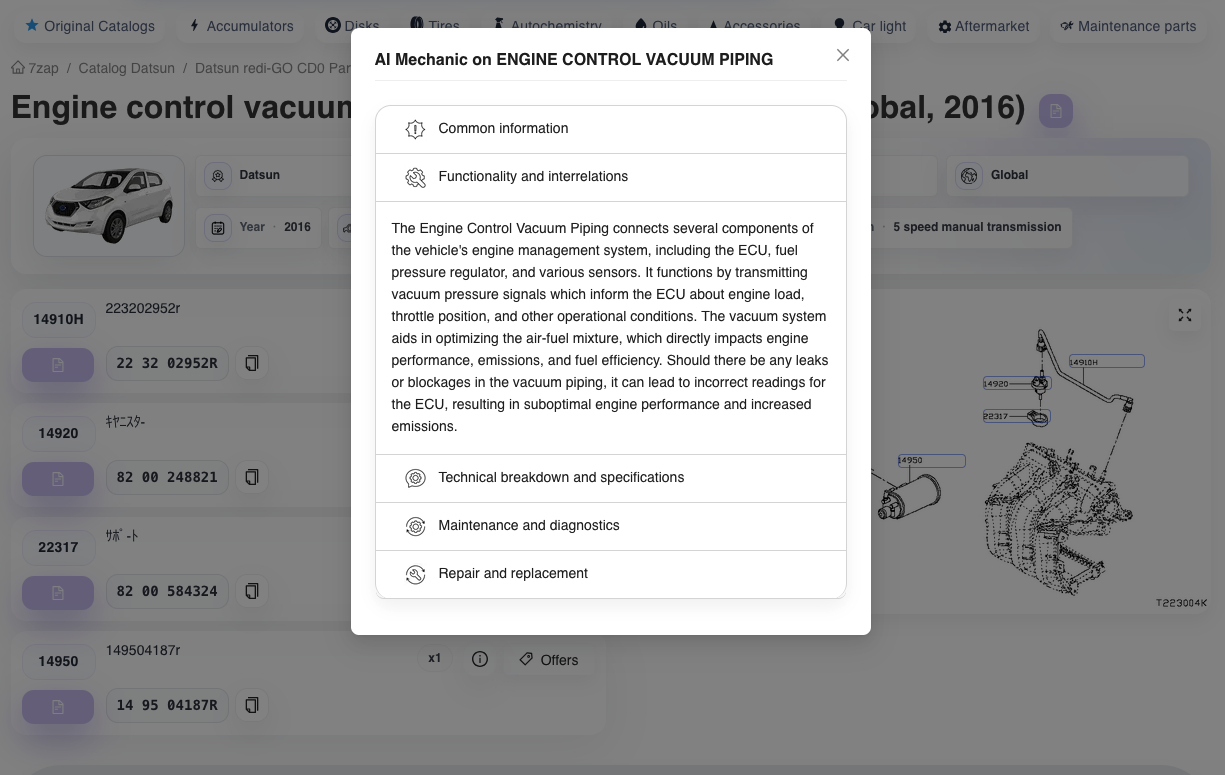
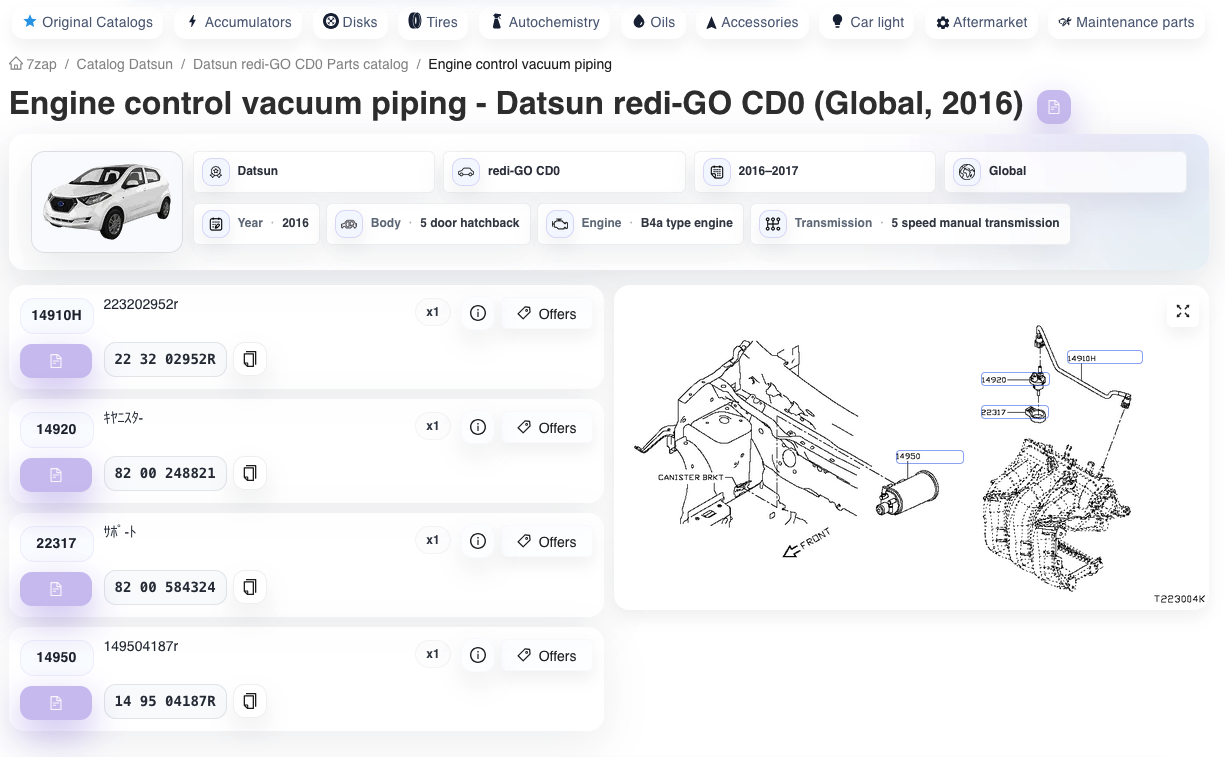
Datsun catalog preview
Screenshot
Screenshot
Screenshot
Support

FAQ

Quick answers to common questions about Datsun VIN decoding and VIN-based identification.

VIN decoders for other brands

Decode VINs for other manufacturers with the same level of accuracy and OEM-based data.