

Short intro: Wheels that are balanced and properly aligned keep your car stable, predictable and economical. Neglect either service and you'll notice vibrations, uneven tire wear, unpredictable handling and — eventually — higher repair bills. This guide explains the difference between balancing and alignment, common symptoms, how frequently to check or perform the services, simple DIY tests you can do in your driveway, what a professional will do, and what can happen if you delay.
What’s the difference: wheel balancing vs wheel alignment?
Wheel balancing corrects uneven weight distribution around a wheel and tire assembly. When tires and rims have heavy spots (manufacturing tolerances, repairs, or accumulated grime), that imbalance shows up as a vibration that varies with speed. Balancing uses small counterweights placed on the rim to make the assembly rotate smoothly.
Wheel alignment (often called “toe/camber/caster adjustment” or simply “tracking”) adjusts suspension geometry so the wheels point and tilt correctly relative to the vehicle and the road. Alignment affects steering returnability, straight-line tracking, and how tires meet the road. Alignment does not add weight to the wheel — it sets angles.
Common signs that you need balancing or alignment
- Steering wheel vibration at highway speeds — classic sign of wheel imbalance; usually felt in the steering wheel between ~50–100 km/h (30–62 mph).
- Seat, floorboard or pedal vibration — imbalance can transmit to the whole car; vibration felt more in the seat or floorboard may mean rear wheel imbalance.
- Pulling to one side — vehicle drifts left or right on flat road without steering input: common sign of misalignment (toe or camber issue).
- Off-centre steering wheel — steering wheel not straight when driving straight ahead usually indicates alignment problem.
- Uneven or rapid tire wear — feathering, cupping, inner or outer edge wear: alignment or suspension problems. Cupping often links to wheel imbalance combined with worn shocks.
- Poor handling, wandering or instability — alignment issues reduce stability, especially under braking or at speed.
- New steering/bearing noises after a hit — striking a curb or pothole can damage wheel, rim or steering/suspension parts causing both imbalance and alignment faults.
Consequences of ignoring balancing and alignment
Delaying corrective work compounds costs and risk:
- Accelerated tire wear: misaligned wheels wear certain parts of the tread much faster, forcing earlier replacement.
- Damaged suspension and steering components: bad geometry causes higher loads on tie rods, ball joints, bearings and shocks; these parts wear out sooner.
- Reduced fuel efficiency: improper alignment increases rolling resistance and drag.
- Reduced safety: braking distances and vehicle stability are negatively affected; the car can behave unpredictably in evasive maneuvers.
- Uncomfortable driving: constant vibrations and steering corrections make daily driving tiring and stressful.
- Potential rim and tire damage: hitting potholes can bend rims; unbalanced wheels magnify vibration that may loosen wheel bolts or damage the valve stem.
How often to balance and align — practical recommendations
Exact intervals depend on vehicle type, driving conditions and your priorities (comfort, wear, performance). Use these practical, conservative guidelines:
- Wheel balancing: Every time you mount new tires — always. Also rebalance if you repair a tire, after a patch, or when you rotate tires and feel vibration. As a preventive check, have balance inspected at every tire rotation (commonly every 8,000–12,000 km / 5,000–8,000 miles).
- Wheel alignment: Check alignment annually or every 10,000–15,000 km (6,000–9,000 miles), whichever comes first. Also check alignment after:
- Hitting a curb or a large pothole
- Replacing steering or suspension parts (tie rods, control arms, struts, bushings)
- Installing new tires
- If you observe uneven tire wear, steering pull, or off-center steering wheel
If you use your vehicle harshly (track days, heavy loads, repeated off-road use), you should check alignment more often — perhaps every 5,000–8,000 km (3,000–5,000 miles).
Simple DIY checks to tell whether you need balancing or alignment
- Vibration drive test (balancing): safely drive on a smooth road and note speed ranges where vibration occurs (e.g., 50–70 km/h). Steering wheel vibration suggests front-wheel imbalance; seat/floor vibration suggests rear-wheel imbalance.
- Visual tread inspection (alignment): look at tread — inner/outer edge wear suggests camber/toe issues; feathered edges point to toe problems.
- Straight-line test (alignment): on a calm road, briefly take hands off steering wheel (but be ready to correct); if the car pulls to one side, alignment is suspect.
- Centering check (alignment): drive straight and note if steering wheel is centered; an off-center wheel while driving straight indicates alignment adjustment needed.
- Measure tire pressure and rim damage (both): uneven or very low pressure can mimic imbalance; bent rims can cause imbalance and leaks — visually inspect rims for dents.
Tools, what a professional does and what you can try at home
Common tools and equipment:
- Wheel balancer (dynamic balancing machine) — workshop machine
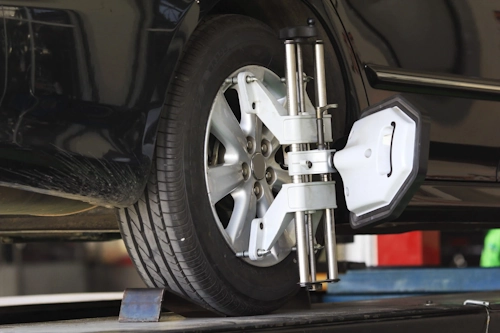
- Four-wheel alignment rack or laser alignment system — required for precise geometry
- Tire changer (for removing/mounting tires)
- Torque wrench, jack stands, jack
- Basic hand tools and a tire pressure gauge
What professionals do:
- Inspect tires, rims, suspension and steering components for wear or damage.
- Mount wheels on a wheel balancer, remove previous weights if needed and add new dynamic weights to correct imbalance.
- Use a 2- or 4-wheel alignment machine to measure camber, toe and caster against manufacturer specifications and adjust tie rods, control arms or eccentric bolts as required.
- Perform a road test to confirm corrections.
What you can do at home: inspect tires, measure tread, check pressures, look for rim damage and perform simple driving checks described above. You can perform a static balance with a bubble balancer or use small stick-on weights if you have basic shop experience, but dynamic balancing and alignment adjustment require shop equipment for repeatable, safe results.
How to prepare your car for an alignment (HowTo)
Follow these preparatory steps before taking your car to an alignment shop — the job will be faster and more accurate.
- Check and set tire pressures to manufacturer spec (cold pressure).
- Make sure the spare is stowed and trunk load reflects normal driving load (alignment presets assume typical weight distribution).
- Inspect tires for uneven wear and rim damage; note any problems for the technician.
- Replace obvious worn parts (e.g., tie rods, ball joints, bushings, shocks); worn parts should be fixed before alignment because they affect readings.
- Bring info about vehicle modifications (lift/coilovers/wheel offsets) so the technician can adjust targets or advise accordingly.
Typical costs and time
Costs vary widely by region, equipment and whether you choose a quick front-end alignment vs full four-wheel alignment. Typical ranges:
- Wheel balancing: per wheel — often in a range roughly equivalent to a modest workshop fee; many shops charge per wheel or include with tire mounting. (Prices vary, check local shops.)
- Alignment: front-end alignment is cheaper than full 4-wheel; expect to pay more for high-end vehicles or performance setups. Ask whether the quoted price includes a post-adjustment road test.
Time: balancing and a tire mount usually take under an hour in a busy shop; a full 4-wheel alignment typically takes 45–90 minutes depending on needed corrections and vehicle complexity.
When to head to the shop immediately
- Sudden, strong vibrations after hitting a pothole or curb
- Front wheel pull or a steering wheel that is badly off-center and won’t self-center
- Noticeable clunks, noises or handling instability
- Visible tire cords, bulges or rim cracks
Preventive tips to prolong balance and alignment
- Rotate tires on the manufacturer’s schedule (commonly every 8,000–12,000 km / 5,000–8,000 miles).
- Avoid potholes and curbs when possible and reduce speed on rough surfaces.
- Keep tire pressures correct and check them monthly.
- Replace worn suspension components promptly.
- When buying new wheels or tires, request professional mounting, dynamic balancing and a post-installation alignment check.
Short summary
Wheel balancing and wheel alignment are separate but equally important services. Balancing eliminates vibration caused by uneven wheel/tire mass; alignment corrects wheel angles to the manufacturer’s geometry. Balance every time you mount tires and whenever vibration appears. Check alignment annually (or every 10,000–15,000 km / 6,000–9,000 miles), after impacts, and after suspension repairs. Neglect leads to premature tire and component wear, poorer fuel economy and reduced safety. When in doubt, get a professional inspection — it’s usually cheaper than the repairs that follow months of neglect.