

Your Subaru WRX or STI (2015–2021) pulls slightly or eats tires on the inner edge? Alignment is critical on AWD performance cars. This guide covers factory specs, aftermarket camber bolts, and the corner-weight consideration that makes track alignment different from street.
Owner's case
Tyler's 2018 WRX had inner-edge tire wear on the fronts after lowering springs. Factory camber bolts maxed out; he added aftermarket adjustable top hats to dial in -1.5° camber for street + occasional autocross.
Factory alignment specs (WRX –)
- Front camber: -0.75° ± 0.75° (range: 0° to -1.5°)
- Front toe: 0° ± 0.15° (total)
- Rear camber: -1.3° ± 0.75°
- Rear toe: +0.08° ± 0.15° (slight toe-in for stability)
- Caster: +3.8° ± 0.75°
Street vs track alignment philosophy
- Street (daily): minimize camber for even tire wear; slight rear toe-in for highway stability.
- Track/autocross: more negative camber (front -2° to -2.5°) for cornering grip; zero or slight toe-out front for turn-in.
Adjustment methods on WRX/STI
- Camber (front): eccentric bolts at strut-to-knuckle; range ~1° adjustment. For more, add adjustable top hats.
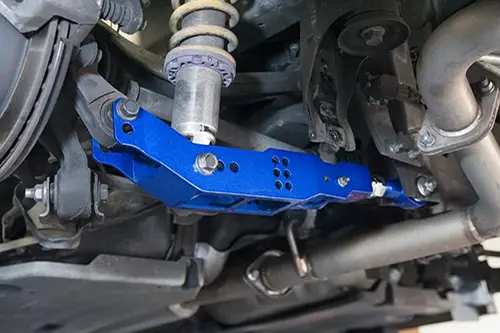
- Camber (rear): limited with OEM hardware; adjustable lateral links or camber bolts aftermarket.
- Toe (front/rear): tie rod ends (front), eccentric bolts on lateral links (rear).
Tyler's setup (street + autocross)
- Front: -1.8° camber (adjustable top hats), 0° toe
- Rear: -1.5° camber, +0.05° toe-in
- Result: even tire wear on street; strong grip at autocross events.
Corner-weight consideration
On lowered WRX/STI, corner weights may shift. Use alignment rack scales to verify cross-weight; adjust ride height or spring pre-load to balance if needed.
After alignment
- Test drive on familiar roads; steering should center and feel balanced.
- Re-check toe after 500 miles if you installed new suspension components.
- Monitor tire wear at 5k-mile intervals—camber/toe drift shows up as uneven tread.
Tools
- Alignment rack or DIY string method (less precise but catches major issues)
- Camber/caster gauge if doing it yourself
For WRX/STI suspension specs and diagrams
Check Subaru 7zap: subaru.7zap.com.
Common mistakes
- Copying "aggressive" track specs for daily use—kills tires fast.
- Not re-checking alignment after suspension work—camber/toe shift with new parts.
- Ignoring corner-weight balance on lowered cars—handling suffers.
Bottom line: WRX alignment is tunable; Tyler found the sweet spot for dual-use—his tires last 30k miles and he's competitive on track days.
Tyler's tool list for home alignment checks
- String method: mason line, tape measure, level surface
- Camber gauge: magnetic or smartphone app with level calibration
- Toe plates: DIY from plywood or buy adjustable ($50–100)
Quick home check (no rack)
- Park on level ground; measure wheelbase left vs right—should be within 1/8 inch.
- String from front to rear wheel centers; measure toe at wheel rim center.
- Use camber gauge on hub face; compare left/right.
When home alignment isn't enough
If you've changed major suspension components (struts, control arms, subframe bolts), book a shop alignment with corner weights and thrust angle measurement—DIY methods can't match that precision.