

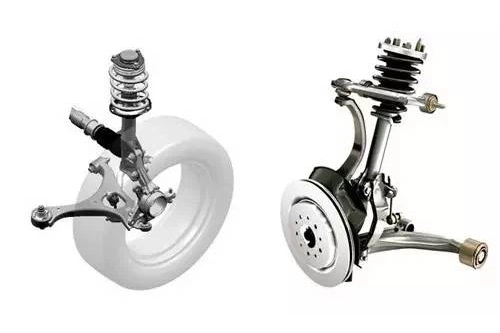
Your vehicle's suspension system performs the remarkable engineering feat of maintaining tire contact with the road surface while insulating passengers from bumps and vibrations. Among the various suspension designs, two systems dominate modern automotive engineering: the MacPherson strut and the double wishbone suspension. These fundamentally different approaches to solving the suspension challenge each offer unique advantages and limitations that directly impact handling, comfort, and cost.
Understanding Suspension Fundamentals
Before examining specific designs, it's essential to understand what suspension systems accomplish. When a wheel encounters a road imperfection, the suspension:
- Absorbs impact energy through springs (coil, leaf, or air springs)
- Controls spring oscillation through dampers (shock absorbers)
- Maintains proper wheel alignment through linkages
- Minimizes body roll during cornering
- Provides predictable steering response
Without an effective suspension system, vehicles would experience dangerous loss of tire contact with the road surface, excessive body movement, and uncomfortable vibration transmission to passengers.
Double Wishbone Suspension: Precision Engineering
Historical Development
Double wishbone suspension (also known as double A-arm suspension) predates the MacPherson design by approximately a decade. Originally developed for premium vehicles, its adoption expanded to performance models due to its superior handling characteristics.
Structural Design
This system features two distinct wishbone-shaped control arms (A-arms) arranged in parallel:
- Upper Control Arm: Shorter arm connecting the steering knuckle to the vehicle frame
- Lower Control Arm: Longer arm providing stability and attachment points
- Coil Spring & Shock Absorber: Typically mounted on the lower wishbone
The geometry created by the unequal arm lengths (Short-Long Arm or SLA design) induces negative camber during compression, enhancing cornering stability.
Performance Characteristics
Double wishbone systems excel in maintaining consistent wheel alignment throughout suspension travel. Key advantages include:
- Superior camber control during cornering, keeping tires perpendicular to the road
- Lower center of gravity compared to strut systems
- Minimal scrub radius variation for predictable steering
- Reduced torque steer in front-wheel-drive applications
These characteristics make double wishbone suspensions the preferred choice for performance vehicles like the Honda Accord, Mercedes-Benz models, and sports cars where handling precision is critical.
Limitations
Despite performance advantages, double wishbone systems present challenges:
- Increased complexity with more components (bushings, ball joints, arms)
- Higher manufacturing costs and weight
- Greater space requirements in engine and wheel well areas
- Potential for alignment issues when components wear
MacPherson Strut Suspension: Efficient Simplicity
Historical Development
Named after General Motors engineer Earle S. MacPherson who refined and popularized the design in the 1940s, this system became dominant with the rise of unibody vehicle construction. Its compact design proved ideal for space-efficient front-wheel-drive layouts.
Structural Design
The MacPherson strut integrates multiple functions into a single compact unit:
- Strut Assembly: Combines shock absorber and coil spring into one structural unit
- Single Lower Control Arm: Provides horizontal wheel location
- Steering Pivot: Integrated into the strut assembly
- Upper Mount: Directly attached to the vehicle body
This integrated design eliminates the need for an upper control arm, simplifying the suspension geometry considerably.
Performance Characteristics
MacPherson struts offer compelling advantages for mass-market vehicles:
- Compact design freeing engine compartment space
- Reduced unsprung weight improving ride quality
- Lower manufacturing costs with fewer components
- Simplified maintenance procedures
These benefits explain why MacPherson struts dominate the economy and mid-range vehicle segments, particularly front-wheel-drive platforms.
Limitations
Engineering tradeoffs with MacPherson struts include:
- Limited camber control during cornering, reducing ultimate grip
- Higher center of gravity due to tall strut configuration
- Increased transmission of noise, vibration, and harshness (NVH)
- Torque steer sensitivity in powerful front-wheel-drive applications
Modern revisions address some limitations through optimized mounting points and separated steering/suspension geometry.
Head-to-Head Technical Comparison
| Design Factor | Double Wishbone Suspension | MacPherson Strut Suspension |
|---|---|---|
| Structural Components | Upper/lower control arms, separate spring & shock, multiple bushings/joints | Integrated strut assembly, single lower control arm, strut mount |
| Weight & Complexity | Heavier, more complex (30-50% more components) | Lighter, simpler design |
| Camber Control | Precise control through full suspension travel | Limited control, especially during cornering |
| Space Requirements | Wider space needed for A-arm configuration | Compact vertical design ideal for transverse engines |
| Ride & Handling | Superior handling dynamics, predictable response | Smoother highway ride, adequate for most driving |
| Cost Considerations | Higher manufacturing cost (15-30% more) | Economical production and maintenance |
| NVH Characteristics | Better vibration isolation from passenger compartment | More noise/vibration transmission through body mounts |
| Common Applications | Sports cars (Porsche 911), luxury sedans (Mercedes S-Class), trucks (Dodge Ram) | Economy cars (Toyota Corolla), compact SUVs (Honda CR-V), mainstream sedans |
Engineering Insight: While double wishbone systems offer superior kinematics, modern computer-aided design has narrowed the performance gap. Advanced MacPherson implementations with optimized geometries can approach double wishbone performance in many driving scenarios, explaining their continued dominance in the market.
Application in Modern Vehicles
Double Wishbone Dominance Areas
Manufacturers select double wishbone systems when performance priorities outweigh cost concerns:
- High-Performance Vehicles: Sports cars (Acura NSX, Ferrari models) leverage precise camber control during aggressive cornering
- Luxury Vehicles: Premium sedans (Genesis G90, Audi A8) utilize the design's superior vibration isolation
- Off-Road Applications: Trucks and SUVs (Ford Raptor, Land Rover Defender) benefit from robust articulation capabilities
- Racing Applications: Formula 1 and touring car series exploit the tunable geometry
MacPherson Strut Dominance Areas
Strut systems dominate applications where packaging efficiency and cost effectiveness are paramount:
- Economy Vehicles: Compact cars (Kia Forte, Hyundai Elantra) benefit from reduced manufacturing costs
- Mainstream SUVs: Crossovers (Toyota RAV4, Ford Escape) utilize space savings for cabin volume
- Electric Vehicles: Many EVs (Nissan Leaf, Chevy Bolt) leverage the compact design for battery packaging
- Entry-Level Models: Base trims across segments prioritize affordability
Maintenance Considerations
Double Wishbone Maintenance
More complex systems require careful attention to wear components:
- Regular inspection of eight bushings and four ball joints (front suspension)
- Alignment checks when replacing any suspension components
- Watch for uneven tire wear indicating alignment issues
- Prompt replacement of worn components to prevent cascading failures
MacPherson Strut Maintenance
Simpler designs have fewer wear points but critical failure points:
- Strut assembly replacement typically needed every 50,000-80,000 miles
- Strut mount inspection for noise transmission issues
- Lower control arm bushing and ball joint inspections
- Complete strut assembly replacement often more cost-effective than rebuilding
Evolution and Future Trends
Suspension design continues evolving with new technologies:
- Adaptive Dampers: Electronically-controlled shock absorbers now compensate for inherent limitations in both systems
- Lightweight Materials: Aluminum control arms reduce unsprung weight in wishbone systems
- Hybrid Designs: Some vehicles feature wishbone rear suspension with strut front suspension
- Active Geometry: Systems that dynamically adjust suspension geometry are entering production
- Air Suspension: Replacing conventional springs in premium applications
These advancements blur traditional distinctions while improving performance across suspension architectures.
Selection Guide: Which Suspension is Right For You?
When evaluating vehicles based on suspension design, consider these factors:
Choose Double Wishbone Suspension If:
- You prioritize handling precision over cost considerations
- You regularly drive on challenging roads with curves and elevation changes
- You modify vehicles for performance and need camber adjustability
- You value a more isolated, premium ride quality
- Long-term maintenance costs are secondary to performance
Choose MacPherson Strut Suspension If:
- Budget constraints influence your purchasing decision
- You primarily drive on highways and well-maintained roads
- Cabin and cargo space efficiency are priorities
- Lower maintenance complexity is desirable
- You drive a front-wheel-drive economy vehicle
While suspension design significantly impacts vehicle dynamics, remember that implementation quality matters more than the basic design. A well-engineered MacPherson system can outperform a poorly implemented double wishbone design. Test driving vehicles with attention to steering feedback, bump absorption, and cornering stability remains essential regardless of suspension architecture.