

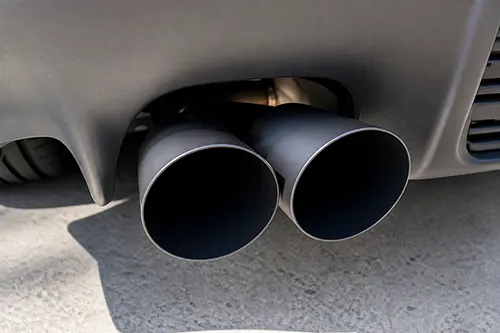
You walk up to your car, and something catches your eye: the left exhaust tip is coated in thick black soot, while the right side looks almost clean. You scrub it off. A week later, the same side is black again. What’s going on? Uneven blackening of exhaust tips isn’t just a cosmetic nuisance – it’s a visible clue about your engine’s health and your exhaust system’s integrity. In this guide, we’ll dissect the three primary suspects: a rich-running condition, short-trip driving habits, and exhaust leaks that create asymmetric soot patterns. By the end, you’ll know exactly what to inspect and how to restore even, clean exhaust tips.
Why Exhaust Tips Turn Black: The Science of Soot
Before we focus on one‑side blackening, let’s look at why any exhaust tip turns black in the first place. The dark deposit is primarily carbon soot – unburned or partially burned fuel particles. Complete combustion of gasoline produces carbon dioxide (CO₂) and water vapor. Real engines, though, never burn fuel with perfect efficiency. Cold starts, rich air‑fuel mixtures, misfires, or poor atomization leave behind tiny carbon particles that move through the exhaust and stick to cooler surfaces like the tip. A thin, uniform gray‑black film is normal over many miles. Heavy blackening that returns quickly on one side only, however, points to an imbalance worth chasing down.
Suspect #1: Rich Fuel Mixture (But Why Only One Side?)
A rich mixture means the engine is getting too much fuel relative to air. This can come from faulty oxygen sensors, leaking fuel injectors, a restricted air filter, or a malfunctioning mass airflow sensor (MAF). If the overall mixture is rich, you’d expect both exhaust tips to darken at roughly the same rate. So why does only one side go black? Usually because something is making one bank behave differently from the other.
How a Rich Condition Becomes One‑Sided
- Asymmetric fuel injectors: One or two injectors on the same bank (e.g., cylinders 1‑3 on a V6) may leak or spray excess fuel, making that exhaust bank run richer than the other.
- Oxygen sensor imbalance: In V‑style engines with dual exhaust and separate oxygen sensors per bank, a faulty upstream O₂ sensor on one side can cause that bank to run rich while the other stays normal.
- Intake manifold or gasket issues: A vacuum leak on one bank leans out that side, but the ECU may compensate by adding fuel to both banks – or if the leak is after the MAF, it might create a cross‑bank imbalance.
Diagnostic Clues for a Rich Condition
- Check engine light with codes like P0172 (System Too Rich, Bank 1) or P0175 (Bank 2).
- Fuel smell from the exhaust or oil dipstick.
- Decreased fuel economy – you’re filling up more often.
- Rough idle or hesitation on acceleration.
- Spark plug inspection: On the affected bank, plugs will appear black and sooty.
| Possible Cause | One‑Sided Effect? | How to Verify |
|---|---|---|
| Leaky injector on one bank | Yes – that cylinder bank runs richer | Injector balance test or resistance check; swap injectors between banks |
| Faulty O₂ sensor (Bank 1 vs Bank 2) | Yes – ECU enriches only that bank | Scan live data; compare O₂ sensor voltage and fuel trims on both banks |
| Restricted air filter or MAF | Generally both banks, but uneven airflow can affect one side | Clean/replace air filter; check MAF readings |
| Exhaust valve or camshaft timing issue on one side | Yes – incomplete scavenging leads to rich mixture on that bank | Compression test and leak‑down test; inspect valve train |
Suspect #2: Short Trips – The Condensation Culprit
Short trips (less than 10‑15 minutes) are hard on any engine, but they can also create one‑sided blackening in dual‑exhaust systems. Here’s the reason: during a cold start, the engine runs intentionally rich to warm up the catalytic converters. Unburned fuel and water vapor condense inside the exhaust pipes. In a dual system, if one exhaust path is shorter, has fewer bends, or simply gets warmer faster, condensation may linger longer on the cooler side. That moisture mixes with soot and forms a sticky paste that builds up fast. The cooler tip turns black sooner. Sometimes much sooner.
Why Short Trips Favor One Side
- Uneven exhaust heating: The side closer to the engine’s heat source (e.g., driver’s side on some transverse V6 engines) warms up sooner, evaporating moisture. The far side stays cooler longer, trapping soot.
- Exhaust pipe routing: Longer or more convoluted pipes cool down faster, promoting condensation.
- Driving pattern: If you always park with the same side facing prevailing wind, that side may cool faster and accumulate more soot during the next cold start.
Quick test: After a short trip, say 5 minutes to the store, feel both exhaust tips carefully – they may still be hot. If one is significantly cooler and you see water droplets inside, short‑trip condensation is likely the main issue. It is worth noting that a 30‑minute highway drive often clears both tips and burns off accumulated soot, bringing the appearance back to something more even.
Suspect #3: Exhaust Leaks – The Hidden Soot Pattern Maker
An exhaust leak may seem unrelated to a black tip, but it can create a strong one‑sided soot pattern. When a leak exists before the oxygen sensor or catalytic converter on one bank, it pulls in false air. That extra oxygen is read by the O₂ sensor, which then tells the ECU to add more fuel to compensate. The result is simple: that entire bank runs rich, produces excess soot, and sends it downstream to blacken the tip on that side. The other bank, meanwhile, can stay almost untouched.
Common Leak Locations That Cause One‑Sided Soot
- Exhaust manifold gasket leak on one cylinder bank (audible ticking that goes away as the engine warms up).
- Cracked exhaust manifold – more common on cast iron manifolds.
- Leak at the flange between the manifold and the front pipe – often due to a failed gasket or broken studs.
- Hole or rust perforation in the pipe upstream of the O₂ sensor on one side.
How to Identify an Exhaust Leak as the Root Cause
- Listen for a ticking or puffing sound that increases with engine RPM.
- Perform a smoke test – introduce smoke into the exhaust system; leaks will reveal themselves with visible smoke escaping.
- Check fuel trims with a scanner: A leak on one bank will show positive long‑term fuel trim (adding fuel) on that bank while the other bank stays near zero.
- Inspect for black soot trails around gaskets or flanges – escaping exhaust leaves dark marks.
Other Possible Causes of One‑Sided Blackening
Rich running, short trips, and leaks account for 90% of cases. Still, a few less common issues are worth mentioning before you start replacing parts on a hunch:
- Clogged catalytic converter on one side: A restricted cat increases backpressure and may force exhaust gases to take the path of least resistance, sending more flow – and soot – out the other tip. This usually comes with power loss or a rotten‑egg smell.
- Misfire on one cylinder bank: A misfiring cylinder dumps raw fuel and oxygen into the exhaust, creating heavy soot. Misfire codes (P030X) will appear.
- PCV system routing: On some engines, the PCV valve feeds crankcase vapors into only one intake runner, causing that cylinder to run slightly richer over time.
- Aftermarket exhaust tip design: A tip with a narrower opening or internal baffle can collect soot faster than an open one, even if exhaust flow is equal. Swap tips side‑to‑side to rule this out.
Step‑by‑Step Diagnosis: From Tip to Engine
Follow this logical flow to pinpoint the cause of your one‑sided soot issue without throwing parts at the problem. Why guess when the soot is already telling you where to start?
- Clean both exhaust tips thoroughly and note the mileage. Drive 100 miles normally, then recheck. If the same side is black again, proceed.
- Check for exhaust leaks using the listening and smoke methods. Repair any leaks first – they’re often cheap to fix and very often solve the problem.
- Read engine codes with an OBD2 scanner. Look for rich or lean codes (P0172, P0175) or misfire codes. Note which bank is affected.
- Examine fuel trims: Compare short‑term and long‑term fuel trims on Bank 1 vs Bank 2. A bank with trims above +10% (adding fuel) indicates a rich condition or a leak.
- Inspect oxygen sensor waveforms while driving. A lazy or stuck O₂ sensor will cause incorrect fueling on one bank.
- Perform a cylinder balance or injector test if you suspect a leaking injector.
- Evaluate your driving habits: If you mostly do short trips, take a long highway drive (45+ minutes) and see if the blackness disappears. If it does, condensation is the culprit.
Real‑World Example: The Uneven Twin Turbo
A 2016 BMW 550i with the N63 V8 came in complaining of a “black left exhaust tip within 200 miles.” The right tip stayed clean. The owner had already cleaned the tips twice. Inspection revealed a small crack in the left turbocharger to downpipe flex joint – an exhaust leak upstream of the primary O₂ sensor. Smoke test confirmed the leak. After replacing the gasket and welding the crack, fuel trims on Bank 2 dropped from +18% to +2%. After a week of driving, both tips remained equally clean. A tiny leak caused a massive one‑sided soot problem. Funny how often that happens.
Prevention and Maintenance Tips
Once you’ve identified and fixed the underlying cause, keep the tips clean and the engine healthy with a few basic habits:
- Use top‑tier fuel to reduce combustion deposits.
- Perform regular Italian tune‑ups – occasional spirited driving burns off accumulated soot and moisture.
- Replace oxygen sensors at recommended intervals (every 60‑100k miles).
- Check exhaust system annually for rust, loose clamps, or gasket leaks.
- Avoid excessive idling – it promotes soot buildup without warming up the exhaust fully.
- Use a quality exhaust tip cleaner (non‑abrasive) and apply a light coat of wax to the tips to reduce future adhesion.
When to Worry – And When to Ignore
A single black exhaust tip isn’t always an emergency. If there’s no check engine light, no drivability issue, and the car passes emissions, it may simply be a quirk of the exhaust design or of the way the car is driven. Still, there are a few cases where you really shouldn’t shrug it off:
- The black soot is oily or wet – could indicate engine oil burning (valve seals, piston rings).
- The tip is destroyed by heat or blued metal – suggests a very lean misfire or ignition problem.
- You notice a strong fuel smell inside the cabin – potential fire hazard.
- Fuel economy has dropped more than 20% without explanation.
Conclusion: Listen to What Your Exhaust Tip Is Telling You
Your car’s exhaust tips are more than decorative finishers – they’re diagnostic windows into combustion efficiency and exhaust integrity. When only one side turns black quickly, don’t jump straight to replacing both catalytic converters or tuning the whole engine. Instead, work through the three common causes methodically: a rich condition on one bank, from an injector, O₂ sensor, or mechanical issue; short‑trip condensation patterns; or an exhaust leak that tricks the ECU into over‑fueling one side.
Armed with a code scanner, a sharp ear for leaks, and a willingness to go for a long drive, you can usually pinpoint the root cause in an afternoon. Fix the real problem, and you’ll not only end up with cleaner, matching exhaust tips – you’ll also restore proper fuel economy, reduce emissions, and enjoy a smoother running engine. So the next time you notice that one‑sided soot, treat it as a conversation starter with your car, not just an annoyance to wipe away.
Remember: Safety first when working around hot exhaust components. Always let the exhaust system cool completely before touching tips or inspecting for leaks. And never attempt to seal an exhaust leak with tape or putty – use proper gaskets and clamps, or consult a professional.