

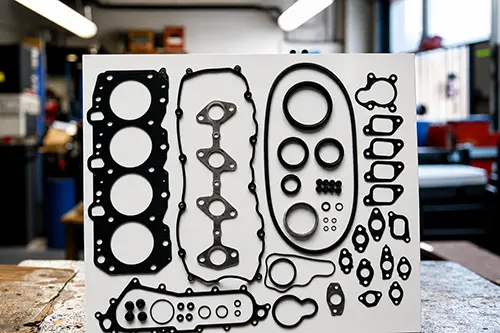
In any workshop—automotive, hydraulic, pneumatic, or industrial—the decision to reuse a clip, seal, or gasket can mean the difference between a reliable repair and a costly, dangerous failure. Small part, big consequence. This rulebook provides clear, inspection‑based guidelines to help technicians know when to replace and when reuse is acceptable.
1. General Principle: The Three‑Strike Rule
Any clip, seal, or gasket that fails any of the following three checks must be replaced immediately:
- Visual integrity – cracks, tears, permanent deformation, or surface erosion.
- Elasticity / resilience – the part no longer returns to its original shape.
- Sealing surface condition – embedded debris, scoring, or chemical residue.
If it passes all three, limited reuse may be acceptable under the specific conditions below. What is important is that passing one or two checks is not enough.
2. Clips (Spring Clips, Retaining Rings, Hose Clamps)
| Condition | Replace | Reuse (only if) |
|---|---|---|
| Visible necking or metal fatigue | Yes | No reuse allowed |
| Loss of clamping force (hand‑tested) | Yes | No reuse allowed |
| Rust or galvanic corrosion | Yes | No reuse allowed |
| Light surface oxidation, no pitting | No | Clean and reuse once |
| Proper tension and undamaged plier holes | No | Reuse up to 2 cycles |
Workshop rule: Replace all one‑time‑use clamps (e.g., Oetiker ear clamps) every time. For reusable spring clips, if the free gap has widened more than 5% of its original width, discard it. Simple rule, and worth sticking to.
3. Seals (O‑Rings, Lip Seals, Quad‑Rings)
Seals are the most sensitive to wear and environmental attack. Use this decision flow:
- Hardness change – if the seal feels harder or softer than a new sample → replace.
- Surface damage – any nick, scratch, or flat spot deeper than 0.2 mm → replace.
- Chemical swelling – increased diameter or loose fit in groove → replace.
- Compression set – after removal, if the seal does not spring back within 5 seconds → replace.
- Clean, elastic, and within tolerances – may be reused only in low‑pressure (under 500 psi), non‑critical static applications.
Absolute no‑reuse zones: Fuel systems, brake hydraulics, respiratory air circuits, and any seal that has seen temperatures above its rated limit.
4. Gaskets (Sheet, Rubber, Cork, Metal MLS)
Gasket reuse is rarely recommended, but practical workshops sometimes allow it under strict rules:
- Fiber / paper / cork gaskets – always replace. These compress permanently and will leak.
- Rubber coated metal (e.g., valve cover gaskets) – replace if rubber shows cracks, hardening, or peeling. Reuse only if perfectly soft, undamaged, and torqued to a lower value (80% of new).
- Multi‑layer steel (MLS) head gaskets – never reuse. The viton coating and spring layers are one‑time crush.
- Solid copper or annealed aluminum gaskets – can be re‑annealed and reused once if no scuffs or gas cutting. After second use, replace.
Quick rulebook table for gaskets:
| Gasket material | Reuse allowed? | Maximum cycles |
|---|---|---|
| Compressed non‑asbestos (CNA) | No | 1 (replace each disassembly) |
| Cork / rubberised cork | No | 1 |
| Solid copper (annealed) | Yes, after re‑annealing | 2 |
| Rubber (elastomeric) | Only if like‑new | 2 (non‑critical only) |
| PTFE (virgin) | Yes, inspect for creep | 3 |
5. Safety and Liability Rule
If a clip, seal, or gasket is part of a safety‑critical system (brakes, fuel, steering, lift hydraulics, pressure vessels), always replace it – regardless of visual condition. No debate there. Document all reuses in a workshop log for traceability.
6. Final Workshop Checklist
Before deciding to reuse, answer these five questions:
- Is the application static or dynamic? (Dynamic seals → replace more often)
- Has the part ever been overheated or exposed to aggressive fluids? (Yes → replace)
- Does the manufacturer explicitly forbid reuse? (Yes → replace)
- Is the replacement part in stock and low cost? (Yes → replace, it is cheaper than a rework)
- Would a failure cause injury or major downtime? (Yes → replace)
Golden rule of the practical workshop: “When in doubt, throw it out.” A new clip, seal, or gasket is cheap insurance compared to a catastrophic leak or mechanical failure. Why gamble on the cheapest part in the job?