

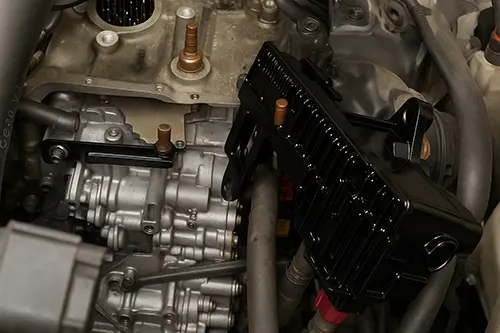
Transmission fluid temperature (TFT) sensor failures cause harsh shifts, limp mode, or incorrect temp readings. This guide covers resistance testing, common failure modes, and replacement procedures for internal and external TFT sensors.
Sensor types and locations
- Internal (in pan or valve body): requires pan drop; common on Honda, Toyota, some GM.
- External (on trans case or line): accessible without disassembly; Ford, Chrysler, some Nissan.
Failure symptoms by sensor type
Internal sensor
- Erratic shift points (ECU sees wrong temp)
- Limp mode in extreme cold or heat
- P0710, P0711, P0712, P0713 codes
External sensor
- Similar symptoms but easier to test/replace
- Connector corrosion common (exposed to road spray)
Resistance testing (NTC thermistor type)
| Temp (°C) | Resistance (Ω) typical |
|---|---|
| 20 | ~3000–4000 |
| 40 | ~1200–1600 |
| 80 | ~250–350 |
| 100 | ~140–200 |
Test with ohmmeter; compare to spec for your transmission. Out of range = failed sensor.
Live data diagnosis (scan tool)
- Cold trans (~ambient temp): sensor should read within 5°C of ambient.
- After 10-minute drive: should climb to 70–90°C (normal operating range).
- If stuck at one value or jumps erratically → sensor fault.
Replacement (internal sensor example: Accord –)
- Drain trans fluid (~3 qts).
- Drop pan (12–16 bolts); locate sensor in valve body or pan.
- Unplug connector; unscrew sensor (may require special socket on some).
- Install new sensor with new O-ring; torque to spec (~10–15 ft-lb typical; verify).
- Reinstall pan with new gasket; refill fluid to correct level.
Replacement (external sensor example: –)
- Locate sensor on trans case (no drain needed).
- Unplug connector; unscrew sensor.
- Install new sensor with new O-ring or seal washer.
- Reconnect; test with scan tool.
Post-replacement
- Clear codes; drive until trans reaches operating temp.
- Verify live data shows accurate temp rise and fall.
- Confirm shift quality improves (if harsh shifts were symptom).
Costs
- Internal sensor: $30–80 part; $150–300 labor (pan drop)
- External sensor: $25–60 part; $50–120 labor
- Fluid for refill (if internal): $30–60
Diagnostic tip: TFT sensor faults often misdiagnosed as transmission internal failure; test sensor first before assuming expensive trans work is needed.
Sensor mounting configurations
Type A: Threaded into trans case
- Platforms: Ford, Chrysler, some GM
- Seal: O-ring or crush washer
- Torque: 10–20 ft-lb typical
Type B: Pressed into valve body
- Platforms: Honda, Toyota, Mazda
- Seal: O-ring on sensor body
- Retention: bolt or clip
Type C: In-line on cooler circuit
- Platforms: some BMW, Mercedes
- Threads into cooler line tee
- Easiest access; no fluid drain needed
Scan tool live data analysis
Normal temp progression during drive:
| Time | Expected TFT |
|---|---|
| Start (cold) | Ambient ±5°C |
| 5 minutes city | 50–70°C |
| 15 minutes mixed | 80–95°C |
| Normal operating | 85–100°C |
Stuck reading or erratic jumps = sensor fault.
Lifespan and failure rate
- Internal sensors: 120k–180k miles average
- External sensors: 80k–150k miles (exposed to elements)
- Failure rate increases sharply after 150k miles across all platforms