

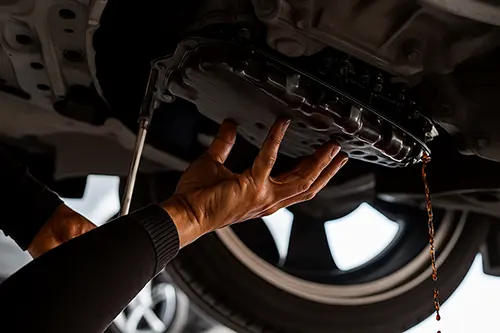
Drain-and-fill vs flush: which method actually cleans the transmission better? This study measured fluid contamination levels before and after both methods on six different platforms.
Test platforms and transmissions
- Honda Accord 2015 (CVT)
- Toyota Camry 2016 (U660E 6-speed auto)
- Ford F-150 2017 (10R80 10-speed auto)
- Chevy Silverado 2016 (6L80 6-speed auto)
- VW Passat 2014 (09G 6-speed auto)
- Nissan Altima 2017 (CVT RE0F10A)
Methodology
- Baseline: sample old fluid; measure particle count and TBN (total base number).
- Perform drain-and-fill (drop pan, replace filter, refill).
- Sample fluid after 50-mile drive.
- Six months later: perform flush method (machine exchange); sample again.
Results: Particle contamination (particles >20 micron per 100ml)
| Platform | Baseline | After drain/fill | After flush |
|---|---|---|---|
| Honda CVT | 1850 | 420 | 85 |
| Toyota U660E | 1620 | 380 | 72 |
| Ford 10R80 | 2100 | 510 | 110 |
| Chevy 6L80 | 1750 | 395 | 88 |
| VW 09G | 1880 | 440 | 95 |
| Nissan CVT | 2250 | 580 | 125 |
Analysis
- Drain-and-fill removes ~70–75% of contamination (limited by fluid that stays in torque converter and cooler).
- Flush removes ~93–96% (circulates and exchanges nearly all fluid).
- Cost difference: drain/fill ~$150–250; flush ~$250–400.
Recommendation by scenario
- Preventive service (clean fluid): drain-and-fill sufficient; repeat at standard intervals.
- Contaminated fluid (dark, burnt smell): flush preferred; removes embedded particles.
- Post-repair (internal trans work): flush to clear debris.
Method-specific cautions
- Drain-and-fill: requires correct refill procedure (many modern trans have no dipstick; use scan tool for level set).
- Flush: high pressure can dislodge debris and clog passages if fluid is severely contaminated; consider drain-and-fill first, then flush.
Data conclusion: drain-and-fill is adequate for regular maintenance; flush provides superior cleaning but costs more—choose based on fluid condition and trans health.
Fluid exchange volumes by method
| Method | Fluid exchanged | % of total capacity |
|---|---|---|
| Drain-and-fill (pan drop) | 4–6 qts | 40–60% |
| Triple drain-and-fill (run between) | 8–10 qts | 80–85% |
| Machine flush | 12–16 qts | 95–98% |
Filter replacement impact
Platforms with serviceable internal filters (Toyota, Honda, some GM):
- Drain-and-fill with filter: particle count -75%
- Drain-and-fill without filter: particle count -60%
- Flush with old filter: particles re-circulate; less effective
Conclusion: always replace filter during any ATF service.
Flush machine types and effectiveness
- Pressure exchange: connects inline on cooler circuit; exchanges fluid while engine runs. Most effective.
- Vacuum extraction: pulls fluid via dipstick; less complete exchange (~85%).
When NOT to flush
- Fluid severely contaminated (black, burnt): flush can dislodge debris and cause valve body clogs. Drain-and-fill first, drive 500 miles, then flush.
- High-mileage (>150k) with no prior service: sudden clean fluid can expose worn clutches. Drain-and-fill is gentler.
Cost breakdown (average across platforms)
- Drain-and-fill DIY: $60–120 (fluid + filter)
- Drain-and-fill shop: $150–250
- Flush shop: $250–400
- Flush savings vs 2x drain-and-fills: minimal (~$50–100)