

Why Wheel Alignment Matters More Than You Think
Proper wheel alignment isn't just a technical service item listed in your vehicle's maintenance schedule—it's a fundamental aspect of your car's overall health and performance. When your wheels are perfectly aligned, your vehicle handles precisely as engineered, tires wear evenly, and you enjoy optimal fuel efficiency. Misalignment, on the other hand, can lead to premature tire wear, compromised handling, and even safety concerns that creep up gradually until they become impossible to ignore.
Many drivers underestimate how frequently alignment checks are needed. Contrary to popular belief, you don't need to hit a massive pothole or curb to knock your suspension out of specification. Daily driving gradually deteriorates alignment settings through normal wear and tear on suspension components, with the average vehicle requiring alignment checks at least once per year or every 12,000 miles.
Recognizing the Telltale Signs of Misalignment
Before delving into the technical aspects of alignment, every driver should know the warning signs that indicate when service is needed:
- 🧭 Vehicle pulling persistently to one side when driving on a straight, level road. This is one of the most common complaints that drivers notice first. The pull may be subtle initially but typically worsens over time.
- 🎡 Steering wheel vibration or off-center position when driving straight. If you notice your steering wheel isn't centered when traveling straight or has developed an unusual vibration, this often indicates alignment issues [3].
- 🔊 Uneven or abnormal tire wear patterns. Regularly inspecting your tires can reveal alignment problems before they become severe. Specific wear patterns correspond to particular alignment issues, which we'll explore in detail later.
- 🚗 General handling vagueness or decreased stability. You might notice your vehicle doesn't respond as crisply to steering inputs or feels less stable at highway speeds, requiring more constant steering corrections.
If you're experiencing any of these symptoms, it's time to have your alignment checked by a professional. Continuing to drive with misaligned wheels will only exacerbate the problems, potentially leading to costlier repairs down the road.
Understanding the Three Key Alignment Angles
Wheel alignment primarily involves adjusting three fundamental angles: toe, camber, and caster. Each angle affects your vehicle's handling and tire wear in distinct ways, and understanding these will help you comprehend what technicians are adjusting during an alignment service.
Toe Alignment: The Direction Your Tires Point
Toe is arguably the most critical alignment angle for tire longevity. Imagine looking down at your feet from above and angling them inward toward your body's center—this illustrates toe-in alignment. Conversely, pointing them outward demonstrates toe-out alignment.
- Measurement: Toe is measured in degrees or inches/millimeters and represents the difference in distance between the front and rear of the tires on the same axle
- Effect on vehicle: Incorrect toe settings cause immediate tire wear issues rather than affecting handling characteristics
- Wear patterns: Excessive toe-in accelerates wear on the outer tire edges, while excessive toe-out accelerates wear on the inner edges
- Adjustment: Technicians adjust toe by altering the length of the tie rod assemblies, which are components of your steering system
Camber: The Vertical Tilt of Your Wheels
Camber refers to the inward or outward vertical tilt of your tires when viewed from the front of the vehicle. Think of a motorcycle taking a sharp turn—its wheels tilt radically to maintain contact with the road surface. Your car uses similar principles, though with much subtler angles.
- Positive camber: The top of the tire tilts outward from the vehicle's center
- Negative camber: The top of the tire tilts inward toward the vehicle's center
- Effect on vehicle: Camber affects how the tire contacts the road during cornering. Modern vehicles often have slight negative camber to aid stability during turns
- Wear patterns: Positive camber causes wear on the outer edges of tires, while negative camber causes wear on the inner edges
- Adjustment: Depending on your suspension design, camber may be adjusted using eccentric bolts on strut assemblies, shims, or eccentric cams on control arm bushings
Caster: The Steering Axis Angle
Caster might be the least understood alignment angle, but it significantly impacts your steering feel and stability. Caster is the forward or backward tilt of the steering axis when viewed from the side of your vehicle.
- Positive caster: The steering axis tilts toward the driver. This enhances straight-line stability and helps the steering wheel return to center after turns
- Negative caster: The steering axis tilts toward the front of the vehicle. This makes steering lighter but can cause instability at higher speeds
- Effect on vehicle: Caster primarily affects steering effort and return-to-center characteristics rather than tire wear
- Adjustment: On many vehicles, caster isn't readily adjustable without special kits or components, though some suspensions allow adjustment through moving strut mounting positions or adjusting radius rods
| Alignment Angle | Measured In | Primary Effect | Common Symptoms When Incorrect |
|---|---|---|---|
| Toe | Degrees or inches/mm | Tire wear | Feathering wear patterns, rapid shoulder wear |
| Camber | Degrees | Tire wear & cornering stability | Uneven wear across tread, pulling |
| Caster | Degrees | Steering stability & return | Wheel doesn't return to center, wandering |
The Fourth Critical Measurement: Thrust Angle
While toe, camber, and caster get most of the attention, thrust angle is equally important for proper alignment, especially in vehicles with independent rear suspensions or those that have suffered collision damage.
The thrust angle represents the direction the rear wheels are pointing relative to the vehicle's centerline. When improperly set, it causes what technicians call "dog-tracking" or "crab-walking," where the vehicle appears to be moving slightly sideways rather than perfectly straight.
An incorrect thrust angle can't be corrected by front-wheel adjustments alone and requires proper alignment of all four wheels to ensure the vehicle tracks straight and true.
Types of Wheel Alignments: Which Does Your Vehicle Need?
Not all alignment services are created equal. Depending on your vehicle's suspension design, you might need one of three primary alignment types:
1. Front-End Alignment
This basic alignment focuses solely on the front axle, adjusting the toe, camber, and caster of the front wheels only. While this was sufficient for older vehicles with solid rear axles, most modern vehicles require more comprehensive alignment to ensure proper handling and wear characteristics.
2. Thrust Alignment
A thrust alignment combines front-end adjustments with ensuring the rear wheels are squared with the front axle. This type is typically recommended for vehicles with a solid rear axle that doesn't allow for individual wheel adjustments.
3. Four-Wheel Alignment
The most comprehensive alignment service, four-wheel alignment, adjusts all adjustable angles on both front and rear suspensions. This is essential for all-wheel drive vehicles, front-wheel drive cars with independent rear suspensions, and most modern vehicles.
| Alignment Type | Vehicle Applications | What's Adjusted |
|---|---|---|
| Front-End | Older vehicles with solid front and rear axles | Front toe, camber, caster |
| Thrust | Vehicles with solid rear axles | Front angles, rear thrust angle |
| Four-Wheel | Most modern vehicles, especially those with independent rear suspension | All adjustable angles front and rear |
The Professional Alignment Process: What Technicians Do
When you bring your vehicle in for alignment service, certified technicians follow a meticulous process to ensure precise results:
- Pre-alignment inspection and test drive: Before any measurements are taken, the technician will test drive your vehicle to verify the concerns you've reported and conduct a visual inspection of your tires and suspension components.
- Comprehensive suspension check: The vehicle is raised on a hoist, and the technician thoroughly examines tires, suspension, and steering components for wear or damage. Worn parts must be replaced before alignment, as they prevent accurate adjustments and cause rapid reversion to misalignment.
- Tire pressure adjustment: All tires are inflated to the manufacturer's specified pressures, as incorrect pressure affects alignment measurements and outcomes.
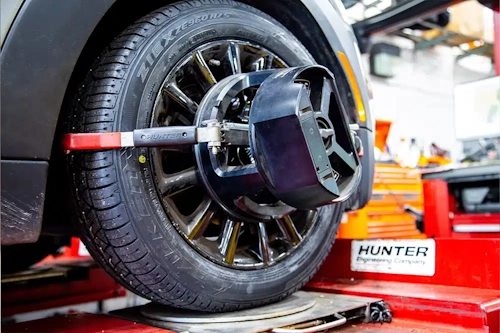
- Mounting alignment equipment: Specialized alignment heads or reflectors are attached to each wheel, connecting to a computerized alignment machine that takes precise measurements.
- Taking initial measurements: The computer measures all alignment angles and compares them to the manufacturer's specifications for your specific vehicle based on its year, make, model, and sometimes even trim level or optional equipment.
- Making adjustments: The technician methodically adjusts each angle to bring it within specification, focusing first on the rear angles (if applicable) before moving to the front to ensure a proper baseline.
- Verification and test drive: After adjustments, the system verifies all angles are within tolerance, the steering wheel is centered, and a final test drive confirms the issues have been resolved.
Understanding Your Alignment Report
After your alignment service, you should receive a printout or digital report showing the before and after measurements. While these reports might look technical, understanding a few basics will help you verify the work was performed correctly.
Alignment specifications are typically presented in degrees and minutes, where a full circle contains 360 degrees, and each degree contains 60 minutes (so 1°35' means 1 degree and 35 minutes).
The report will show:
- Initial measurements: The "before" readings showing how far out of specification your vehicle was
- Final measurements: The "after" readings demonstrating all angles are now within the acceptable range
- Specification ranges: The minimum and maximum acceptable values for each angle, often with a preferred setting in the middle
- Color coding: Typically, red indicates out-of-specification measurements, while green shows values within tolerance
Even if angles aren't adjustable on your vehicle (some vehicles have fixed caster or camber), the report should still show they were checked and recorded.
DIY vs. Professional Alignment: Why Precision Matters
While enthusiastic DIYers can attempt basic alignment checks using string methods and homemade tools, achieving manufacturer-level precision requires professional equipment and expertise. The margin for error is extremely small—often measured in minutes of degrees—and imperceptible to the naked eye.
Professional alignment systems use precise cameras, sensors, and computerized measurement technology that can detect deviations as small as hundredths of a degree. This precision is necessary because:
- Modern tires are expensive: Proper alignment maximizes their lifespan, potentially saving you hundreds of dollars in premature replacement costs
- Safety depends on precise handling: Even slight misalignment can affect emergency maneuverability
- Modern vehicles have sophisticated stability systems that rely on proper alignment to function correctly
Unless you have access to professional equipment and training, alignment service is best left to qualified technicians who can ensure the job is done right.
Maintaining Your Alignment: Protection for Your Investment
After investing in a proper alignment, you'll want to protect that investment. These practices will help maintain your alignment and extend the life of your tires:
- Avoid potholes and curb impacts: Even seemingly minor impacts can knock your alignment out of specification. Stay alert for road hazards, especially during changing seasons when potholes tend to form
- Have your alignment checked regularly: Most manufacturers recommend alignment checks at specific mileage intervals or anytime you notice potential symptoms of misalignment
- Address suspension issues promptly: Worn shocks, struts, or other suspension components can allow alignment to shift gradually. Replace worn parts before they affect your alignment
- Check tire pressure monthly: Improper inflation affects how your tires contact the road and can mimic or exacerbate alignment issues
- Rotate your tires regularly: Regular rotation helps promote even wear patterns and can sometimes reveal alignment issues before they become severe
The Connection Between Alignment and Other Services
Wheel alignment is often performed alongside other maintenance services that complement each other:
- Tire rotation and balancing: While alignment ensures your wheels are positioned correctly, balancing ensures the weight distribution around each wheel is even. These services work together to provide a smooth, vibration-free ride
- Suspension service: Worn suspension components prevent proper alignment and cause rapid reversion to misalignment. Sometimes, suspension repairs are necessary before alignment can be performed accurately
- Tire replacement: Whenever you install new tires, having an alignment ensures they wear evenly from day one, maximizing your investment
Conclusion: Alignment as Preventive Maintenance
Proper wheel alignment isn't just a repair to address obvious symptoms—it's a crucial preventive maintenance service that protects your investment in tires, ensures optimal vehicle handling, and maintains safety margins engineered by your vehicle's manufacturer.
By understanding the principles behind wheel alignment, recognizing the signs of misalignment, and having your vehicle serviced regularly by qualified professionals, you'll enjoy better handling, longer tire life, and greater confidence behind the wheel.
Don't wait until symptoms become severe—make alignment checks a regular part of your vehicle maintenance routine. Your tires, your wallet, and your safety will thank you.