

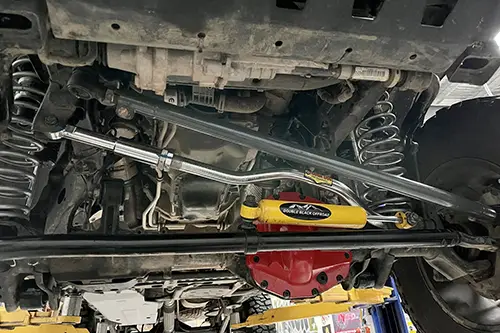
Thinking about lifting your Jeep Wrangler JL (2018–2024) for 35-inch tires? The marketing says "bolt-on"; reality includes geometry changes, alignment limits, and driveline angles. I ran both 2-inch and 3.5-inch lifts on my JL Rubicon—here's what actually happens.
My Jeep and testing method
2021 JL Rubicon Unlimited 3.6L; factory on 33s. Ran a 2-inch budget lift for 10k miles, then stepped up to 3.5-inch with control arm correction for 35s. Measured steering feel, MPG, wear patterns, and trail performance.
2-inch lift on 33s (budget path)
- Setup: coil spacers front, add-a-leaf rear (~$300 kit).
- Pros: cheap, reversible, no alignment issues, factory geometry preserved.
- Cons: ride quality suffers (spacers are harsh); 33s look small in fenders at this height.
- MPG impact: 17.2 → 16.8 (minimal).
3.5-inch lift on 35s (serious setup)
- Setup: full coils front, extended shocks all around, adjustable control arms (~$1,800 kit + install).
- Pros: proper geometry restored, great ride quality, 35s look right, clearance for trails.
- Cons: expensive, alignment critical, driveshaft angles need attention, regearing recommended (4.56 or 4.88 for 3.6L).
- MPG impact: 17.2 → 14.9 (significant with 35s and no regear).
Geometry and alignment at 3.5-inch
Lift changes control arm angles; without correction:
- Caster drops → wandering steering.
- Camber goes positive → inner tire wear.
- Ball joint bind at droop → premature wear.
Solution: adjustable upper or lower control arms restore factory angles. Cost: $400–800 for quality arms.
Driveline vibration (common at 3.5+)
- Rear driveshaft angle steep → vibration at highway speed.
- Fixes: transfer case drop, adjustable track bar, or double-cardan driveshaft (~$500).
What I'd do differently
Skip the 2-inch spacer phase; save money and go straight to a quality 3.5-inch kit with arms and shocks. The ride quality difference is night and day.
Real costs (my build)
- 3.5-inch lift kit (Metalcloak or EVO): ~$1,800
- Adjustable control arms: ~$600
- Alignment: ~$150
- 35x12.5R17 tires (5): ~$1,400
- Total: ~$4,000 for a proper setup
For JL suspension specs and part diagrams
Check Jeep 7zap: jeep.7zap.com.
Verdict: 3.5-inch + 35s transform the JL for trails; just budget for control arms, alignment, and possibly regears—halfmeasures waste money.
Regearing math (why it matters on 35s)
Stock 3.73 gears + 35-inch tires = sluggish, trans hunts for gears, poor MPG. Recommended regear for 3.6L JL with 35s:
- 4.56: balanced for highway and trails
- 4.88: if you spend >50% time off-road or heavily loaded
Cost: ~$2,000–3,500 installed (both axles).
What I did (and didn't) regear
Ran 35s on 3.73 gears for 5k miles—livable but not ideal. Regeared to 4.56; trans behavior night-and-day better. Worth every penny if you keep the Jeep.
Alignment after lift (my final specs)
- Caster: +5.5° (restored with arms)
- Camber: -0.5° (street use)
- Toe: +1/16 inch total (slight toe-in for highway stability)
For JL lift kits and suspension specs
Check Jeep 7zap: jeep.7zap.com.