

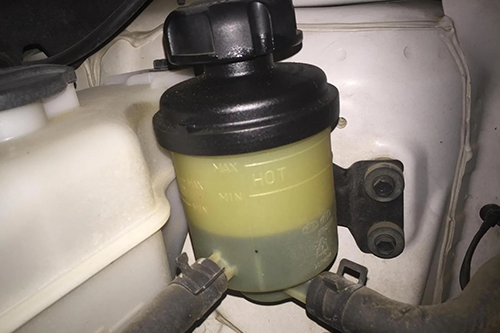
Whine when turning the wheel cold, or a groan at full lock? Your Hyundai Tucson (2016–2021) power steering might need fresh fluid or air bleeding. This guide covers when to service, how to flush cleanly, and how to eliminate noise without replacing the pump or rack.
Owner's case
Chris's 2018 Tucson 2.0L developed a morning whine turning into parking spots; disappeared after a few turns. Fluid was dark; air bubbles visible in the reservoir. A proper flush and bleed fixed it—no pump replacement.
When to service power steering fluid
- Every 50k–100k miles depending on use (towing, harsh conditions shorten intervals)
- Dark/burnt fluid or visible particles in the reservoir
- Groaning, whining, or delayed response when steering cold
- After rack or pump work—air always enters the system
Tucson-specific notes
The 2016+ Tucson uses Motor-Driven Power Steering (MDPS) on most trims (electric assist, no fluid). If your Tucson has hydraulic (base trims, some markets), it uses PSF-4 fluid (verify in manual).
Flush procedure (hydraulic systems)
- Raise front wheels off the ground; engine off.
- Remove reservoir cap; use a turkey baster or syringe to extract old fluid.
- Refill with fresh PSF-4; turn steering lock-to-lock slowly 10–15 times (engine off).
- Top up reservoir; start engine, turn lock-to-lock 5 times, check for bubbles.
- Let idle 2–3 minutes; top up again if needed.
Air bleeding (critical for noise elimination)
- With engine running, turn slowly lock-to-lock; do NOT hold at full lock >2 seconds (overheats pump).
- Watch reservoir for bubbles; continue until fluid stays clear and level stable.
- Road test; re-check fluid level after first drive.
Chris's outcome
Flushed 1.5 quarts; bled air per procedure; whine disappeared. Fluid stayed clean after 500 miles. Total: $15 fluid, 45 minutes.
Tools
- Turkey baster or fluid extractor pump
- Catch pan, funnel, nitrile gloves
- Jack stands for front wheels
For Tucson power steering diagrams
Check Hyundai 7zap: hyundai.7zap.com.
Common mistakes
- Holding steering at full lock while running—pump damage.
- Using ATF instead of PSF—wrong viscosity, possible seal damage.
- Not bleeding air—noise returns quickly.
Bottom line: if your Tucson has hydraulic steering, fresh fluid and proper bleeding restore quiet operation—Chris saved a $400 pump diagnosis.
Tucson hydraulic vs MDPS (electric)—which do you have?
Check your owner's manual or VIN decoder. MDPS (Motor-Driven Power Steering) has no fluid; hydraulic has a reservoir near the firewall. If you have MDPS and hear whine, suspect the motor or column bearings—not fluid.
Detailed bleeding for stubborn air
- After initial flush, let the engine run at idle for 3–5 minutes.
- Turn steering slowly left to center, hold 2 seconds, then right to center, hold 2 seconds—repeat 10 cycles.
- Check for foam in reservoir; if present, continue cycles until foam clears.
- Top up fluid; road test with tight turns; re-check level next day.
Chris's follow-up
Initial flush left minor whine at cold start. Second bleeding session (10 more lock-to-lock cycles with engine running) eliminated all noise. Fluid level stabilized after 100 miles.
Costs
- PSF-4 fluid (1 qt): ~$8–15
- Full flush typically needs 1–1.5 qt
- Shop service: ~$80–150 (flush + bleed)
Practical section
- Can I use generic PS fluid? Verify compatibility; Hyundai PSF-4 is specific—wrong fluid can damage seals.
- How often should I check the level? Monthly if you hear noise; every 6 months otherwise.