

Introduction: The Heartbeat of Your Silverado's Speed and Transmission Control
The Vehicle Speed Sensor (VSS) is a critical component in your Chevrolet Silverado's powertrain management system. It provides real-time vehicle speed data to the Engine Control Module (ECM) and Transmission Control Module (TCM), enabling accurate speedometer readings, proper shift scheduling, cruise control operation, and even torque converter clutch engagement. A failing VSS can lead to erratic behavior, poor drivability, and even transmission damage if ignored. Whether you drive a classic 1990s Silverado or a modern 2023 model, understanding this sensor's role, how to identify it, and how to safely service it can save you time, money, and frustration.
What is a Vehicle Speed Sensor (VSS)?
The VSS is typically a magnetic or Hall-effect sensor mounted near a rotating component—such as the transmission output shaft, transfer case (on 4WD models), or differential. It generates an electrical signal (either analog AC voltage or digital square wave) proportional to the rotational speed of that component. The ECM/TCM uses this signal to calculate vehicle speed and adjust transmission shift points, line pressure, and torque converter lockup accordingly. On modern Silverados, the VSS also communicates with the ABS system, stability control, and even the speedometer cluster.
Identifying the VSS on Your Chevrolet Silverado
Location varies by model year, drivetrain, and transmission type. Here are common mounting points:
- Rear of Transmission (2WD models): On most rear‑wheel‑drive Silverados (1500, 2500HD, 3500HD), the VSS is threaded into the tailhousing of the transmission, near the output shaft. It's usually held by a single bolt or screwed in directly.
- Transfer Case (4WD models): On four‑wheel‑drive versions, the VSS may be located on the transfer case, monitoring the speed of the output shaft to the rear or front driveshaft.
- Differential (some models): Certain heavy‑duty or later models place the VSS in the differential housing, reading the ring gear speed.
- Engine Speed Sensor vs. VSS: Don't confuse the VSS with the crankshaft or camshaft position sensors—those measure engine RPM, not vehicle speed.
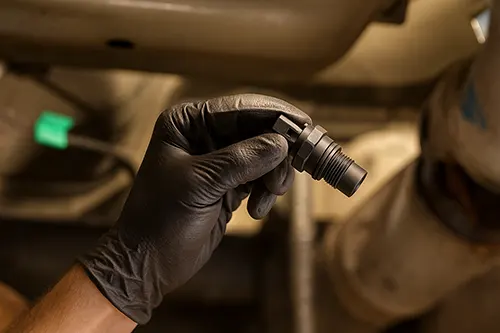
Visually, the VSS is a small plastic or metal sensor with an electrical connector (usually two or three wires) and a threaded body. On earlier Silverados (GMT400, GMT800), it often has a black plastic connector and is accessible from under the vehicle. Newer models may have a similar design but with different connector shapes.
Symptoms of a Faulty VSS
A failing VSS can manifest in several ways. Recognizing these symptoms early can prevent misdiagnosis and further damage:
| Symptom | Description |
|---|---|
| Inaccurate or erratic speedometer | Speedometer needle jumps, reads zero, or shows incorrect speed while driving. |
| Harsh or delayed shifting | Transmission shifts erratically, slips, or fails to shift at proper speeds because the TCM lacks speed data. |
| Check Engine Light (CEL) illuminated | Diagnostic Trouble Codes (DTCs) such as P0500 (Vehicle Speed Sensor Malfunction), P0501, P0502, or P0503 may be stored. |
| Cruise control inoperative | Cruise control system relies on VSS signal to maintain set speed; without it, cruise will not engage or will drop out. |
| Torque converter clutch (TCC) not locking | Reduced fuel economy and increased transmission heat due to lack of lockup. |
| ABS warning light | Some Silverados use VSS data for ABS; a fault may trigger the ABS light. |
Diagnostic Checks: Verifying VSS Health
Before replacing the VSS, perform basic checks to confirm it's the culprit. You'll need a digital multimeter (DMM) and possibly a scan tool.
Visual Inspection
Inspect the wiring harness and connector for damage, corrosion, or loose pins. Check for metal debris on the sensor tip—this can indicate internal transmission wear. Also ensure the sensor is securely mounted; a loose sensor can cause intermittent signals.
Electrical Tests
- Resistance test (for magnetic type): Disconnect the sensor and measure resistance across its terminals. Consult your service manual for specifications; typical values range from 190 to 250 ohms for many GM sensors. If open or shorted, replace the sensor.
- AC voltage output (magnetic): Jack up the drive wheels safely, support the vehicle on stands, and rotate the wheels by hand (or with engine running in gear, but be extremely cautious). Connect a DMM set to AC voltage to the sensor terminals. You should see a rising voltage as speed increases—typically from 0.5V AC at low speed to several volts at higher speed. No output indicates a faulty sensor or missing reluctor ring.
- Hall-effect sensors (digital): These require a DC reference voltage (usually 5V or 12V from the ECM). With the connector plugged in, backprobe the signal wire and check for a square wave using an oscilloscope or a multimeter set to frequency/duty cycle. Alternatively, you can monitor scan tool data for VSS reading.
Scan Tool Verification
Connect an OBD-II scanner and look at live data for "Vehicle Speed Sensor." With the wheels spinning, the value should increase smoothly. If it stays at zero or jumps erratically, suspect sensor or wiring issues. Also check for stored codes; P0500‑P0503 point directly to VSS circuit problems.
Note: A faulty VSS can also be caused by a damaged reluctor ring (tone wheel) or excessive air gap—these require transmission disassembly to fix. But in most Silverado cases, the sensor itself fails due to age, heat, or contamination.
Safe Service Steps: Replacing the VSS on a Chevrolet Silverado
Replacing the VSS is a straightforward job for a DIYer with basic mechanical skills. However, safety must come first. Follow these steps carefully.
Tools and Materials Needed
- New VSS (ensure it matches your Silverado's year, model, and drivetrain—use OEM or high‑quality aftermarket)
- Socket set and ratchet (typically 10mm, 13mm, or specific size for the sensor retaining bolt)
- Jack and jack stands (if you need to lift the vehicle)
- Wheel chocks
- Dielectric grease or anti‑seize compound (optional but recommended)
- Torque wrench (for precise tightening)
- Cleaning solvent and rag
- Safety glasses and gloves
Step‑by‑Step Replacement Procedure
- Prepare the vehicle: Park on a level surface, engage the parking brake, and chock the wheels. If the sensor is underneath, safely lift the vehicle with a jack and support it on jack stands. Never rely solely on a jack.
- Disconnect the battery: Remove the negative battery cable to prevent any electrical shorts or accidental airbag deployment. (Some technicians skip this, but it's a good safety practice.)
- Locate and access the VSS: Crawl under the vehicle (or raise it) and find the sensor. On 2WD models, it's on the driver's side of the transmission tailhousing. On 4WD, check the transfer case rear output. Clean the area around the sensor to prevent debris from falling into the transmission when removed.
- Disconnect the electrical connector: Press the tab and pull the connector off. Inspect the pins for corrosion or damage.
- Remove the sensor: Depending on design, you may need to remove a retaining bolt (often 10mm or 13mm) or simply unscrew the sensor using a wrench (some are hex‑shaped). Gently twist and pull the sensor out. If it's stuck, use a penetrating lubricant and carefully rock it side‑to‑side—do not pry against the transmission case.
- Inspect the old sensor: Look for metal shavings on the tip; this could indicate internal transmission wear that needs further investigation. Also check the O‑ring for damage.
- Prepare the new sensor: Apply a thin film of clean transmission fluid or dielectric grease to the new O‑ring to ease installation and ensure a good seal. Some technicians also put a dab of anti‑seize on the threads if the sensor screws in, but avoid getting any on the sensor tip.
- Install the new sensor: Carefully insert the sensor into the bore, aligning it with the hole. Do not force it—it should slide in smoothly. If it resists, check for obstructions or misalignment. Once seated, install the retaining bolt and tighten to the manufacturer's torque specification (usually 8‑12 ft‑lbs for a bolt, or hand‑tight plus a slight turn for a screw‑in sensor). Over‑tightening can crack the sensor body.
- Reconnect the electrical connector: Push it in until you hear a click. Apply dielectric grease to the connector terminals to prevent corrosion.
- Reconnect battery and test: Lower the vehicle, reconnect the negative battery cable, and start the engine. Test drive at various speeds to ensure the speedometer operates smoothly and transmission shifts correctly. Clear any DTCs with a scan tool if the check engine light was on.
Additional Tips and Considerations
- Use OEM or quality aftermarket sensors: Cheap sensors often fail quickly or provide erratic signals. Brands like ACDelco (GM's original equipment) are recommended.
- Check wiring harness: If the new sensor doesn't fix the issue, the problem may be a damaged wire or poor connection between the sensor and ECM. Inspect the harness for breaks, chafing, or corrosion.
- Transmission fluid level: On some models, removing the VSS may cause a small amount of fluid to leak. Have a rag ready and check the transmission fluid level after replacement; top up if necessary.
- Reluctor ring issues: If the sensor signal remains absent after replacement, the reluctor ring (tone wheel) inside the transmission may be broken or loose. This requires transmission removal to repair—consult a professional.
- Torque specifications: Always use a torque wrench to avoid damaging the sensor or transmission housing. For screw‑in sensors, snug is usually sufficient; for bolt‑retained sensors, follow the spec in your service manual.
Frequently Asked Questions
Can I drive my Silverado with a bad VSS?
Technically yes, but it's not recommended. The transmission may shift improperly, leading to increased wear, reduced fuel economy, and potential transmission failure. The speedometer and cruise control will not work correctly.
How much does a VSS replacement cost?
The sensor itself costs between $20 and $80 for most Silverados. Labor at a shop would add $50‑$150. DIY replacement saves the labor cost.
Will a bad VSS cause the check engine light to come on?
Yes, it typically sets codes P0500‑P0503. The light may flash or remain steady depending on the fault.
Is the VSS the same for automatic and manual transmissions?
Often they are different because the mounting location and signal requirements vary. Always verify compatibility with your vehicle's specific transmission (e.g., 4L60E, 4L80E, 6L90, etc.).
Conclusion
The Vehicle Speed Sensor is a small but vital component in your Chevrolet Silverado's drivetrain management. By understanding its function, knowing where to find it, recognizing symptoms of failure, and following safe diagnostic and replacement procedures, you can keep your truck running smoothly and avoid costly transmission repairs. Always prioritize safety—use jack stands, disconnect the battery, and torque fasteners to spec. With the right approach, a VSS replacement is a manageable DIY task that restores proper shifting, accurate speed readings, and peace of mind on the road.