

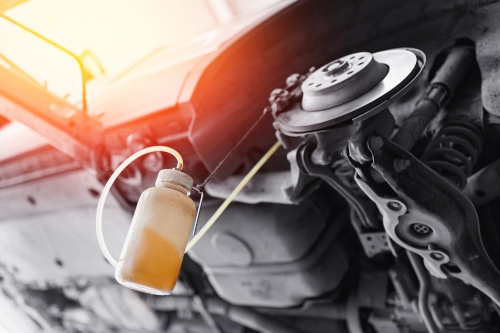
A proper brake fluid flush restores pedal feel and protects ABS valves. This isn’t just “new fluid”—it’s moisture management, boiling‑point margin, and doing the bleed the right way for your tools and car.
DOT ratings—what changes and why it matters
DOT 3/4/5.1 are glycol‑based and hygroscopic (they absorb water). More water = lower boiling point = vapor and a spongy pedal. DOT 5 is silicone—non‑hygroscopic and not mixable with 3/4/5.1; it’s niche (classic cars with specific rubber and no ABS).
- DOT 3: adequate for light duty; lower boiling points.
- DOT 4: higher dry/wet boiling points; most modern cars.
- DOT 5.1: DOT 4‑like chemistry with higher boiling points; ABS‑friendly, low viscosity.
Service interval, but intelligent
- Every ~2 years is a good rule, but verify with boiling‑point tester or copper test strips (corrosion indicator).
- Track days or towing shorten intervals; shared reservoir with clutch can darken fluid faster.
Bleeding methods—strengths and gotchas
- Two‑person: time‑proven; avoid over‑stroking the master on old cars (seal damage risk).
- Pressure bleeder: consistent one‑person results; keep the reservoir topped and the cap seal healthy.
- Vacuum bleeder: quick, but can draw air past threads—use grease on bleeders and watch for micro‑bubbles.
- Scan‑tool ABS cycling: mandatory for some modulators to purge trapped air after component work.
Order and technique that prevent comebacks
- Follow OEM wheel order (often farthest to nearest, but not always).
- Keep the fluid fresh; don’t let the reservoir run dry.
- Tap calipers/lines lightly to release trapped bubbles.
- Finish with a firm pedal test; on a safe road, perform an ABS stop to move any residual air.
Fluid selection—match use, not hype
- Daily street: quality DOT 4, low viscosity for cold climates.
- Heavy loads/spirited: high‑temp DOT 4 or 5.1 with documented wet/dry points.
- Track: true racing fluids with frequent changes; monitor caliper temps.
Case study: spongy pedal that pads couldn’t fix
Car returned twice after pad/rotor service. Copper test was high; wet boiling point measured low. Pressure bleed + ABS cycle restored feel; customer returned for a preventive flush the next year—no parts swapping needed.
Common mistakes
- Mixing DOT types without a full flush—spec changes, seals suffer.
- Reusing old fluid from an opened bottle—absorbed moisture lowers boiling point.
- Over‑tightening bleeders—damaged seats leak air later.
Disposal & safety
- Brake fluid is hazardous—keep off paint; dispose at a proper facility.
- Never smoke near open brake fluid; it’s flammable.
Bottom line: test, choose the right fluid for your use, and bleed with the method your tools (and ABS) support. The pedal will tell the story.
Moisture science in one minute
Glycol‑based fluids pull water from air through hoses and caps. Every 1% of water can drop boiling point by ~20–30 °C. That’s why a car that felt fine in spring gets a long pedal in late summer traffic.
ABS module pitfalls (and how to avoid them)
- If the pedal won’t firm up after a conventional bleed, your modulator may hold air pockets—cycle it with a scan tool.
- Some platforms require a specific order and pressure; check the service manual before forcing fluid where it doesn’t want to go.
Tools deep‑dive
- Pressure bleeder: aim for ~1–1.5 bar; too much pressure can aerate or lift seals in old masters.
- Vacuum bleeder: wrap bleeder threads with PTFE tape (above the seat) or use grease to stop false air.
- One‑way bleeder screws: helpful on older cars; still follow the correct sequence.
Time & cost reality
- DIY: 30–90 min depending on ABS and rust; 0.5–1 L of fluid typically.
- Shop: labor 0.7–1.2 h plus fluid; ABS cycling may add time.
Practical section
- Can I switch from DOT 3 to DOT 4/5.1? Yes, if the manufacturer allows—flush completely and mind viscosity in cold climates.
- Why is my new fluid already dark? Old rubber hoses and debris in lines can tint fluid—consider hose replacement on very old cars.
Track‑day prep checklist
- High‑temp DOT 4/5.1 with documented wet/dry points
- Fresh bleed the week of the event; inspect all hoses and bleeders
- Bed pads properly; bring a spare liter to the paddock