

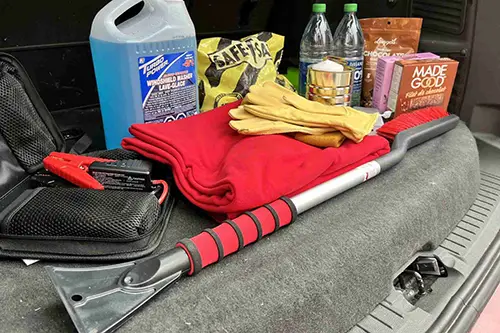
Stranded in winter with a dead battery or stuck in snow? Your Kia Sportage (2017–2022) needs more than a cheap scraper. This guide builds a practical emergency kit tested by a real owner through two Canadian winters—no fluff, just gear that works.
Owner's case
Laura's 2019 Sportage LX got stuck on an icy hill at night; battery died from repeated start attempts. Her "emergency kit" was a broken scraper and expired flares. After that night, she built a real kit and tested each item.
Core gear (fits in the cargo area)
- Jump starter (lithium, 12V, 600+ peak amps): compact, holds charge for months; test it quarterly.
- Traction aids: folding shovel + sand/traction mats; tire chains if your region requires them.
- Lighting: LED headlamp (hands-free) + magnetic work light; fresh batteries.
- Warmth: space blanket, hand warmers, extra gloves in a waterproof bag.
- Visibility: LED road flares (battery or rechargeable); last longer than pyro, safer in enclosed spaces.
Sportage-specific notes
- Cargo area: the Sportage has under-floor storage—perfect for the jump starter and tool roll.
- 12V socket: confirm it stays live with the key off for charging a phone in an emergency.
- Spare tire: verify condition and pressure quarterly; the compact spare is rated for 50 mph max.
Secondary items Laura added after testing
- Multi-tool with pliers, knife, screwdriver bits
- Duct tape and zip ties (10-pack)
- Basic first-aid kit (band-aids, pain relief, gauze)
- Small fire extinguisher (1 lb ABC type)
- Bottled water (2 liters) and energy bars (rotate every 6 months)
Laura's winter breakdown drill
- Stay with the car; turn on hazards; set LED flares 50 ft behind if safe.
- Call for help; use the jump starter if battery is the issue.
- If stuck in snow: clear exhaust pipe (CO risk), run engine in short bursts for heat, crack a window.
- Use traction mats under drive wheels; shovel approach and exit paths.
Costs
- Jump starter (quality lithium): ~$80–150
- Traction mats: ~$40–80
- LED flares (set of 3): ~$25–50
- Shovel, blanket, gloves, misc: ~$50–100
- Total: ~$200–380 for a complete kit
For Sportage cargo accessories and part numbers
Check Kia 7zap: kia.7zap.com.
Common mistakes
- Cheap jump starters that fail when cold—lithium units perform better in freezing temps.
- Leaving the kit in the garage—it's useless there.
- Never testing the gear—flares with dead batteries or an uncharged jump starter won't help.
Quarterly kit check (5 minutes)
- Jump starter: charge level >75%; test crank on a warm day.
- LED flares: battery check; replace if dim.
- Food/water: check expiration; rotate stock.
- Spare tire: 60 psi (verify placard for your Sportage).
Result: Laura's kit saved her twice—once for a dead battery in a parking lot, once helping a stranded driver. Sportage owners, build yours before you need it.
Laura's full kit breakdown
After her winter incident, Laura spent $320 on quality gear and organized it in two bags:
- Bag 1 (always in car): jump starter, traction mats, LED flares, headlamp, blanket, gloves.
- Bag 2 (winter only): shovel, hand warmers, extra winter hat, fire extinguisher.
Testing the kit (September drill)
- Jump starter: crank her Sportage from dead battery—worked perfectly.
- Traction mats: simulated stuck scenario in gravel lot—freed the car in under 2 minutes.
- LED flares: set them up at night—visible from 500+ ft.
Practical section
- Do I need chains? If your region gets ice/heavy snow and you lack AWD or winter tires, yes.
- Jump starter vs cables? Jump starter works alone; cables need another car. Both are useful.