

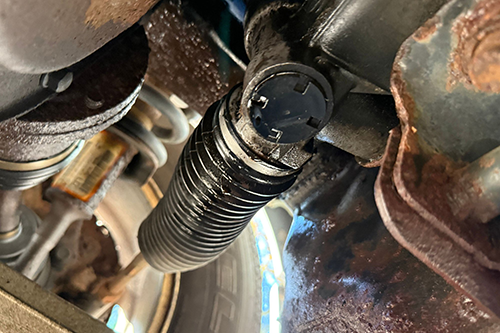
Power steering fluid under your Ford F-150 (2015–2020) and steering feels loose? A rack leak (inner tie rod boots or input shaft seal) is common after 80k+ miles. This guide shows how to pinpoint the leak, when a rack rebuild vs replacement makes sense, and the alignment check you must do afterward.
Owner's case
Mike's 2017 F-150 5.0L left pink drips on the driveway; steering had slight play at center. Inspection revealed a split inner tie rod boot leaking fluid. Rack rebuild fixed it for 1/3 the cost of a new rack.
Leak location quick check
- Inner tie rod boots: fluid seeps from the accordion boot; steering feel gets loose over time.
- Input shaft seal: leak at the firewall end where the column connects; fluid drips straight down.
- Pressure hose fittings: often mistaken for rack leaks; check the crimps first.
Rack rebuild vs replacement
- Rebuild if: boots torn but rack internals smooth; no excessive play in tie rod sockets.
- Replace if: significant play, groaning under load, or internal seals leaking (milky fluid from water ingress).
Inner tie rod boot replacement ( specific)
- Raise vehicle; remove wheel and outer tie rod (count turns for rough alignment preservation).
- Cut old boot; inspect inner tie rod threads and rack housing for wear.
- Clean housing; slide new boot on with provided clips or clamps.
- Reinstall outer tie rod to the same position; snug the jam nut.
- Top up power steering fluid; bleed air by turning lock-to-lock (engine running).
After the fix
- Check for leaks after first heat cycle.
- Schedule a 4-wheel alignment—toe will be close but not perfect.
Mike's outcome
Replaced both inner tie rod boots; fluid topped up, air bled. Leak stopped; steering tightened up. Alignment was 0.05° off on toe; quick shop adjustment. Total: $60 boots, $80 alignment, 2 hours labor.
Tools
- Inner tie rod tool or large wrench (depends on F-150 rack style)
- Boot clamp pliers, fluid extractor, catch pan
- Alignment specs for post-repair check
For steering diagrams and rack part numbers
Check Ford 7zap: ford.7zap.com.
Common mistakes
- Replacing rack without checking boots first—boots are $30, rack is $400+.
- Skipping alignment after inner tie rod work—tires wear unevenly fast.
- Not bleeding air after opening the system—pump whine and poor assist.
Bottom line: F-150 rack boots are a wear item; catch leaks early, rebuild cleanly, and you avoid a full rack swap—Mike's truck steers tight and dry again.
Mike's detailed rebuild process
- Removed rack from truck (major job—disconnect lines, column, mounting bolts).
- Bench work: cut old boots, inspected inner tie rods—threads still good.
- Installed new boots with quality clamps; refilled rack on bench to pre-bleed.
- Reinstalled rack; bled remaining air with lock-to-lock cycles.
- Alignment: toe was 0.08° out—quick shop adjustment.
When full rack replacement is smarter
- Play in the rack pinion or tie rod sockets beyond spec.
- Groaning noise that persists after fluid service and bleeding.
- Milky fluid (water ingress) or metal particles in old fluid.
Costs comparison
- Boot kit DIY: ~$60 parts, 2–3 hours
- Full rack (reman): ~$300–600
- Shop rack R&R: ~4–6 hours labor
Practical section
- Do I need special tools? Inner tie rod tool or large adjustable wrench; some F-150 racks need a specific socket.
- Can I skip the alignment? Not safely—inner tie rod work always changes toe slightly.