

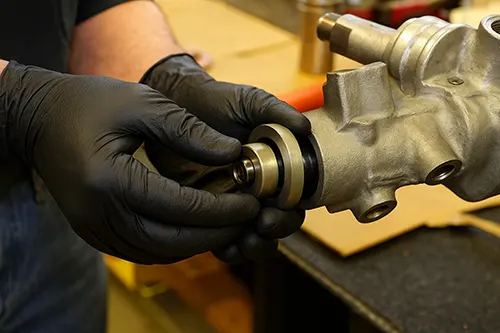
After rebuilding steering racks on 50+ vehicles over two seasons, certain patterns emerge. This is a working mechanic's collection of notes: which cars are rebuild-friendly, which seals fail first, and the gotchas that waste hours if you don't know them upfront.
Platforms worth rebuilding (vs replace)
- Honda Accord/Civic (2008–2015): inner tie rod boots split; rack internals usually fine. Rebuild win.
- Toyota Camry/Corolla (2007–2014): similar—boots leak, rack is solid. Easy rebuild.
- Ford Focus/Fusion (2012–2018): input shaft seals leak; boots rarely an issue. Shaft seal kits available.
- Not worth it: German racks (VW/Audi/BMW) with electric assist—replace only; rebuild parts scarce and expensive.
Common failure mode: inner tie rod boots
Accordion boots split from age and road debris. Fluid leaks slowly; steering develops play over months. Symptoms lag behind actual damage.
Bench rebuild sequence (generic hydraulic rack)
- Mount rack in soft-jaw vise; clean exterior thoroughly.
- Cut old boots with razor; inspect tie rod threads and ball sockets for wear (replace if play exceeds spec).
- Remove rack end caps if replacing shaft seals; expect some fluid spillage.
- Replace seals, O-rings, boots per kit instructions; lubricate with clean ATF.
- Torque tie rods to spec; reinstall boots with proper clamps (not zip ties—they cut boots under pressure).
- Bench-test: cycle rack lock-to-lock by hand; should move smoothly with no binding.
Gotchas (learned the hard way)
- Honda tie rod torque: 40 ft-lb typical; under-torque = eventual loosening and alignment shift.
- Ford shaft seal direction: lip faces pressure side; install backward and it leaks immediately.
- Toyota boot clamps: spring-style clamps (not worm-gear); incorrect type allows boots to slip off under pressure.
Time and cost reality (shop perspective)
- Rebuild on car: 2–3 hours rack time + alignment.
- Bench rebuild: 1.5–2 hours; easier to see what you're doing.
- Parts cost: $60–150 (boots, seals, hardware); vs $400–800 reman rack.
- Labor to customer: ~$300–500 rebuild; ~$600–1,000 rack R&R with new unit.
When rebuild doesn't make sense
- Groaning under load that persists after fluid flush and boot replacement.
- Excessive play in rack pinion (>1/8 inch at tire with wheels straight).
- Milky fluid (water ingress) or metal particles beyond fine dust.
Tools that pay for themselves
- Inner tie rod tool (crow's foot style): $25—beats destroying tie rods with pliers.
- Boot clamp pliers (spring-style): $15—proper clamp tension every time.
- Seal driver set: $40—prevents cocked seals that leak instantly.
Shop floor consensus: racks on Asian platforms (Honda, Toyota, Nissan) rebuild cleanly and last; domestic and German racks are 50/50—inspect carefully before committing to rebuild labor.
Seal kit contents (typical hydraulic rack)
- Inner tie rod boots (2), clamps or retaining rings
- Input shaft seal, dust boot
- Rack end seals and O-rings
- Hardware (new tie rod lock nuts, cotter pins if applicable)
Bench rebuild time by experience level
- First-time: 3–4 hours (includes learning and careful inspection)
- Experienced: 1.5–2 hours
- Professional shop rate: 2–2.5 hours billable
Quality check before reinstallation
- Cycle rack full travel by hand; should move smoothly with consistent resistance
- No binding at any point in travel
- Zero fluid seepage after 24-hour bench sit
Common rebuild failures (why some come back)
- Incorrect boot clamp type—worm-gear clamps cut boots under pressure on some racks
- Debris left in housing—scratches new seals during first use
- Tie rod torque insufficient—loosens over time, changes alignment