

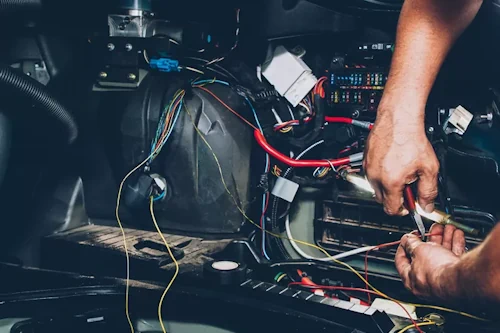
Beneath your car's hood lies a silent symphony of electrons - an intricate nervous system more complex than early spacecraft. Having traced electrical gremlins from vintage Corvettes to modern Teslas, I've witnessed this hidden network evolve from simple lighting circuits to supercomputer-level sophistication. Let's illuminate the vital components and principles powering every modern vehicle.
The Central Trinity: Battery, Alternator, Starter
These three pillars form the foundation of automotive electricity:
The Battery: Chemical Power Reservoir
Your 12V lead-acid battery (or increasingly, lithium-ion) doesn't just start the car - it stabilizes voltage, powers electronics when engine's off, and supplements peak demands. Key specifications:
- Cold Cranking Amps (CCA): Power available at -18°C (0°F)
- Reserve Capacity (RC): Minutes it can run essentials without alternator
- Ah Rating: Total energy storage capacity
The Alternator: Onboard Power Plant
This electromagnetic generator converts engine rotation into electrical energy through induction principles:
- Rotating rotor creates magnetic field
- Stationary stator coils capture induced current
- Diode rectifier converts AC to DC
- Voltage regulator maintains 13.5-14.8V output
The Starter: Controlled Explosion Initiator
This high-torque electric motor engages via solenoid:
- Solenoid connects battery directly to starter
- Pinion gear meshes with engine flywheel
- Typical draw: 150-200 amps (briefly)
- Modern systems disable during engine operation
The Nervous System: Wiring Architecture
Modern vehicles contain over 3 miles of wiring in organized harnesses:
Power Distribution Centers
Centralized fuse/relay boxes replace old-fashioned inline fuses. Benefits include:
- Reduced wiring complexity
- Standardized protection ratings
- Diagnostic accessibility
- Modular circuit design
Multiplex Networks (CAN Bus)
Controller Area Networks revolutionized automotive electronics:
- Reduced wire weight by up to 50%
- High-speed (500kbps-1Mbps) digital communication
- Modules share sensor data (e.g., wheel speed to ABS, transmission, dash)
- Self-diagnostic capabilities through OBD-II port
Electronic Control Units: The Vehicle's Brain Trust
Modern luxury cars contain 100+ specialized computers:
| ECU | Primary Functions | Critical Sensors |
|---|---|---|
| PCM (Powertrain Control) | Engine management, transmission control, emissions | O2 sensors, MAF, crank position, throttle position |
| BCM (Body Control) | Lighting, windows, locks, security | Door switches, light sensors, key fob receivers |
| ABS/ESC Module | Brake modulation, stability control | Wheel speed sensors, steering angle, yaw |
| SRS (Airbag) | Occupant protection deployment | Impact sensors, seat occupancy, belt tension |
Voltage Evolution: 12V to 48V and Beyond
While 12V remains standard, new architectures are emerging:
48V Mild-Hybrid Systems
- Enables engine-off coasting and restart
- Powers turbochargers, active suspension
- Reduces wiring gauge requirements
- Compatible with existing 12V accessories via DC-DC converter
High-Voltage EV Systems
- 300-800V architectures for efficiency
- Isolated safety systems with contactor disconnects
- Separate 12V systems for legacy components
- Regenerative braking capturing kinetic energy
Grounding: The Forgotten Hero
Ground paths complete circuits - poor connections cause baffling issues:
- Star Grounding: Multiple points converge at central location
- Chassis vs. Signal Grounds: Prevent noise in sensitive circuits
- Common Failure Points: Rusty bolts, painted surfaces, corroded cables
- Diagnostic Tip: Voltage drop testing reveals bad grounds
Advanced Electrical Components
Smart Relays vs. Traditional Relays
Traditional Electromechanical
- Coil activates switch contacts
- Audible click when operating
- Prone to contact pitting/arcing
- Simple replacement
Solid-State "Smart" Relays
- No moving parts - MOSFET transistors
- Silent operation
- Programmable current limits
- Diagnostic feedback to ECUs
Electrical System Maintenance Checklist
Prevent failures with these pro tips:
- Terminal Care: Clean battery posts annually with baking soda solution
- Load Test: Check battery CCA capacity every 2 years
- Charging Check: Verify alternator output (13.5-14.8V engine running)
- Ground Inspection: Remove/clean critical ground points during service
- Fuse Audit: Identify frequently blown fuses indicating underlying issues
- Wiring Inspection: Check for rodent damage, chafing near moving parts
The Future: Ethernet Backbones and AI Diagnostics
Emerging technologies transforming automotive electrical systems:
- Gigabit Ethernet: Replacing CAN bus for high-bandwidth systems (cameras, infotainment)
- AI-Powered Diagnostics: Cloud-based systems predicting failures before they occur
- Wireless Updates: OTA firmware upgrades for ECUs
- Bi-Directional Charging: EVs powering homes during outages
- Dynamic Power Allocation: Prioritizing energy to critical systems during low voltage
Essential Diagnostic Tools
Every enthusiast should own:
- Multimeter: Measures voltage, resistance, continuity
- Test Light: Quick circuit verification
- OBD-II Scanner: Reads fault codes and live data
- Power Probe: Applies power/ground at probe tip
- Wiring Diagrams: Factory service manual access is essential
Final Connection
Understanding your car's electrical system transforms you from passive driver to empowered troubleshooter. While modern networks seem intimidating, they still obey Ohm's Law and Kirchhoff's principles I learned decades ago. Whether you're restoring a classic or maintaining a new EV, remember: electrons flow where they're invited but invade where they're not resisted. Respect the fundamentals, invest in quality tools, and never work on high-voltage systems without proper training. The spark of knowledge ignites both engines and curiosity - keep that current flowing!