

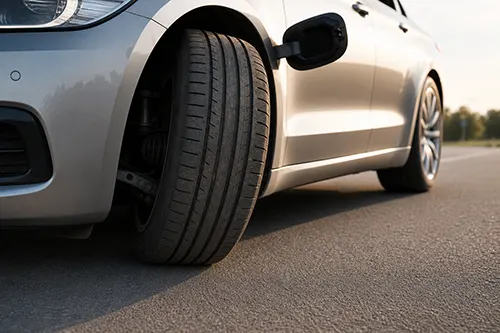
The character of the hum
Noise from a single corner narrows the field, but the pitch, speed sensitivity, and reaction to steering input are your best diagnostic tools. A tire-related hum tends to be lower in frequency, more like a growl or a womp-womp-womp that cycles with wheel rotation. It is loudest between 30 and 55 mph and often fades into the background at highway speeds. A hub bearing hum usually shows up as a smoother, higher-pitched drone or whir that builds steadily with road speed and does not cycle as obviously. Both can seem directional. Their behavior under load is where the real difference shows.
Feathering: the invisible sawtooth
Feathering happens when the tread blocks wear unevenly across their face, so one edge of each block sits slightly higher than the other. Run your hand around the tire’s circumference in both directions. If it feels smooth one way and rough the other, like a scrub brush against the grain, you have feathering. It is most common on low-profile or directional tires and is almost always caused by toe misalignment or worn suspension bushings. The tire still holds air, and the wear is often invisible from a quick standing glance, but those sawtooth edges slap the pavement and create a humming or roaring noise that sounds a lot like a bad bearing. The giveaway? The noise may change or diminish slightly when you rotate the tires front to rear, which a hub bearing will not do.
Cupping: the hidden scallops
Cupping, also called scalloping, creates alternating high and low spots around the tread. These dips are often subtle enough to escape a quick visual check, though you can usually find them by running your palm flat over the tread surface. The tire will feel wavy. Cupping is typically a symptom of worn shocks or struts that let the wheel bounce excessively, or sometimes of severely out-of-balance assemblies. The noise comes through as a rhythmic thumping or hollow hum that increases with speed. Because the contact patch is constantly changing shape, cupping can also cause a vibration in the steering wheel or seat. If swapping that wheel to a different corner moves the hum with it, the tire is the culprit. If the noise stays put, keep reading.
Hub bearing: the drone that loads up
A wheel bearing in its early failure stage often produces a speed-dependent hum or growl that is remarkably similar to tire noise. The classic test is the side-load maneuver: on a safe, empty road, gently swerve left and right. When you turn left, you shift weight onto the right-side bearing; if the hum gets louder, the right bearing is suspect. Turning right loads the left side. A bearing noise will typically change tone or volume during this exercise, while a tire noise will often stay constant or vary only slightly because of scrub angle change. Another clue is temperature. After a drive, carefully touch the center of each wheel near the hub. A failing bearing generates excess heat, so a noticeably warmer hub on one corner can confirm the diagnosis. Note, too, that a truly worn bearing may also have play when the wheel is rocked at 12 and 6 o’clock, but in the “starting to talk” phase there is often no mechanical movement yet. Sneaky little fault, really.
Quick isolation table
| Symptom | Feathering | Cupping | Hub Bearing |
|---|---|---|---|
| Hand feel on tread | Smooth one way, rough the opposite | Wavy or scalloped dips | Smooth and even |
| Noise pattern | Hum/roar, often 30–55 mph | Rhythmic thump or hum | Smooth drone, increases with speed |
| Steering input effect | Little change | Little change | Changes volume when side-loaded |
| Moves with tire rotation? | Yes | Yes | No |
| Common causes | Toe misalignment, worn bushings | Worn shocks/struts, imbalance | Wear, contamination, lack of lubrication |
Don’t ignore the quiet witness
Even a tire that passes a visual once-over can hide subtle wear patterns that broadcast themselves as a hum. Catch feathering early, and a simple alignment correction plus tire rotation may quiet things down before the damage becomes permanent. Cupping, once established, cannot be reversed, but replacing the worn dampers will keep it from returning on a new set. A humming hub bearing will not heal, and ignoring it risks heat buildup that can eventually cause the bearing to seize or the wheel to separate. If the noise stops when you lift off the gas and coast in neutral, you might be chasing an entirely different ghost, like a differential or CV joint issue, but that’s for another diagnostic session.
The next time you hear that one corner humming while the tread looks fine, remember this: your ears can catch what your eyes miss. A careful hand sweep, a strategic swerve, and a moment to ask whether the hum moves with the rubber or stays with the hub can save you from swapping good parts and overlooking the real problem. Small checks. Big payoff.