

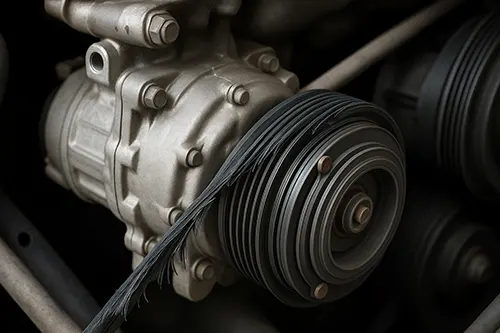
A/C compressor won't engage or cycles rapidly? The electromagnetic clutch is often the culprit—not the compressor itself. Air gap measurement and coil resistance testing isolate clutch vs compressor vs electrical faults in 15 minutes.
Clutch engagement sequence (normal operation)
- A/C button pressed → ECU energizes clutch relay
- 12V applied to clutch coil → creates magnetic field
- Clutch plate pulls against pulley → locks compressor shaft to pulley
- Compressor begins pumping refrigerant
Failure modes
| Symptom | Fault | Test |
|---|---|---|
| No click, no engagement | Coil failed or no power | Measure coil resistance + power at connector |
| Clicks but doesn't engage | Air gap excessive | Measure gap with feeler gauge |
| Engages then slips | Clutch plate worn | Visual inspection for scoring |
| Cycles on/off rapidly | Low refrigerant or pressure switch | Check pressures; not clutch fault |
Air gap measurement procedure
- Engine off; rotate compressor pulley by hand.
- Insert feeler gauge between clutch plate and pulley at 3 points around circumference.
- Spec: 0.014–0.030 inch typical (verify for platform).
- >0.030 = excessive; clutch won't engage reliably.
- <0.010 = too tight; causes drag and premature wear.
Air gap adjustment
- Some clutches use shims behind clutch plate; remove shim(s) to decrease gap.
- Others are non-adjustable; replace clutch assembly if gap excessive.
Coil resistance testing
- Key off; unplug clutch coil connector.
- Measure resistance across coil terminals.
- Spec: 3–5 Ω typical (verify for your compressor model).
- Open circuit (infinite) or short (near zero) = bad coil.
Platform-specific notes
Honda (Denso compressors)
- Gap spec: 0.014–0.026 inch
- Coil: 3.5–4.5 Ω
- Clutch typically non-adjustable; replace assembly if worn
Toyota (Denso compressors)
- Gap spec: 0.016–0.024 inch
- Coil: 3.0–4.0 Ω
- Some use shim adjustment; others are fixed
Nissan (Calsonic or Denso)
- Gap spec: 0.012–0.028 inch (wider tolerance)
- Coil: 3.2–4.8 Ω
- Shim-adjustable on most models
Clutch replacement (without system evacuation)
- Remove serpentine belt.
- Unbolt clutch hub center bolt (impact wrench + holder tool recommended).
- Remove hub, shims (if present), and coil assembly.
- Install new clutch assembly; set air gap per spec.
- Reinstall belt; test engagement.
Costs
- Clutch assembly: $80–180 (aftermarket); $200–350 (OEM)
- Coil only: $40–80
- Shop labor: 1–2 hours
When compressor replacement is actually needed
- Clutch engages but no cold air + compressor makes noise (seized compressor)
- Metal shavings in system from compressor failure
- Clutch plate and pulley both damaged (impact damage)
Diagnostic insight: 70%+ of "bad compressor" diagnoses are actually clutch or electrical faults; test before replacing the compressor ($600–1200 saved).
Air gap adjustment detailed (shim calculation)
To decrease gap by 0.010 inch:
- Remove one 0.010" shim from behind clutch plate
- Re-measure at 3 points to verify uniform gap
- Typical shim thicknesses: 0.010", 0.020", 0.030"
Clutch hub bolt torque
- Spec varies widely: 15–25 ft-lb common; some platforms require 100+ ft-lb
- Always verify for your compressor model
- Use impact wrench for removal; torque wrench for install
- Holder tool prevents compressor shaft rotation
Coil failure vs clutch plate wear
| Symptom | Coil fault | Plate wear |
|---|---|---|
| Engagement sound | No click | Weak click |
| Resistance test | Out of spec | In spec |
| Air gap | Normal | Excessive |
| Visual | Coil intact | Plate scoring visible |
Refrigerant pressure impact
Low refrigerant prevents clutch engagement via pressure switch—system won't cycle compressor if pressure <25 psi typically. Verify refrigerant charge before diagnosing clutch.