

Why Tire Rotation Matters: The Foundation of Vehicle Safety and Performance
Tire rotation is one of the most fundamental yet often overlooked aspects of vehicle maintenance. This simple procedure—methodically repositioning your vehicle's tires in specific patterns—is crucial for achieving even tread wear, maximizing tire lifespan, and maintaining optimal handling characteristics. For driving enthusiasts who appreciate both performance and value, understanding tire rotation isn't just about following maintenance schedules; it's about unlocking your vehicle's full potential while ensuring safety on every journey.
The science behind tire rotation is straightforward but profound. Each wheel position on your vehicle experiences different stresses and forces. Front tires on front-wheel-drive vehicles bear the brunt of steering, acceleration, and most of the braking forces, causing them to wear significantly faster than rear tires. This uneven wear doesn't just shorten tire life—it can compromise handling balance, reduce wet weather traction, and even lead to dangerous blowouts if left unaddressed. Regular rotation ensures that all four tires share these burdens equally, promoting uniform wear patterns that translate to better performance, improved fuel efficiency, and enhanced safety.
Manufacturers and tire experts universally recommend rotation intervals between 5,000-8,000 miles (approximately 8,000-13,000 km), though you should always consult your owner's manual for specific recommendations. Some performance vehicles or severe driving conditions may warrant more frequent rotations. The benefits extend beyond mere tire longevity: proper rotation maintains consistent handling characteristics, reduces strain on your vehicle's drivetrain (especially important in all-wheel-drive vehicles), and provides regular opportunities to inspect your tires for damage, check pressures, and assess tread depth.
Understanding Tire Wear Patterns: Reading the Stories Your Tires Tell
Before diving into rotation patterns, it's essential to understand how and why tires wear unevenly. Different wheel positions create distinct wear patterns that reveal much about your vehicle's condition and driving habits:
- Shoulder Wear (Outer Edges): Typically caused by under-inflation, aggressive cornering, or neglected alignment issues. When tires lack proper pressure, the outer edges make excessive contact with the road surface, wearing prematurely.
- Center Wear: Usually results from over-inflation, where excessive pressure causes the tire to bulge, placing more wear on the center of the tread.
- Feathering: Occurs when tread ribs are worn smoother on one edge than the other, often indicating incorrect toe alignment or worn suspension components.
- Cupping (Scalloping): Manifested as dips or scallops around the tire's edge, typically signaling worn shocks, struts, or other suspension problems that allow the tire to bounce excessively.
- Heel/Toe Wear: Appears as saw-toothed tread blocks and often results from improper rotation intervals or infrequent pressure checks.
Regular rotation helps mitigate these patterns by ensuring no single tire remains in a position prone to a specific type of wear for too long. During rotation, technicians can identify these patterns early, potentially catching alignment issues or mechanical problems before they become serious safety concerns.
Tire Rotation Patterns: Selecting the Right Approach for Your Vehicle
Not all vehicles benefit from the same rotation pattern. The optimal approach depends on several factors: your vehicle's drive type (front-wheel drive, rear-wheel drive, all-wheel drive), whether your tires are directional or non-directional, if you have different-sized tires front and rear, and whether you have a full-size spare to include in the rotation.
For Non-Directional Tires of Uniform Size:
1. Front-Wheel Drive Vehicles (Forward Cross Pattern)
Front tires move directly backward to the same sides of the rear axle. The rear tires move forward diagonally to the opposite sides of the front axle. This pattern addresses the accelerated wear on front tires responsible for steering, acceleration, and most braking.
2. Rear-Wheel Drive Vehicles (Rearward Cross Pattern)
Rear tires move directly forward to the same sides of the front axle. The front tires move backward diagonally to the opposite sides of the rear axle. This pattern accommodates the greater wear on rear tires that handle power delivery in RWD vehicles.
3. All-Wheel/Four-Wheel Drive Vehicles (X-Pattern)
All tires move diagonally to the opposite ends of the vehicle. The front-right tire moves to the left-rear position, front-left to right-rear, right-rear to front-left, and left-rear to front-right. This comprehensive approach ensures even wear across all positions in systems where all wheels receive power.
For Vehicles with Full-Size Matching Spare Tires:
Including your full-size spare in the rotation pattern is highly recommended, especially for all-wheel and four-wheel-drive vehicles where even slight tread depth variations can strain drivetrain components.
Front-Wheel Drive with Full-Size Spare:
The left-front moves to left-rear, left-rear moves to right-front, right-front becomes the new spare, the spare moves to right-rear, and right-rear moves to left-front.
Rear-Wheel/4-Wheel Drive with Full-Size Spare:
The left-rear moves to left-front, left-front becomes the new spare, the spare moves to right-rear, right-rear moves to right-front, and right-front moves to left-rear.
For Directional Tires and Special Configurations:
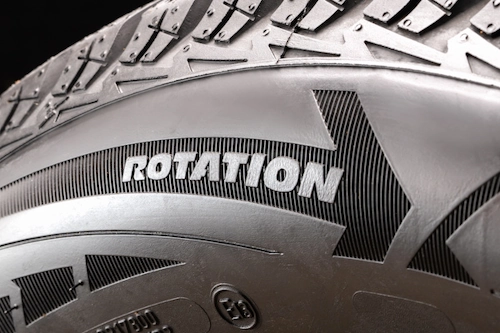
Directional tires (with tread patterns designed to rotate in only one direction, indicated by sidewall arrows) require specific patterns:
Directional Tires Same Size:
Tires must remain on the same side of the vehicle. The front-left moves to rear-left, rear-left moves to front-left, front-right moves to rear-right, and rear-right moves to front-right (front-to-back only).
Different-Sized Directional Tires or Wheels with Different Offsets:
This most complex scenario requires dismounting, remounting, and rebalancing tires on appropriate wheels to maintain proper direction and positioning.
Performance Vehicles with Staggered Setups (Different Widths Front/Rear):
Rotation is typically limited to side-to-side on the same axle, as front and rear tires cannot be swapped due to size differences.
| Vehicle/Tire Type | Recommended Pattern | Key Consideration |
|---|---|---|
| Front-Wheel Drive | Forward Cross | Addresses accelerated front tire wear |
| Rear-Wheel Drive | Rearward Cross | Accommodates rear tire power delivery wear |
| AWD/4WD | X-Pattern | Ensures even wear across all driven wheels |
| Directional Tires | Front-to-Back (Same Side) | Must maintain rotation direction |
| Full-Size Spare | Five-Tire Rotation | Includes spare to maintain even wear |
| Staggered Setup | Side-to-Side Only | Different front/rear sizes prevent full rotation |
The Professional Advantage: Why Sometimes Experts Should Handle Rotation
While DIY rotation is possible for enthusiasts with proper tools and knowledge, there are compelling reasons to consider professional service:
- Advanced Equipment: Professional shops use hydraulic lifts, torque wrenches calibrated to manufacturer specifications, and advanced balancing equipment that surpasses typical home garage capabilities.
- Comprehensive Inspection: During professional rotation, technicians typically perform multipoint inspections checking alignment, balance, brake condition, and suspension components that might otherwise go unnoticed.
- Pattern Expertise: Professionals understand the nuances of various rotation patterns and can identify which approach best suits your specific vehicle, tires, and driving habits.
- Proper Torque Procedures: Lug nuts must be tightened to exact manufacturer specifications in a proper star pattern sequence—under-tightening risks loosening while over-tightening can damage studs or warp brake rotors. Professionals have calibrated torque wrenches to ensure perfect specification.
- Specialized Knowledge: Modern vehicles with tire pressure monitoring systems (TPMS), special lug nuts (locking, security, or tuner lugs), and complex AWD systems often benefit from professional handling to avoid accidental damage.
Beyond Rotation: Complementary Maintenance for Optimal Tire Life
Rotation is most effective when combined with other fundamental maintenance practices:
- Proper Inflation: Monthly pressure checks (when tires are cold) are crucial. Under-inflation causes excessive sidewall flexing and heat buildup, while over-inflation reduces contact patch and accelerates center wear. Always follow pressure recommendations on the driver's door jamb sticker, not the tire sidewall.
- Wheel Alignment: Have your alignment checked annually or whenever you notice pulling, uneven wear, or after hitting significant potholes or curbs. Proper alignment ensures tires meet the road at optimal angles for even wear.
- Regular Balancing: Unbalanced wheels create vibration and cause uneven wear patterns. Balance should be checked with each rotation or whenever vibration is detected, especially at highway speeds.
- Visual Inspections: Regularly examine tires for embedded objects, sidewall damage, irregular wear patterns, or age-related cracking. Early detection prevents more serious issues.
- Driving Habits: Aggressive acceleration, braking, and cornering dramatically accelerate tire wear. Smooth, anticipatory driving significantly extends tire life.
The Economic Equation: How Regular Rotation Saves Money
Viewed through an economic lens, regular tire rotation delivers exceptional return on investment:
- Extended Tire Life: Proper rotation can extend tire life by thousands of miles, potentially delaying the substantial expense of premature replacement.
- Improved Fuel Efficiency: Evenly worn tires with proper inflation reduce rolling resistance, directly improving fuel economy—typically by 2-3%, which accumulates significantly over time.
- Prevention of Costly Damage: Regular rotations help identify alignment issues, suspension problems, or brake concerns early, preventing more expensive repairs down the road.
- Drivetrain Protection: Especially in AWD/4WD vehicles, uneven tires force drivetrain components to work against each other, potentially causing thousands of dollars in damage to differentials and transfer cases.
- Safety Enhancement: While difficult to quantify financially, the safety benefits of maintained traction and predictable handling are invaluable, potentially preventing accidents in emergency situations.
Conclusion: Making Rotation a Non-Negotiable Part of Your Maintenance Routine
Tire rotation transcends mere maintenance—it represents a smart, proactive approach to vehicle ownership that rewards enthusiasts with better performance, enhanced safety, and significant financial savings over time. By understanding the specific needs of your vehicle and implementing a consistent rotation schedule, you're not just maintaining tires; you're preserving the carefully engineered handling balance intended by manufacturers, protecting substantial investments in both tires and drivetrain components, and ensuring your vehicle responds predictably when you need it most.
The rhythm of tire rotation—ideally every 5,000-8,000 miles or according to your manufacturer's recommendation—creates natural opportunities for comprehensive vehicle inspection and maintenance planning. This regular attention transforms tire care from a reactive expense into a strategic practice that maximizes your driving enjoyment while minimizing unexpected costs. Whether you choose the satisfaction of DIY rotation or the comprehensive service of professionals, making this practice a non-negotiable part of your maintenance regimen will pay dividends throughout your vehicle's lifespan, ensuring many miles of safe, enjoyable, and performance-oriented driving.
Remember: Always prioritize safety when working with tires. Use proper jacking techniques with jack stands, never work under a vehicle supported only by a jack, and always tighten lug nuts to specification with a torque wrench. When in doubt, consult professionals who have the expertise and equipment to ensure your safety on the road.