

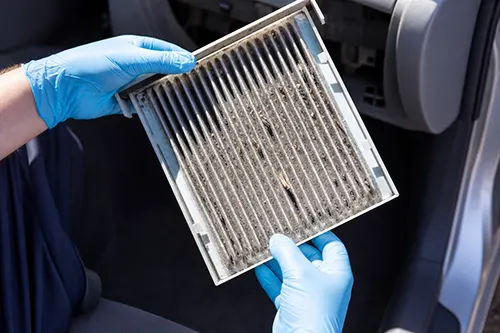
You’ve just replaced your cabin air filter, expecting fresh, clean air from the vents. But a week later, the musty, mildew-like odor is back. Frustrating? Very. And it’s more common than you might think. In most cases, the smell points to one of three underlying problems: a persistently wet filter housing, an incorrectly oriented filter, or microbial growth deep in the evaporator core. Below, we break down each cause and how to fix it.
1. Wet or Flooded Filter Housing
The cabin filter housing is supposed to stay dry. If water gets in—because of a clogged AC drain, a leaking windshield cowl, or even a recent car wash—the new filter can become saturated very quickly. Damp paper and fabric are perfect breeding grounds for mold and bacteria, which is why that musty smell can come back in just days.
- Check the AC drain tube: Find the rubber drain under the car (passenger side firewall). If no water drips with AC on, the drain is clogged. Clear it with compressed air or a flexible brush.
- Inspect cowl seals: Pour water over the windshield and look for leaks entering the HVAC intake. Replace cracked seals or reseal the cowl panel.
- Replace the filter again after fixing the leak—drying a wet filter won’t kill the existing mold spores.
2. Wrong Orientation – Airflow Direction Matters
Cabin filters have a marked airflow arrow (→ or “AIR FLOW”). Install the filter upside down or backwards, and the intended filtration layers are reversed. What happens then? The active carbon or anti-microbial side may face the wrong direction, letting dust and moisture collect on the wrong surface and causing odor to develop much faster than it should.
- Locate the blower fan: The arrow should point toward the blower motor (or into the cabin, depending on your vehicle). Check your owner’s manual.
- Mark the housing before removing the old filter – take a photo of the original orientation.
- If you’re unsure, install the filter with the arrow pointing downward or toward the passenger compartment (common for most cars).
3. Evaporator Residue – The Hidden Culprit
Even a brand‑new filter can’t remove smells that are already baked into the AC evaporator core. Over time, the evaporator’s cold, damp fins collect dust, pollen, and bacteria. Then, when you turn off the AC, moisture stays behind and microbial colonies keep growing. A new filter will just wick that smell right into the cabin within a week. Not exactly the result you paid for.
- Perform an evaporator cleaner treatment: Use a foaming AC cleaner (e.g., from CRC, Liqui Moly) injected through the drain tube or evaporator temperature sensor port.
- Practice “dry out” routine: Turn off the AC compressor but keep the fan on high for 2–3 minutes before parking. This dries the evaporator and prevents rapid recontamination.
- If the smell persists, a professional AC evaporator cleaning (or, in severe cases, replacement) may be required.
Diagnostic Summary Table
| Symptom | Likely Cause | Quick Check |
|---|---|---|
| Musty smell immediately after rain or car wash | Wet housing (leak) | Check AC drain drip; inspect cowl |
| Smell appears only when AC is on (not heat) | Evaporator residue | Try foaming cleaner; dry-out routine |
| Filter looks clean but arrow points incorrectly | Wrong orientation | Reverse filter and test for 2 days |
In most cases, fixing the musty smell means dealing with all three areas: dry the housing, verify filter orientation, and kill existing evaporator mold. It is worth noting that the cabin filter should be replaced last, only after the root cause is fixed. Otherwise, you’ll end up stuck in the same one‑week cycle again and again. And honestly, who wants to do that twice?