

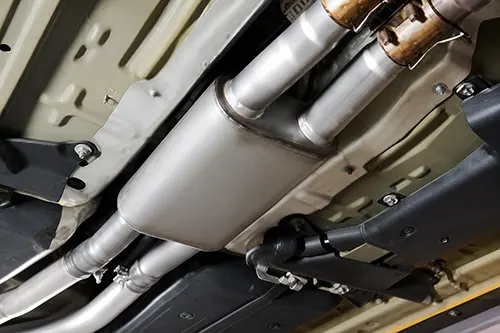
You’re cruising on the interstate, windows up, music off. Everything feels smooth until the needle touches one very specific speed — say 65, 70, or 73 mph. Then, all at once, a deep, pulsating low-frequency drone fills the cabin, vibrates through the seats, and makes your skull throb. Drop 3 mph below that threshold and it vanishes like a ghost. Go 5 mph faster, and the silence comes back. Strange, right?
This “magic speed drone” is one of the most frustrating NVH (noise, vibration, harshness) problems. It’s rarely just a simple exhaust leak. More often, three classic suspects step forward: acoustic resonance, exhaust hanger preload, and a culprit people overlook all the time — cabin seal leaks. Let’s break down each one, why they show up only at a single highway speed, and how to pinpoint the fix without throwing parts at the car.
🔊 1. Acoustic Resonance – The Organ Pipe Effect
Every exhaust system has a natural resonant frequency, determined by pipe length, diameter, muffler design, and even the gas temperature. When engine firing frequency, which rises with RPM, lines up with the exhaust’s acoustic mode, you get pressure wave reinforcement — a drone. Why only at one road speed? Because gearing ties engine RPM to vehicle speed. On a typical modern car with overdrive, 55 mph might be 1,700 RPM and quiet, while 68 mph hits 1,950 RPM — exactly where the exhaust wants to sing. Drop to 65 mph, RPM falls 100‑200, and the resonance disappears.
🛠️ Quick resonance check:
- Note the exact RPM where drone is worst (lock in that gear, try manual mode).
- Does it happen in different gears at same RPM? If yes → engine/exhaust resonance.
- Try a temporary “hemholtz tuner” (add a capped side branch pipe or J-pipe) — if drone shifts or disappears, resonance is the core issue.
- Solutions: add a resonator, swap muffler, install a quarter-wave tube, or change hanger stiffness to shift natural frequency.
⚙️ 2. Exhaust Hanger Preload – The Stressed Rubber Band
Rubber exhaust hangers are meant to isolate movement, but improper installation or worn hangers can introduce preload — a static tension that changes the system’s dynamic behavior. At lower speeds, the exhaust may move and vibrate pretty harmlessly. At one particular highway speed, though, the harmonic excitation from the engine and road matches the preloaded stiffness, and the whole exhaust starts acting like a vibrating tuning fork. The drone then transmits straight into the chassis. Worse, a single misaligned hanger bracket can create metal-to-metal contact at resonance and amplify the drone even more.
- Clues: drone feels like a heavy bass that shakes the floor pan, not just a sound.
- Test: Safely lift the car (or use a drive-on lift), and at idle, push/pull the exhaust tailpipe. There should be ½–1 inch of soft movement. If it feels rigid or one hanger is stretched tighter than others, you’ve found preload.
- Fix: loosen all hanger rods, relax the exhaust system (support with a jack), then retighten with zero preload. Replace hardened or collapsed rubber hangers.
💨 3. Cabin Seal Leak – The Hidden Pressure Valve
Here’s the wild card: an otherwise small exhaust drone can be barely audible outside, but inside it feels like a drum. Why? Helmholtz amplification through body leaks. Modern cars have carefully tuned cabin pressure relief vents, usually behind rear bumpers, along with door and trunk seals. At a specific highway speed, aerodynamic pressure changes around the car can let a low-frequency pressure wave enter the cabin through a degraded seal — a torn trunk gasket, a missing grommet, or a misaligned window. The exterior exhaust drone couples with that air leak, and suddenly the cabin becomes a resonator. The result is a one-speed-only drone that sounds like it’s inside your skull. Nasty.
🧪 Seal leak diagnosis (simple tape test):
- Temporarily seal all suspect areas: trunk perimeter, rear tail lamp gaskets, door weatherstrips, and plastic body plugs.
- Use masking tape and plastic sheeting over the trunk interior vents (don’t block them permanently — they equalize pressure when doors close).
- Test-drive at the offending speed. If drone intensity drops >70%, you have a seal-induced resonance.
- Permanent fix: replace worn trunk seal, use butyl rope for taillights, or add closed-cell foam to hanger pass-through holes.
🕵️ How to tell which one is YOUR problem?
Since the three causes can overlap, here’s a decision roadmap you can follow in your garage, or with basic tools if that’s what you’ve got.
- Step 1 – Exclude basic exhaust contact: Inspect clearance around the exhaust near the differential, subframe, or heat shields. Even a 2mm closer gap at one speed can cause metal clanking or drone.
- Step 2 – Perform the “hanger relaxation” test: Loosen all rubber hangers, add a bit of silicone lubricant, reinstall without stretch. If drone frequency changes or reduces, it’s preload/resonance interplay.
- Step 3 – Inside/outside comparison: Have a passenger record video outside the car at the drone speed (safely on a long straight road) while you note interior noise. No drone outside but loud inside → strong cabin leak coupling.
- Step 4 – Frequency analysis (smartphone): Use a free FFT app (like Spectroid). A pure, stable drone frequency (e.g., 48 Hz) that matches exhaust RPM/2 order suggests acoustic resonance. A broader, irregular hum hints at structural or seal issue.
🔧 Real-world case: 2018 Subaru Outback, drone at 72 mph
Owner replaced mufflers, added resonators — no fix. Finally, the real problem turned out to be that the rear bumper under-seal was missing a grommet because a factory clip had broken. At 72 mph, airflow created low pressure that sucked exhaust pulses through the 8 mm hole, turning the rear quarter panel into a drum. Sealing the hole reduced drone by 90%. The remaining 10% came from a slightly preloaded hanger near the muffler. Relaxing it killed the drone entirely. It is worth noting what this case teaches: resonance alone rarely creates a narrow-speed drone — it’s often a resonance + preload + seal leak combination.
📌 Final takeaways (before you throw money at an exhaust shop):
- ✅ Don’t ignore cabin air leaks – tape test is free and revelatory.
- ✅ Adjust hanger preload before cutting/welding anything new.
- ✅ If all else fails, install a tuned quarter-wave resonator (helmholtz) calculated to the drone frequency. Many aftermarket kits exist for as low as $40.
- ✅ Sometimes the “one speed” matches tire harmonics – rotate tires, check if drone changes speed. If it stays exactly on the same mph, exhaust is likely the culprit.
Bottom line: that maddening highway drone isn’t a curse — it’s physics asking for attention. By systematically testing resonance, hanger preload, and cabin seal integrity, you can turn your highway drive from a bass-thumping nuisance into a peaceful cruise. Start with the easy stuff, like tape and rubber hangers, and only after that move to exhaust modifications. Your ears — and your passengers — will thank you.