

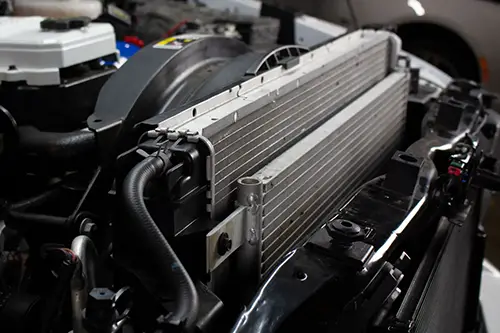
Trans running hot while towing or in winter staying too cold on your Dodge RAM 2500/3500 Cummins (2003–2018) with 68RFE trans? The transmission cooler thermostat regulates fluid temp; when it fails, you get overheating under load or poor warm-up efficiency. This guide shows where it hides, how to test it, and the replacement procedure.
Owner's case: Carlos's RAM 2500
6.7L Cummins; towing temps hit 240 °F (safe max ~220 °F). In winter, trans never warmed past 140 °F (optimal 180–200 °F). Thermostat was stuck partially open—replaced it, temps normalized.
What the trans cooler thermostat does
It's a valve in the cooling circuit:
- Cold trans: thermostat closed; fluid bypasses external cooler, warms up faster.
- Hot trans: thermostat opens; fluid flows through radiator-mounted cooler.
- Stuck open: trans runs cold (poor efficiency, delayed shifts); stuck closed = overheating.
Symptoms
- Trans temp >220 °F towing or in traffic (stuck closed)
- Trans never reaches 180 °F in cold weather (stuck open)
- Harsh shifts when cold (fluid too thick) or soft shifts when hot (fluid too thin)
Quick test
- Monitor trans temp with scan tool during cold start and warm-up.
- Should climb steadily to ~180–200 °F within 10–15 minutes of driving.
- If stuck at 140 °F or spikes above 220 °F under normal load, suspect thermostat.
Location on 68RFE (RAM 2500/3500)
Thermostat is inline on cooler lines near the trans or integrated into the trans cooler bypass circuit. Verify exact location for your year via service manual—it varies.
Replacement procedure
- Raise truck; locate thermostat assembly on cooler line.
- Place catch pan; loosen hose clamps or quick-disconnect fittings.
- Remove old thermostat; expect ~1 qt ATF loss.
- Install new thermostat with correct orientation (flow arrow points toward cooler).
- Tighten clamps or reconnect fittings; top up trans fluid via dipstick or fill plug.
Carlos's outcome
New thermostat; towing temps dropped to 205 °F; winter warm-up improved to 185 °F within 12 minutes. Cost: $65 thermostat, 1 hour labor.
Tools
- Hose clamp pliers or screwdriver, catch pan, funnel
- Scan tool with trans temp PID
For RAM 68RFE trans diagrams
Check Dodge 7zap: dodge.7zap.com.
Common mistakes
- Installing thermostat backward—temps get worse.
- Not verifying temps after replacement—fault may be elsewhere (clogged cooler, failing pump).
- Overfilling ATF after service—foaming and erratic shifts.
When thermostat isn't the issue
- Temps still high after replacement → clogged external cooler or weak cooling fan.
- Temps erratic → trans temp sensor fault.
Bottom line: RAM diesel trans cooler thermostats are simple wear items; Carlos's temp control is now perfect and his 68RFE is happy towing.
Carlos's detailed temp monitoring (before/after)
| Condition | Before (stuck open) | After (new thermostat) |
|---|---|---|
| City driving (winter) | 125–140 °F | 185–195 °F |
| Highway cruise | 160–175 °F | 190–200 °F |
| Towing 8k lbs (summer) | 235–245 °F | 200–210 °F |
Why trans temp matters (efficiency and life)
- Too cold (<160 °F): fluid thick; delayed shifts, poor MPG, clutch slip.
- Optimal (180–200 °F): best efficiency and clutch engagement.
- Too hot (>220 °F): fluid breaks down; varnish forms; clutch life plummets.
Alternate diagnosis (if thermostat tests OK)
- Clogged external cooler: poor delta-T across cooler; back-flush or replace.
- Weak cooling fan: trans cools inadequately at idle; test fan operation.
- Failing trans temp sensor: erratic readings that don't match IR measurement.
Carlos's prevention plan
- Monitor trans temp via scan tool when towing—catches issues early.
- Change 68RFE fluid every 50k with heavy towing; 100k light use.
- Inspect cooler lines and fittings every oil change—leaks start small.