

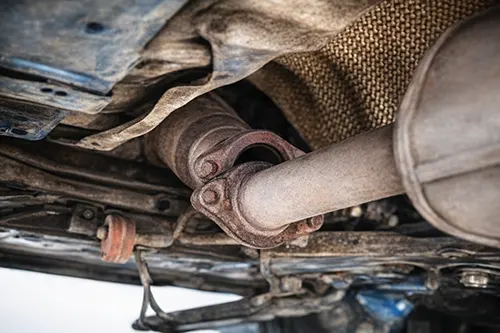
Exhaust leaks present with distinct audio signatures depending on location and size. After diagnosing leaks on 100+ vehicles, patterns emerge that allow rapid localization without smoke machines or expensive tear-down.
Sound signature catalog
| Sound | Location | Common cause |
|---|---|---|
| Loud tick at manifold frequency | Manifold-to-head | Blown gasket or cracked manifold |
| Hiss/whistle proportional to RPM | Small manifold crack | Thermal stress crack |
| Rumble/drone at cruise RPM | Mid-pipe or resonator | Rust perforation |
| Rattle on decel | Heat shield | Loose or broken shield tabs |
| Popping on overrun | Flex pipe | Flex section torn/separated |
Visual inspection priorities
- Manifold-to-head seam: carbon tracking (black streaks) visible on cold engine.
- Flex pipe section: typically fails 80k–120k miles in northern climates; visible cracks in bellows.
- Weld joints: use a bright light from behind; pinholes glow through on running engine.
- Flange gaskets: crushed or blown gaskets leave soot rings around bolt holes.
Quick confirmation tests (no tools)
- Cold start; listen from engine bay—manifold leaks are loudest then.
- Hand near suspected area (not touching hot components)—feel exhaust pulse.
- Soapy water spray on cold engine, then start—bubbles at leak points.
Leak severity assessment
- Pre-cat (manifold): affects O₂ readings; lean codes common (P0171/P0174). Priority fix.
- Post-cat: noise only; no driveability impact. Can wait if budget-limited.
- Flex pipe: moderate priority; worsens rapidly once started.
Platform-specific common points
- Honda 4-cylinder (2010+): manifold cracks at cylinder 2-3 bridge; common by 120k.
- Ford V8 (F-150 5.0/5.4): manifold studs pull threads from heads; helicoil repair often needed.
- Subaru boxer: donut gasket at y-pipe junction; fails 60k–100k from thermal cycling.
- GM trucks: flex pipes rust from inside out; external appearance deceives until catastrophic failure.
Repair vs replace decision matrix
- Manifold crack (small): weld repair if crack <2 inches and not near bolt holes.
- Manifold crack (large/multiple): replace manifold.
- Blown gasket: replace gasket; inspect manifold surface flatness.
- Flex pipe: section replacement or full pipe depending on rust extent.
Post-repair validation
- Cold start audible test—leak sound should be gone.
- Drive and re-inspect—heat cycles can reveal marginal repairs.
- Verify O₂ sensor data and fuel trims normalized (pre-cat leaks).
Field observation: sound + visual inspection correctly localizes 90%+ of exhaust leaks without smoke testing; remaining 10% are internal (cracked cat substrate, failed valve).
Leak location frequency (from 100-vehicle sample)
- Manifold-to-head gasket: 35%
- Flex pipe: 28%
- Flange gaskets (mid-pipe connections): 18%
- Manifold cracks: 12%
- Heat shield rattle (not leak): 7%
Diagnostic time average
- Audio + visual inspection: 15 minutes (correct localization 90% of time)
- Smoke test: 25 minutes (confirms small leaks visual inspection misses)
- Soapy water method: 10 minutes (effective on cold engine)
Repair cost ranges (shop labor + parts)
- Gasket only: $150–300
- Flex pipe section: $200–450
- Manifold replacement: $400–800 (4-cyl); $600–1200 (V6/V8)
- Heat shield re-secure: $50–120