

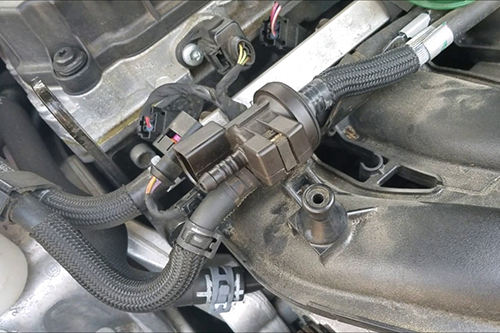
P0441, P0455, or rough idle after refueling on your Audi A4 / A5 (2009–2016) 2.0 TFSI? The EVAP purge valve (N80) is a common fault. This guide shows how to test it in 5 minutes, where it hides on the engine, and how to replace it without fighting the intake plumbing.
Owner's case
Sophia's 2012 A4 2.0T threw P0441 (EVAP purge flow) after a fill-up; idle was lumpy for 30 seconds, then cleared. Smoke test showed no leaks; the N80 valve was sticking open intermittently.
Symptoms
- P0441, P0455, P0456 (EVAP system codes)
- Rough idle or stumble right after refueling (purge at the wrong time)
- Fuel smell in the cabin when parked
Quick tests
- Commanded test via scan tool: activate the purge valve; listen for a click and feel airflow through the valve with your hand.
- Resistance check: key off, unplug N80, measure across terminals—spec ~20–30 Ω (verify for your year). Open circuit or very low resistance = failed.
- Vacuum test: apply vacuum to inlet side; valve should hold when off, release when 12 V applied.
Location on 2.0 TFSI (A4/A5 B8/B8.5)
The purge valve is mounted on the intake manifold, driver's side near the firewall. Access is tight but doable without removing the manifold.
Replacement, step by step
- Key off; disconnect battery (optional but safer for electrical work).
- Unplug the N80 electrical connector (press the tab, wiggle gently).
- Release the vacuum hose quick-connects at both ends (press the collar, pull the hose).
- Unbolt the valve (single T25 or T30 Torx, depending on year).
- Install new valve; torque lightly (plastic threads)—don't over-tighten.
- Reconnect hoses and connector; ensure hoses are indexed correctly (charcoal canister side vs manifold side).
After the fix
- Clear codes; drive until the readiness monitor sets (20–50 miles).
- Refuel and idle—check for rough running or codes returning.
Sophia's outcome
New OEM N80 valve; P0441 cleared and stayed gone. Idle smoothed out immediately. Cost: $45 OEM part, 20 minutes labor.
Tools
- T25/T30 Torx, small flathead for hose collars
- Multimeter for resistance check
- Scan tool for commanded tests
For A4/A5 EVAP system diagrams
Check the 7zap Audi catalog: audi.7zap.com.
Common mistakes
- Replacing the valve without testing it—sometimes it's just a stuck hose or a bad charcoal canister.
- Mixing up hose connections—system won't purge correctly; codes return.
- Over-torquing the plastic valve body—cracks the threads.
Takeaway: the N80 purge valve on 2.0 TFSI Audis is accessible and testable; prove the fault first, swap cleanly, and EVAP codes stay cleared.
EVAP system quick primer for owners
The purge valve (N80) is one small piece in a larger evaporative emissions system that includes:
- Charcoal canister: stores fuel vapors; can saturate and trigger codes.
- Vent valve (N115): seals the system for leak tests; stuck open = P0455.
- Fuel tank pressure sensor: monitors system integrity; drift causes false leak codes.
- Lines and check valves: aging rubber cracks; small leaks are hard to find without smoke.
Extended testing for persistent codes
- Smoke test the entire EVAP system: pump smoke at the purge valve inlet; watch for leaks at canister, tank filler neck, and fuel cap.
- Monitor fuel tank pressure sensor in live data: should swing negative/positive during purge cycles.
- Command vent valve closed and pressurize gently; system should hold 0.5–1 psi.
Sophia's follow-up
After N80 replacement, she performed a smoke test: tiny leak at the canister vent line. Replaced the cracked hose; P0441 and P0455 both stayed cleared. Total fix: $45 purge valve + $12 hose + 45 minutes.
Cost and time reality
- N80 purge valve (OEM): ~$40–70; aftermarket ~$25–50.
- DIY time: 20–30 minutes if you know where it is.
- Shop: often bundled with leak check; ~$120–200 labor + parts.
Long-term prevention
- Don't top off the tank past the first click—overfilling saturates the canister.
- Replace the fuel cap every 3–5 years; cheap insurance against small leak codes.
- Inspect EVAP hoses during other engine bay work; replace any that are hard or cracked.