

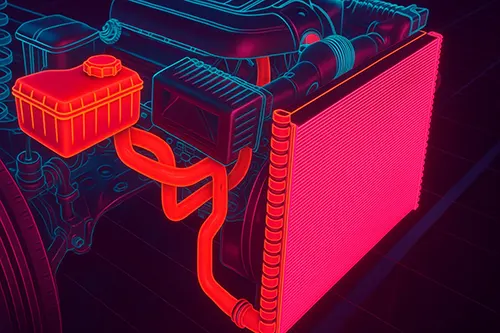
These are the actual questions customers ask most about cooling systems—answered straight from service bay experience, no marketing talk.
Basic operation
Q: How do I know if my coolant is low?
Check the overflow reservoir when cold; it should be between MIN and MAX marks. If it's below MIN or the radiator is low when you crack the cap (cold engine only), you're low.
Q: Can I mix coolant types?
Avoid it. Mixing green and orange creates sludge over time. If you must top up and don't know the type, use distilled water temporarily, then flush and fill with correct coolant ASAP.
Q: How often should I change coolant?
Traditional green: 30k miles. Extended-life (orange, pink): first change 100k–150k, then 50k. Check your manual; stretching intervals leads to corrosion and pump failure.
Overheating
Q: Temp gauge climbs in traffic, normal on highway—what gives?
Airflow issue. Check: radiator fan operation (scan tool can command it on), clogged condenser/radiator fins, weak fan motor or relay.
Q: Gauge normal but overflow tank boils over—why?
Likely bad radiator cap. Cap pressure rating is critical; weak cap lowers boiling point. Replace cap ($15) before chasing expensive parts.
Q: How do I know if it's thermostat vs water pump?
Thermostat: upper hose stays cold or gets hot too early. Pump: temp rises with no coolant circulation (lower hose stays cold), often with noise or visible leaks at pump weep hole.
Leaks
Q: Coolant smell but no puddles—where's it going?
Slow evaporation leak (heater core, small hose seep) or internal combustion leak (head gasket). Pressure test finds external; CO₂ block test finds internal.
Q: How much does a pressure test cost?
Most shops do it for $30–60; many parts stores lend the tool free (you do it yourself in 15 minutes).
Q: Pressure test passed but I'm still losing coolant—now what?
Run UV dye through the system; drive 50 miles; inspect with UV lamp. Finds evaporated leaks that pressure tests miss (small hose weeps, heater core misting).
Maintenance
Q: Do I really need to bleed air after coolant changes?
Yes. Air pockets create hot spots and cause overheating even with a full system. Follow the bleed procedure for your car (usually involves running to temp with bleed screws open or specific fill sequence).
Q: Can I drive with low coolant temporarily?
Short distances at low speed, maybe—but one overheat event can warp heads or blow gaskets. Top up immediately; if it's leaking fast, tow it.
Q: Should I replace the thermostat preventively?
At major coolant service (100k+), yes—thermostats are $20–40 and failure means overheating or poor warm-up. Cheap insurance.
Radiators and hoses
Q: When do hoses need replacement?
Squeeze them near clamps—soft/spongy or hard/cracked = replace. Typically 80k–120k miles for rubber hoses in harsh climates.
Q: Radiator replacement—plastic vs aluminum?
OEM plastic/aluminum combo: $150–350; lasts 10–15 years. Full aluminum aftermarket: $300–600; longer life but verify fitment (some don't seal well on plastic tanks).
Advanced
Q: What's a normal radiator temp delta (inlet vs outlet)?
10–25 °C with fan on, moderate load. <5 °C = clogged core or no flow; >30 °C = poor airflow or restriction before radiator.
Q: Can a stuck-open thermostat cause problems?
Yes—engine runs cold, poor fuel economy, heater weak. It won't overheat but efficiency suffers. Replace even if "it doesn't overheat."
Q: Electric vs mechanical fan—which is better?
Electric: more efficient, controlled by ECU, better for A/C. Mechanical (clutch fan): simpler, no wiring to fail. Both work; electric is modern standard.
Common theme in answers: test first, don't guess parts; cooling system faults are measurable with simple tools.
Additional cooling system Q&A
Q: Heater blows cold but engine temp is normal—what's wrong?
Air pocket in heater core, clogged heater core, or stuck heater control valve. Bleed the system first; if that doesn't fix it, back-flush the heater core.
Q: Why does my overflow tank overflow when hot?
Either overfilled, radiator cap not sealing (pressure vents to overflow), or combustion gases pressurizing the system (head gasket). Pressure test and CO₂ test split these scenarios.
Q: Coolant turns rusty—just change it or flush the system?
Flush required. Rust means corrosion is active; simply adding new coolant won't stop it. Use a flush kit or reverse-flush with a hose to clear sediment.
Q: Bubbles in overflow tank when running—normal or problem?
Small bubbles during warm-up can be normal air purging. Large bubbles or continuous bubbling = combustion leak (head gasket). Run a block test to confirm.
Q: Should I upgrade to a bigger radiator?
Only if you tow heavy or track the car regularly. Stock radiators are sized for the engine; "upgrades" help in extreme use but don't fix cooling faults caused by weak caps, failed fans, or clogged cores.