

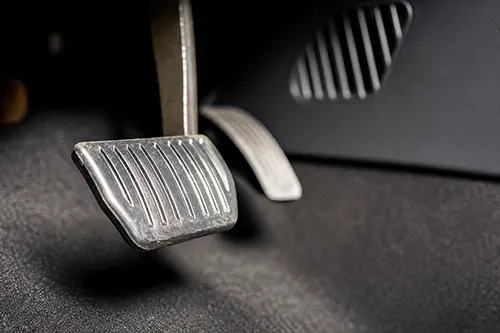
Brake Pedal Feels Soft Right After Pad Change: Rear Adjuster, Air, or Pad Knock-Back?
You’ve just finished installing fresh pads, bedded them in with a few careful stops, and now the brake pedal sinks lower than expected before the car starts to slow. The first press feels long and mushy, though a quick pump often brings the pedal back to a firm height. Frustrating, isn’t it? The work itself may have been done correctly, yet the symptom clearly says something is off. When a soft pedal shows up immediately after a pad swap, three culprits are far more common than a defective master cylinder or a sudden fluid leak: a rear drum adjuster that is not maintaining proper shoe-to-drum clearance, air that entered the hydraulic system during the job, and pad knock-back caused by excessive hub or bearing movement.
1. The Rear Drum Adjuster That Quietly Undoes Your Firm Pedal
On vehicles with front discs and rear drums, a brake job limited to the front axle can still produce a low pedal, because rear shoe clearance directly controls overall pedal travel. Drum brakes rely on a self-adjusting mechanism—usually a star wheel, lever, and cable—that clicks the shoes outward as the lining wears. If the adjusters are seized, stripped, or were backed off too far during a previous service, the rear shoes sit well inside the drum. When you press the pedal, the wheel cylinders have to extend significantly before the shoes contact the drum, which consumes fluid volume and causes a long, sinking stroke.
Changing front pads does not automatically correct this. In fact, the new front pads now grip instantly while the rear shoes travel a long distance, so the soft pedal becomes even more noticeable. A quick diagnostic pump test is telling: if the pedal firms up after two or three rapid applications, the rear shoes are slowly ratcheting outward with each stroke. To confirm it, lift the rear wheels and spin them by hand while a helper gently applies the pedal. You should hear the shoes begin to drag after minimal pedal movement. If the wheel spins freely through a large portion of pedal travel, the adjusters need attention.
Remove the rear drums, inspect the star wheel and threads for rust and binding, clean them thoroughly, and apply a thin coat of high-temperature brake grease to the threads and contact points. Manually adjust the shoes until you feel a light, even drag when rotating the drum. After reassembly, pump the pedal firmly—if the self-adjuster is working, a few hard stops in reverse should fine-tune the setting. What is important here is that a properly adjusted rear end can turn a soft pedal into a firm, high engagement point without any hydraulic bleeding.
2. Air Trapped in the Lines or ABS Module
Any time the hydraulic system is opened—even if you only cracked a bleeder to push back pistons—air can enter. Many DIYers retract caliper pistons without opening the bleeder, forcing fluid back toward the master cylinder. That can stir up sediment or introduce tiny air bubbles if the reservoir ran low. Bleeding may still be required even if you never loosened a line, especially on vehicles with an ABS pump, where old, moisture-laden fluid can vaporize under heat and mimic a compressible pocket.
An air-induced soft pedal feels spongy rather than simply long-travel, and it typically does not pump up to a perfect brick wall. If repeated rapid pumps only raise the pedal slightly and it still feels elastic, air is the prime suspect. Start with a conventional two-person bleed, beginning at the caliper farthest from the master cylinder. Use a clear tube and watch for bubbles. If the pedal remains soft after a thorough bleed, the ABS hydraulic control unit may need to be cycled with a scan tool that activates its solenoids. Some systems trap air in dead-end circuits that open only during ABS events. Without a scan tool, a cautious low-speed gravel stop that triggers ABS can sometimes move trapped air, but a proper electronic bleed is safer and more reliable.
3. Pad Knock-Back: When the Rotor Pushes the Piston Away
Pad knock-back occurs when lateral runout or wheel bearing play allows the brake rotor to wobble and physically push the pads and pistons back into the caliper. After hard cornering or hitting a bump, the next pedal application feels long because that extra clearance has to be taken up first. It is worth noting that this condition is often confused with air, because a quick pump restores normal height. But unlike a rear adjuster issue, the soft pedal returns unpredictably during driving, not just at a standstill.
If you just changed pads and immediately notice a soft initial stroke that pumps up hard, but the symptom persists after verifying rear adjustment and bleeding, inspect the front hub assemblies. With the wheel mounted, grab the tire at the 12 and 6 o’clock positions and rock it firmly. Any perceptible play points to a worn wheel bearing. Also measure rotor runout with a dial indicator; even a few thousandths of an inch can be enough to pump the pistons back. A bent hub flange, uneven rust buildup between the rotor and hub, or an improperly torqued wheel can all create enough wobble to cause knock-back. Correct the root cause—replace the bearing, clean the mating surfaces, or machine the rotor on the car—rather than masking it with thicker fluid or anti-knock-back springs, which are rarely a factory design feature on street cars.
How to Isolate the Root Cause in 10 Minutes
- Pump the pedal with the engine off. If it firms up high and hard after two or three strokes, suspect rear drum adjustment or pad knock-back. If it remains spongy and never truly hardens, suspect air.
- Test rear adjustment. With the engine off, pump the pedal until firm, then start the engine. The pedal should drop slightly as the booster activates, then hold steady. If it continues to sink, there may be a hydraulic leak, but a large initial drop followed by a stable low-but-firm position often points to rear shoe clearance.
- Check for knock-back. Drive slowly in a straight line, lightly apply the brakes, then turn sharply left and right. If the pedal goes soft immediately after the turn, knock-back is the likely cause.
- Visually inspect for leaks. Examine each caliper piston seal, hose fitting, and the rear wheel cylinder boots. A tiny fluid seep can draw in air without leaving a visible drip, producing a gradual softening.
Restoring the Firm Pedal the First Time
A brake pad change should end with a pedal that feels at least as firm as before, usually firmer. Neglecting the rear drum adjustment is the most frequent oversight because it is out of sight. Bleeding is often blamed, but it may not be necessary if the system was never opened; still, it is a quick and inexpensive confirmation. Pad knock-back is less common on vehicles with healthy bearings and true rotors, though it has to be considered when the other fixes fail. Work through rear adjusters, air, and hub-related movement in that order, and you can usually turn a puzzling soft pedal into a confident, predictable stop pretty quick.